The Race to Replace: Why AI Needs to Start Doing the Work
IT Club — Powered by Altitude AI (opens in a new tab)

Keep up with IT Club
Add IT Club as a preferred source in Google Search.
The real economic leap from AI may not come from better search results. It may come when AI agents can perform multi-step tasks, interact with business systems and take responsibility for significant parts of workflows currently performed by people. Jobs are collections of tasks; AI is likely to automate those tasks at different speeds, changing roles before it replaces occupations.
For more than two decades, one of the world's most successful internet business models has been built around the same simple transaction. Someone has a question. They type it into a search engine. The search engine shows results — including advertisements. The user clicks through to a website. A business wins their attention.
Generative AI is already disrupting this. Users increasingly ask an AI system directly rather than searching, reading, comparing and then acting. Instead of searching for hotel recommendations, reading reviews and making a booking through several separate steps, an AI system can potentially understand requirements, compare options and in some cases complete the transaction.
The strategic threat to the old internet model is not that AI gives a better search result. It is that the search result may disappear entirely.
But that disruption — significant as it is — may be only the first stage. The more consequential shift may come not from AI answering questions better, but from AI taking responsibility for the work that follows the answer.
The Quick Answer
From search towards action — from software tools towards digital labour
The first generation of generative AI helped people complete tasks faster. Agentic AI aims to take responsibility for parts of the task itself. That could shift business value from search towards action — and from software tools towards digital labour.
This does not mean entire occupations disappear overnight. Most jobs are bundles of different tasks. AI agents may increasingly take responsibility for repetitive research, data gathering, administration, system updates, scheduling, first drafts, reconciliation and workflow coordination.
Humans remain particularly important for: judgement, accountability, relationships, strategy, managing exceptions and final approval.
The important question is not "Which jobs will AI replace?" It is "Which pieces of each job can now be delegated?"
Why Search Was Such a Powerful Business Model
To understand what AI agents could disrupt, it helps to understand what the internet model they are challenging actually is.
The internet created a fundamental problem: enormous information existed, but users needed help finding it. Search engines solved discovery. Businesses paid to appear at the point of that discovery — buying the attention of someone whose intent was already known. This created one of the most efficient advertising models ever built.
The chain was: user intent → search → advertisement or result → website → business action (purchase, booking, enquiry, subscription). Each link in that chain was a commercial opportunity.
Generative AI compresses parts of this chain. Instead of searching, reading and comparing, a user may ask an AI system directly and receive a synthesised answer. The steps between question and answer collapse.
But agentic AI may compress it further still. The chain becomes: user states objective → AI agent → action completed. The biggest disruption may not be fewer search clicks. It may be fewer steps between intention and transaction.
Why AI Search Alone May Not Be Enough
AI companies have several viable revenue models: subscriptions, enterprise licences, advertising, API consumption, transaction fees, commerce and the ability to charge for autonomous workflow execution. Advertising may remain valuable. Enterprise licences are already substantial. The existing models are not broken.
The argument is subtler than that. An extraordinarily expensive global computing platform — one requiring enormous investment in data centres, GPUs, electricity, networking, model development and engineering talent — ultimately needs to create more value than generating slightly better search results.
AI does not have to replace Google's business model. But simply recreating search with a more expensive answer engine may leave much of AI's potential economic value unrealised.
The economic case for current levels of AI investment depends significantly on AI eventually doing things that search cannot: performing real work, automating substantive processes and delivering measurable productivity. That is the pressure behind the transition from AI assistance to AI agency.
The Infrastructure Economics Behind AI
Building the infrastructure that makes this possible is a significant undertaking. AI requires major investment across data centres, specialised processors, electricity, cooling, networking, model development and the engineering teams to build and operate it. The economics of that investment create pressure for AI to do economically useful work — not merely make existing processes marginally faster.
The level of investment currently flowing into AI infrastructure — from hyperscalers, from governments and from private capital — reflects a belief that AI agents performing real business tasks are a genuine near-term possibility, not merely a speculative future.
What Is an AI Agent?
There is a meaningful difference between a chatbot, a copilot and an agent. The distinction matters because they represent different economic models and different levels of governance risk.
Chatbot
You ask. It answers. The conversation ends. The human then decides what to do with the answer and does it themselves.
Copilot
You perform the work. The AI assists in real time — suggesting, completing, translating, checking, drafting. The human remains in control of each step.
Agent
You define an objective. The AI may perform several steps using available tools and systems to complete it. The human may not be involved in each individual step.
Compare: a chatbot you ask to write an email reminding a customer about an overdue payment. An agent might instead review all overdue accounts, identify customers requiring follow-up based on defined criteria, draft suitable emails for each, update the CRM and present anything unusual for human approval before sending.
Chatbots answer questions. Agents are designed to complete objectives.
Agents may reason, plan, retrieve information, use applications, call external APIs, create or modify files, update records, monitor outcomes, retry failures, escalate exceptions and return completed work. The human supervision requirement shifts from each individual step to the objective and the exceptions.
Chatbot, Copilot and Agent: A Plain Comparison
| Model | Who initiates each step | AI's role | Human's role |
|---|---|---|---|
| Chatbot | Human initiates every exchange | Responds to each prompt | Reads response, decides, acts |
| Copilot | Human leads the work | Assists in real time | Performs the work with AI support |
| Agent | Human sets the objective | Plans and executes steps using tools | Reviews output, handles exceptions, approves consequential actions |
Current Evidence of the Shift
OpenAI has reported that agentic AI usage in its research is moving users from short AI interactions towards longer delegated tasks — users assigning objectives rather than questions. The company describes this as an emerging pattern of AI handling complex, multi-step work with reduced per-step human involvement.
Google Cloud similarly describes what it calls the 'agentic enterprise' — organisations redesigning operations around AI agents and human experts working together. Its research frames agents not as experimental features but as a coming operational model for enterprise knowledge work.
The UK Competition and Markets Authority published research in 2025 and 2026 examining consumer-facing agentic systems capable of acting on behalf of users — booking, purchasing, managing preferences — and the significant questions this raises about competition, accountability and consumer protection.
The transition from AI assistance to AI delegation is already visible, but the scale of the eventual labour-market impact remains uncertain.
These are evidence of direction, not proof of outcome. The scale and speed of any labour-market effect remains genuinely uncertain. What the research does confirm is that the shift from AI answering questions to AI completing tasks is being taken seriously by major AI providers, enterprise technology companies and governments.
Jobs Are Bundles of Tasks
The most useful reframe for understanding AI's effect on work is this: jobs are not indivisible units. They are collections of different tasks, each with different characteristics, different automation potential and different timelines.
Jobs rarely disappear as one indivisible unit. Their individual tasks become cheaper, faster or automated at different speeds.
Consider what an accountant actually does across a working week: collecting documents from clients, reconciling records from multiple sources, investigating anomalies, preparing reports and financial statements, interpreting results in the context of the client's situation, speaking to clients and providing professional judgement. Some of these tasks are already highly AI-assisted. Others require professional judgement, accountability and relationship that are substantially harder to delegate.
A solicitor receives documents, creates chronologies, conducts legal research, drafts documents, analyses evidence, advises clients, negotiates on their behalf and represents them in proceedings. A salesperson researches prospects, updates CRM records, prepares outreach messages, arranges meetings, understands customer needs, negotiates and builds the relationships that enable deals to close.
An IT support engineer reads tickets, collects diagnostic information, checks alerts, runs diagnostic scripts, investigates, communicates with the user, decides on the appropriate remediation, fixes the problem and escalates what they cannot resolve. Each of these tasks has a different profile. Some are already automated. Some are close to being automatable. Some require the engineering judgement that only comes from experience with the specific environment.
Different tasks have very different automation potential. Understanding which tasks within a role are automatable, and on what timeline, is more useful than asking whether an entire job will be replaced.
The Race to Replace Tasks: A Practical Framework
Not all tasks are equally exposed. This framework describes six types of work and their approximate automation profile.
| Task Type | Examples | Automation Status |
|---|---|---|
| Information Retrieval | Find, search, collect, summarise | Already highly AI-assisted |
| Content Preparation | Draft, format, translate, report | Increasingly AI-assisted |
| Structured Processing | Categorise, reconcile, extract, update systems | Increasingly automatable |
| Workflow Execution | Coordinate systems, send, schedule, purchase, follow up | Increasingly agentic |
| Judgement | Approve, negotiate, interpret, prioritise, manage risk | More difficult — substantial human role likely to remain |
| Human Relationship | Trust, persuasion, leadership, empathy, conflict management | Likely to remain strongly human in most contexts |
The closer a task gets to repeatable information processing, the more exposed it is to automation. The closer it gets to accountability, ambiguity and human trust, the harder replacement becomes.
From People Doing Work to People Managing Work
The shift from AI as a tool to AI as a worker changes what some roles involve. Today, one employee performs ten tasks. In an increasingly agentic model, the same employee might delegate six of those tasks to AI agents, personally handle the remaining four — particularly those involving judgement, relationships and accountability — and manage exceptions from the delegated work.
If this model becomes common, several things may follow. Output per employee may increase. Some teams may become smaller while maintaining similar or greater capacity. The nature of remaining human work may shift upward towards judgement, oversight and client relationships. Junior administrative tasks may reduce. The skills required to manage effectively — including managing digital work — may change significantly.
Some employees may increasingly become managers of digital work rather than performers of every individual task.
None of this is inevitable. The speed of transition will vary enormously by industry, organisation, task type and the actual reliability of the AI systems involved. But the direction of travel is already visible in forward-looking organisations.
One Person, Several AI Workers
An emerging operating model places one capable person at the centre of several AI agents, each handling a different category of work. A commercial manager might supervise a research agent that monitors markets and compiles briefings, a sales preparation agent that researches prospects and prepares outreach, an admin agent that manages scheduling and document processing, and a reporting agent that collates data and produces performance summaries.
The person sets priorities, approves consequential actions, handles exceptions that the agents escalate and applies the judgement and relationship skills that make those capabilities commercially valuable.
The productivity breakthrough may come when one capable person can coordinate several pieces of digital labour at once.
This is already a working model in some technology-forward businesses. It is not yet the norm. The reliability, tool access and governance infrastructure required to run it well are still maturing. But the economics of the model — one person leveraging several AI workers — are compelling enough to explain the investment.
The Junior Work Problem
There is an uncomfortable dimension to the automation of tasks that deserves honest discussion. Many professional careers traditionally begin with the very work AI is most likely to automate first.
Junior professionals in law, accountancy, finance, consulting, marketing and many other fields traditionally learn by performing research, preparing documents, entering data, creating first drafts, carrying out routine analysis and handling the administrative work that senior professionals delegate. These are precisely the task types — information retrieval, content preparation, structured processing — where AI assistance is already strong and where agentic automation is advancing most quickly.
If AI removes the work people traditionally learned on, businesses will need another way to create experienced people.
This does not mean junior roles will disappear universally or quickly. But organisations that automate entry-level work without redesigning how people develop expertise may find themselves with a skills pipeline problem in five or ten years. The organisations that handle this well will probably redesign graduate and early-career roles deliberately — combining earlier client exposure, supervised AI work, simulation and structured coaching rather than assuming development happens through volume of routine tasks.
Why Full Job Replacement Is Harder Than It Sounds
For all the genuine progress, there are substantial constraints on how quickly AI agents can replace entire roles rather than automate individual tasks.
Jobs involve exceptions, incomplete information, responsibility, legal accountability, physical activity, interpersonal relationships, tacit knowledge accumulated over years and organisational context that is rarely documented. They also involve the ability to handle novel situations — the category of problem that was not anticipated when the process was designed.
Automating 70% of the tasks inside a role does not automatically mean you can remove 70% of the people doing it.
AI agents also introduce new work of their own. Errors require investigation. Hallucinations need catching. Security risks need managing. Permissions need reviewing. Output needs checking. Failures need cleaning up. The net productivity gain from an AI agent depends on whether the cost of managing and checking it is genuinely lower than the cost of the original human work.
The Checking Problem
AI may produce output quickly. But someone may still need to verify it, correct it, approve it, investigate anomalies and explain the results to a client or colleague who holds the organisation accountable.
Delegation only creates productivity when checking the delegated work is cheaper than doing it yourself.
This is the condition that makes AI agents genuinely valuable rather than merely impressive. If the cost of checking approaches the cost of the original task, the productivity gain disappears. If the agent produces output that requires complete human recreation, the gain is negative. Agents improve this equation only when they can reliably execute tasks, check intermediate steps themselves, identify exceptions before a human has to find them, provide evidence of their reasoning and escalate with appropriate context.
Current AI agents are inconsistently reliable at this. Some tasks — structured data processing, well-defined document production, routine communication from templates — are already viable for autonomous execution with manageable checking cost. Others require more human supervision than the productivity gain justifies. Identifying which is which, for a specific task in a specific organisation, is where AI strategy currently requires the most careful thought.
The AI Productivity Ladder
A useful way to think about where AI creates value is to consider five levels of AI engagement, each representing more delegation and more economic value — with correspondingly more governance responsibility.
| Level | Model | Who does the work | Value created | Governance requirement |
|---|---|---|---|---|
| 1 — Ask | Human asks; AI answers | Human acts on the answer | Better information | Low |
| 2 — Assist | Human leads; AI assists in real time | Human, with AI support | Individual productivity | Low–medium |
| 3 — Delegate | Human gives AI a defined task; AI completes most of it | AI, with human checking output | Task automation | Medium |
| 4 — Orchestrate | Human supervises several AI agents coordinating multiple workflows | Agents, with human handling exceptions | Organisational productivity | High |
| 5 — Autonomous Process | AI executes substantial workflows; humans handle exceptions and oversight | Largely AI, with human governance | Potential operating-model change | Very high |
The economic prize grows as AI moves up the ladder — and so does the governance requirement.
What Happens to Software?
Today, the standard model for using business software is: a human interacts with an interface, navigates through screens, enters data and submits requests. The software validates, processes and stores the result.
In an agentic model, the interaction may look very different. The human states an objective to an AI agent. The agent calls the relevant APIs, updates the relevant records, queries the relevant databases and returns a completed outcome. The human never touches the software interface directly.
AI agents may not replace business software. They may replace some of the clicking humans currently do inside it.
This shifts where software value lives. User interfaces become less important for a class of automated tasks. What matters instead is the quality of the API, the reliability of the data, the clarity of business rules and the robustness of the permissions model. Software that is difficult to integrate with — that has poor API coverage, inconsistent data models or complex permissions — will be poorly served by AI agents. Software that is well-structured for programmatic access will be more valuable in an agentic world.
What Happens to Search?
Search is unlikely to disappear. But it may move behind the agent rather than remaining in front of the human. Instead of a person deliberately opening a browser and typing a query, an AI agent performs the search as a step within a larger task.
Search may become something AI does for you rather than somewhere you deliberately go.
Search becomes infrastructure rather than destination. This does not mean search revenue disappears — search providers may charge AI platforms for high-quality index access in ways that are different from but not necessarily smaller than traditional advertising revenue. But the user experience and the commercial model around that experience will both change substantially.
What Happens to Advertising?
Traditional digital advertising depends heavily on human attention — on a person seeing an advert, forming an impression and choosing to act. When an AI agent selects a product or service on behalf of a user, the conventional advertising impression may not occur.
This could shift competition towards being machine-readable — having structured product information that agents can evaluate, strong reputation in sources agents consult, competitive pricing and availability, and agent recommendations from trusted review platforms. The question 'How do we rank in Google?' may eventually be joined by 'How do we perform in AI agent comparisons?'
When an AI agent chooses between products, convincing the agent may become as important as attracting the human click.
Advertising will not simply disappear. But businesses that depend heavily on pay-per-click advertising should be monitoring how agentic commerce develops and whether their customer acquisition model remains robust as agent-mediated purchasing grows.
What Happens to Jobs?
There is no single answer to this, and any source that claims certainty should be treated sceptically. Several different outcomes may occur simultaneously, in different proportions in different industries.
- Augmentation — the same workforce produces substantially more, with AI handling the routine and people focusing on the high-value
- Role redesign — people stop doing repetitive tasks and take on different responsibilities, often requiring new skills
- Headcount reduction — some processes genuinely require fewer people as tasks are automated and not replaced with new work
- Demand expansion — cheaper, faster services create more demand, and the employment displaced in one place is absorbed elsewhere in the economy
- New businesses — smaller teams create products and services that previously required larger organisations, generating new employment
The labour-market effect will probably not be one story. Different industries, tasks and companies will experience different combinations.
Historical technology transitions offer some guidance. The introduction of word processors did not eliminate secretarial roles in one step — it changed what those roles involved and eventually reduced them over decades as organisations found they could operate differently. The internet created enormous new categories of employment while disrupting established ones. The pace and nature of the current transition may be different, but the pattern of gradual task-level automation rather than instant job-level elimination is consistent with how previous general-purpose technologies have worked.
Agents and Small Businesses
For small businesses, the agentic opportunity may be significant. Historically, a small business competing in markets occupied by larger organisations has been limited by the cost of building capacity — hiring people for marketing, administration, customer support, sales preparation, research and operations.
AI may allow small businesses to behave like larger organisations before they can afford to employ like larger organisations.
A two-person consultancy with well-configured AI agents might produce the research, documentation, client communications and administrative output that previously required a substantially larger team. The competitive advantage goes to those who identify the right work to delegate, configure it reliably and maintain the quality that clients experience.
But agents still require systems, integration, data, permissions, governance and human judgement. The overhead of managing AI tools properly is not zero. Small businesses that deploy agents without appropriate configuration, oversight or quality checking may find they have created new problems — incorrect client communications, errors in financial records, missed escalations — rather than saved time.
Agents and Large Businesses
Large organisations have a different opportunity. They already have staff, processes, systems and data. Agents could reduce the friction between those elements — automating the hand-offs, data transfers and coordination steps that currently require human intermediaries.
Likely early areas for agentic automation in larger organisations include finance operations, HR administration, procurement processes, IT service management, customer service and internal reporting. Each of these involves significant volumes of structured processing tasks — the category AI handles most reliably.
Large businesses have more processes to automate — and more things an over-permissioned agent can break.
The governance challenges are proportionally larger. Legacy systems may have poor API coverage. Organisational boundaries can make agent deployment politically complex. Permissions in large systems can be difficult to scope correctly. And when an agentic system fails at scale, the clean-up can be substantial. The businesses that deploy agents most successfully will be those that invest in the governance infrastructure before they invest in the automation.
Risks of Agentic Work
The move from AI answering questions to AI taking actions changes the risk profile substantially. A chatbot that produces a wrong answer requires a human to do the wrong thing with it. An agent that takes a wrong action may have already done it.
- Actions may be irreversible — deleted records, sent communications, committed transactions cannot always be undone
- Errors can compound — a mistake in an early step propagates through subsequent automated steps
- Security risk increases — an agent with broad system access is a more valuable target for attack than a chatbot
- Prompt injection attacks — where malicious content in documents or emails manipulates agent behaviour — are a specific agentic risk
- Permission drift — agents accumulate access over time that was never explicitly approved
- Over-automation — the agent handles an exception it should have escalated
- Runaway execution — a loop or retry mechanism that cannot be stopped quickly
- Business dependency — a pilot system that quietly becomes business-critical before controls are in place
The moment AI can take action, a prompt stops being enough of a security boundary.
The Human Approval Problem
For AI agents to create productivity, they need enough autonomy to complete tasks without requiring human approval at every step. But meaningful actions — communications to customers, changes to financial records, purchasing decisions, deletions — require human accountability. The design challenge is identifying where approval gates should sit.
The answer is not 'approve everything' (which eliminates the productivity gain) or 'approve nothing' (which removes accountability and creates serious risk). It is identifying the specific actions that are consequential, irreversible or high-risk, and building approval requirements at exactly those points while allowing the agent autonomy everywhere else.
Approval gates should be: explicit (not implied), logged (for audit), tested (to confirm they actually work), owned (a named person is responsible) and maintained (as the agent's scope evolves). The existing IT Club article on AI agent safety covers the full governance checklist. The approach connects to the broader principle: governance should be proportionate to consequence.
Agent Governance
When agents move from answering to acting, governance becomes correspondingly more important. The controls that matter most include:
- Identity — each agent should have its own identity, not share credentials with a person or another agent
- Permissions — scoped to the minimum required for the task; regularly reviewed
- Data access — limited to what is genuinely necessary; customer data appropriately separated
- Tool access — each tool the agent can use should be deliberately authorised, not default-on
- External actions — communications, transactions and external API calls should require explicit approval
- Audit logs — all agent actions should be logged in a form that cannot be modified by the agent
- Spending limits — agents that can trigger financial transactions need hard budget limits
- Rate limits — to prevent runaway execution
- Stop controls — a tested way to pause or shut down the agent quickly
- Workflow ownership — a named person who is accountable for what the agent does
- Monitoring — unusual behaviour should trigger alerts, not just be logged
- Incident response — a documented process for when something goes wrong
These controls should be verified, not merely documented. Infrastructure-level limits — what the agent cannot reach, not just what it has been told not to do — are the most reliable.
Operational Heartbeat
Agentic AI needs an Operational Heartbeat: delegated tasks, permissions, errors, human corrections, costs and business value should be reviewed rather than assumed to remain under control.
Agentic workflows change as models improve, staff leave, permissions expand over time, tools change, costs shift and business dependence on the agent grows. A system that was well-governed at deployment may drift without a regular review that covers: what the agent is doing, who owns it, what tools and permissions it has, what errors have occurred, how many human corrections were required, what it cost, what productivity it actually delivered and whether that remains positive. The next review date should be agreed at deployment and treated as a commitment.
What Businesses Should Do Now
A practical eight-step approach:
- 1Break jobs into tasks — do not begin with 'Which jobs can we remove?' Begin with 'What work is repeatedly being done?' Map the actual tasks within roles rather than thinking at the job-title level.
- 2Identify repetitive work — look for research, copying, checking, updating, scheduling, summarising and drafting. These are the most immediate candidates.
- 3Classify each task — use the AI Productivity Ladder: is this an Ask, Assist, Delegate or Orchestrate task? Or not yet ready for automation?
- 4Pick a low-risk workflow — avoid immediately automating payments, legal submissions, safety-critical work or anything that cannot be reversed. Start with internal, low-consequence, well-defined tasks.
- 5Measure the current process — understand time, cost and error rate before you automate. Without this, you cannot know whether the AI version is actually better.
- 6Pilot the agent — keep scope narrow. One task, one workflow, one team. Not a full department transformation.
- 7Measure total productivity — include checking time, correction time, failure handling and any new overhead the agent creates. Time saved on the task itself is not the same as net productivity gain.
- 8Expand carefully — increase scope, tools and autonomy only when evidence supports it. A pilot that works well in a controlled test may behave differently at scale.
Move work to AI one task at a time before trying to move an entire job.
Warning Signs
Be sceptical of AI agent deployments where:
- Management begins with headcount reduction rather than workflow mapping
- Nobody has documented the actual workflow being automated
- The ROI calculation includes only theoretical time saved and excludes checking, failures and overhead
- The AI output requires complete human recreation rather than verification
- Agents have been given administrator permissions to make configuration simpler
- External actions — emails, transactions, API calls — occur without human approval
- Nobody is named as the owner of the workflow
- Staff are measured by AI adoption rates rather than business outcomes
- Junior role development has not been considered
- Tool licensing costs have been excluded from the productivity calculation
- Every automation failure becomes a human clean-up task with no remediation plan
- A pilot system has quietly become business-critical before controls were established
- There is no tested way to stop the agent quickly
- The process being automated was already broken before AI was applied
Replacing people is a poor starting target. Replacing unnecessary work is a much better one.
Practical Business Implications
- AI search is only the first phase — answers improve information access, but the larger economic opportunity lies in AI performing work
- Agents change the unit of work — AI can potentially take responsibility for multi-step tasks, not just responses to individual prompts
- Tasks will move before whole jobs — work is easier to decompose and automate than entire occupations
- The business model may shift — value may move from attention towards transactions and completed outcomes
- Software may become less visible — agents interact with systems; the user interface becomes less central
- Small teams may become more capable — AI provides access to digital labour that previously required headcount
- Junior roles may need redesign — career development cannot rely exclusively on the routine work AI now performs
- Human oversight still matters — more autonomy creates more governance risk, not less
- Productivity must be measured — AI adoption is not an economic outcome
The IT Club View
The current AI conversation focuses too heavily on a single question — 'Will AI replace jobs?' — and in doing so skips the more immediate transition that is already underway.
The race is not initially to replace people. It is to replace the repetitive tasks occupying people's time.
That is the transition most relevant to most businesses right now. Individual tasks — research, drafting, data processing, scheduling, routine communication — are already moving to AI assistance and will increasingly move to AI delegation. For many businesses, this will change what people spend their time on before it changes how many people they employ.
But there is an uncomfortable consequence that should not be avoided. If enough tasks inside a role disappear, some organisations will eventually find they can operate with fewer people in that role. This is neither inevitable nor instant, but it is a real possibility for some roles in some industries. Pretending AI will never reduce headcount is no more credible than claiming every office job is about to disappear.
Equally, cheaper and more capable businesses may expand, create new services, hire elsewhere and deliver more to the same clients. The eventual outcome is genuinely uncertain and will vary significantly by sector, organisation and the quality of the AI governance in place.
The sensible business strategy is: identify work, automate selectively, protect judgement, measure results, redesign roles, train people and govern agents.
The companies that benefit most from AI may not be the ones that buy the most AI licences. They may be the ones that systematically decide which work humans should continue doing and which work can safely move to machines.
Plain-English Takeaway
What this means in plain English
Generative AI began by helping people find information and create content, but the larger economic shift may come from AI agents that can perform multi-step tasks and interact with business systems. Jobs are made up of many different tasks, so AI is more likely to automate pieces of work at different speeds than replace entire occupations in one step. Businesses should focus first on repetitive work that can be safely delegated, measure the real productivity gain and retain human judgement and approval where consequences are significant.
AI Task Delegation Checklist
Before delegating a task to an AI agent, use IT Club's AI Task Delegation Checklist to assess whether the task is ready, what controls are needed and how to classify it on the AI Productivity Ladder.
Download the AI Task Delegation Checklist →
Administrator and Governance Technical Note
Technical implementation: agents, tool calling, orchestration and governance
What an AI agent actually is, technically
An AI agent is typically a large language model combined with: a set of available tools (functions it can call), a memory system (context it carries between steps), an orchestration loop (logic that determines what to do next) and defined objectives or system prompts that shape its behaviour. The agent reasons about what to do, calls tools, receives results, reasons again and continues until the objective is met or it escalates.
Tool calling
Modern large language models can call external functions — search APIs, database queries, file operations, email sending, HTTP requests to business systems and many others. The model outputs a structured tool call; the host system executes it; the result is returned to the model as context. This is what enables agents to interact with real systems rather than merely generate text.
Agent memory and context
Agents have different types of memory: in-context memory (everything in the current session window), external memory (retrieved from a database or vector store) and persistent state (stored between sessions). Context window limits mean agents cannot hold unlimited history. Well-designed agents summarise and compress earlier steps rather than losing them. Poorly designed agents may repeat work, forget constraints or contradict earlier decisions.
Orchestration
In multi-agent systems, one agent (an orchestrator) may delegate subtasks to specialist agents (workers or sub-agents). The orchestrator maintains the overall goal and assembles outputs. This enables parallelism but introduces complexity: how does the orchestrator handle a sub-agent failure? What happens if two sub-agents produce conflicting information? These questions need architecture decisions, not just prompts.
Identity and permissions in practice
In production deployments, each agent should have a dedicated service identity — a managed identity, service account or OAuth client — not a shared human credential. Permissions should be granted at the API or role level and scoped to the minimum the task requires. Agents should not have interactive login capabilities. Secrets should be stored in a secret management service, not in prompts or environment variables accessible to the agent itself.
Human-in-the-loop vs human-on-the-loop
Human-in-the-loop means a human must explicitly approve before the agent proceeds past a checkpoint. Human-on-the-loop means the agent proceeds autonomously but a human monitors and can intervene. In-the-loop is more conservative and more appropriate for high-consequence actions. On-the-loop may be appropriate for well-tested, low-consequence, reversible tasks where intervention is possible but not required for each action.
Approval gates
Approval gates should be: implemented at the infrastructure level (not just instructed in the system prompt), logged with the approver identity and timestamp, time-bounded (an approval that sits unreviewed for 24 hours may be a problem), tested regularly to confirm they function, and audited to confirm the approval was human rather than automatically generated.
Audit logs
Agent audit logs should capture: the prompt or objective, each tool call and its arguments, each tool response, approval requests and decisions, any errors or retries, external network calls (URL and response code), data accessed and data written, cost per session and the final output. Logs should be append-only and protected from modification by the agent or its operator.
Rate limits and spending limits
Agents that can trigger financial transactions need hard spending limits enforced at the payment system, not merely instructed in the prompt. Agents that call external APIs need rate limits to prevent runaway execution consuming quota or triggering unexpected charges. Token consumption limits per session prevent cost overruns from loops or unexpectedly large context windows.
Retries and failure handling
Retry logic in agent loops must include back-off, maximum retry counts and escalation conditions. An agent that retries a failed action indefinitely can exhaust API quota, create duplicate records or hold resources indefinitely. Failure modes should be designed explicitly: does the agent abandon the task, escalate to a human, roll back completed steps or leave the task in a partial state?
Kill switches and emergency stop
Every agent deployment should have a tested emergency stop procedure: revoke the agent's credentials, block its network access, terminate its session and — where applicable — roll back the last batch of actions. This procedure should be documented, the relevant people should know it exists and it should be tested in a non-production environment before the agent goes live.
Model changes
When the underlying model is updated — whether by your AI provider releasing a new version or your team changing the model used — agent behaviour can change in unexpected ways. Regression testing after model updates should be standard practice for any agent in production use. Pin model versions where possible and treat version updates as a change event requiring review.
Workflow ownership
Every agentic workflow should have a named owner: a person accountable for what the agent does, responsible for reviewing its performance and authorised to change or shut it down. Workflows without named owners drift. When the person who configured the agent leaves, nobody understands it, cannot maintain it and is afraid to change it. Document the owner at deployment.
Related Business Questions
30 questions about AI agents, agentic work and the future of jobs
What is an AI agent?
An AI agent is an AI system designed to complete objectives rather than respond to individual prompts. It can reason, plan, use tools, interact with external systems and execute multiple steps to achieve a defined goal. Unlike a chatbot, which waits for each instruction, an agent can take a sequence of actions autonomously within defined boundaries.
What is agentic AI?
Agentic AI refers to AI systems that can take actions — using tools, calling APIs, updating records, sending communications — rather than merely generating text responses. The term describes AI that can complete tasks independently rather than simply assist humans in completing them.
What is the difference between a chatbot and an AI agent?
A chatbot responds to prompts. An agent pursues objectives. You ask a chatbot a question; it answers. You give an agent a goal; it plans and executes steps to achieve it, using available tools and returning a completed result rather than advice about what to do.
What is the difference between a Copilot and an agent?
A Copilot assists you while you work — suggesting, completing and checking as you lead the task. An agent completes the task on your behalf — you set the objective and review the result. The distinction is who controls each step of the work.
Can AI agents do jobs?
AI agents can complete specific, well-defined tasks. Most jobs consist of many different types of tasks, some of which are much more automatable than others. Agents are currently better at structured, repetitive, information-processing work than at tasks requiring human judgement, relationships, accountability or adaptability to genuinely novel situations.
Will AI replace office workers?
This is not a question with a single correct answer. Some tasks currently performed by office workers will be automated. Some roles will change significantly. Some new roles will appear. The effect will vary by industry, organisation and the specific tasks involved. The honest answer is: some people doing some work will be affected, at different speeds in different settings, and the full scale of the effect remains uncertain.
Which jobs will AI replace first?
AI is most likely to automate tasks before whole jobs, and task types with the most immediate exposure include information retrieval, content preparation and structured data processing. Roles with a high proportion of these tasks — in areas such as data entry, document processing, routine research and some administrative functions — are more exposed earlier. Roles requiring significant judgement, relationship management or physical presence are less immediately affected.
Which tasks are easiest to automate?
Tasks with clear inputs, defined outputs, structured data and low consequences from occasional errors are most automatable. Examples: searching for information across defined sources, extracting data from standard-format documents, generating first drafts from templates and structured data, updating records when given clear instructions and scheduling based on defined rules.
Will AI replace junior roles?
AI may automate many of the tasks junior professionals currently perform — research, document preparation, data entry and routine analysis. Whether this 'replaces' junior roles depends on whether organisations redesign those roles or simply reduce headcount. The risk is that organisations automate entry-level work without redesigning how people develop the expertise needed for senior roles.
Can one employee manage several AI agents?
This is already happening in some organisations. One person managing multiple AI agents — each handling a different category of work — can produce the output that previously required several people. The skill of managing AI agents effectively, including setting objectives, reviewing output and handling exceptions, is becoming commercially valuable.
What is digital labour?
Digital labour refers to AI agents performing work that would otherwise be performed by people — producing documents, processing data, managing communications, conducting research and coordinating workflows. The term reflects that AI is increasingly providing something closer to labour (completing tasks) than tools (enabling humans to complete tasks faster).
Can AI agents use business software?
AI agents can interact with business software through APIs and, in some cases, through browser automation. Whether a specific agent can use specific software depends on what API access that software provides, what permissions the agent has been granted and whether the integration has been built and tested. Software with good API coverage is more amenable to agentic use than software that primarily supports human interfaces.
Can AI agents send emails?
Yes, where an agent has access to an email API and the appropriate permissions. Whether agents should send emails autonomously — without human approval — is a governance decision. For internal, low-consequence communications, autonomous sending may be appropriate. For external client communications or anything that could create legal obligations, human approval before sending is strongly advisable.
Can agents update CRM systems?
Yes, where the CRM provides API access and the agent has appropriate permissions. Most major CRM systems have well-documented APIs that agents can use. The governance question is ensuring that agent-written CRM data is accurate, that the agent cannot access records it should not see and that there is a way to identify and correct errors the agent introduces.
Can AI agents make purchases?
AI agents can be configured with access to payment systems and purchasing platforms. Whether they should do so autonomously depends entirely on the consequence and reversibility of the purchase. Small, routine, reversible purchases within a defined budget may be appropriate for autonomous execution. Significant, irreversible or unusual purchases should require human approval before execution.
Can AI agents work independently?
AI agents can execute defined tasks with limited human involvement at each step. Whether they should operate without any human oversight depends on the risk profile of the work. Current AI agents are not perfectly reliable, can behave unexpectedly and can cause significant problems if given broad autonomy without appropriate controls. Human oversight — at exception points if not at every step — remains important.
Do AI agents need human approval?
For low-risk, reversible, well-tested tasks, autonomous operation with human monitoring may be appropriate. For consequential, irreversible or high-risk actions — external communications, financial transactions, data deletion, permission changes — human approval before execution is strongly recommended. The governance challenge is identifying exactly which actions require approval rather than applying blanket approval requirements that eliminate productivity gains.
Are AI agents secure?
AI agents introduce specific security risks that chatbots do not: they can take actions (not just produce text), they may have access to sensitive systems and data, they can be manipulated through prompt injection attacks and they can act faster than humans can monitor. Security for agentic systems requires deliberate permission scoping, audit logging, network controls, approval gates and tested stop procedures — not just the security of the underlying AI model.
How should AI agent permissions be controlled?
Using least privilege: each agent should have only the permissions required for its specific task, reviewed regularly and revocable quickly. Agents should use dedicated service identities, not shared human credentials. Permissions should be documented, the business owner should understand what the agent can access, and any permission expansion should require a deliberate approval decision.
Will AI replace Google Search?
Search is unlikely to disappear, but it may become infrastructure rather than destination — something AI systems do as a step within tasks rather than something users deliberately navigate to. The user experience of search may change substantially even if the underlying search infrastructure remains important.
Will AI replace websites?
Not straightforwardly. Websites may be consulted by AI agents rather than visited directly by humans for some categories of information and transaction. This changes what websites need to do well: structured, machine-readable information becomes more important; design optimised purely for human attention may matter less for agent-mediated discovery.
Will AI replace advertising?
Traditional display and search advertising depends on human attention. As agent-mediated purchasing grows, some advertising may need to target the agents making recommendations rather than the humans seeing impressions. Advertising is unlikely to disappear, but its form and mechanics may change significantly as agentic commerce develops.
What happens to SEO when AI agents choose products?
When AI agents evaluate products on behalf of users, traditional SEO signals — page rankings, click-through rates, meta descriptions — may matter less. Structured product data, accurate specifications, reputation in sources agents consult, competitive pricing and reliable availability information may matter more. The question of how businesses should optimise for AI-agent discovery is already attracting significant attention.
Can AI improve small-business productivity?
Yes, materially — in specific applications where the task is well-defined, the AI is well-configured and the output is properly checked. The productivity gain is real but not automatic. Small businesses that deploy AI tools without configuring them appropriately, without measuring the actual outcome and without maintaining quality control may find the tools add overhead rather than reduce it.
Does AI always save time?
No. AI can save time on specific tasks while adding time elsewhere — through output checking, error correction, prompt refinement, tool management and the cognitive overhead of switching between AI tools and normal work. Net productivity gain requires measuring total time, not just time saved on the automated step.
How should AI productivity be measured?
Measure output, quality, total staff time (including checking), error rates, customer outcomes, revenue, cost and cycle time. Do not measure merely AI licence count, prompt volume or chatbot adoption rate. AI adoption is not an economic outcome.
What is the AI Productivity Ladder?
The AI Productivity Ladder is an IT Club framework describing five levels of AI engagement: Ask (AI answers questions), Assist (AI helps humans work), Delegate (AI completes defined tasks), Orchestrate (humans supervise multiple AI agents) and Autonomous Process (AI handles substantial workflows with human exception management). Economic value and governance requirements both increase at each level.
Should businesses automate whole jobs?
No, not as the starting point. Jobs are bundles of tasks with different automation profiles. Beginning with 'which job can we remove?' usually leads to poor AI deployment decisions. Beginning with 'which tasks within this role are repetitive, well-defined and low-risk?' leads to better outcomes — tasks that can be automated reliably, improving productivity without eliminating the judgement, relationship and accountability that the role still requires.
How should businesses choose tasks for AI?
Prioritise tasks that are: clearly defined, repeated regularly, have known desired outputs, use consistent inputs, have recoverable consequences if the AI makes an error and do not require professional judgement or legal accountability at every step. Avoid starting with tasks that are safety-critical, legally consequential, irreversible or require tacit expertise to do correctly.
What happens when junior work is automated?
If entry-level professional work is automated without redesigning how people develop expertise, organisations may find they have a skills pipeline problem in future years. Junior roles may need to be redesigned to include supervised AI work, structured coaching, earlier client exposure and deliberate skill development — rather than assuming expertise develops naturally from handling routine tasks.
Can IT Club help assess AI automation ideas?
Yes. Use the Ask the Advisor service. Describe the task or workflow you are considering automating, the tools available and the outcome you are hoping for. We can help assess whether it is ready for AI delegation, what controls are needed and how to measure whether it is actually working.
Plain-English Takeaway
Generative AI began by helping people find information and create content, but the larger economic shift may come from AI agents that can perform multi-step tasks and interact with business systems. Jobs are made up of many different tasks, so AI is more likely to automate pieces of work at different speeds than replace entire occupations in one step. Businesses should focus first on repetitive work that can be safely delegated, measure the real productivity gain and retain human judgement and approval where consequences are significant.
Need the practical steps?
A short, instruction-led version of this topic is available in the Knowledge Centre.
View the Knowledge Centre Guide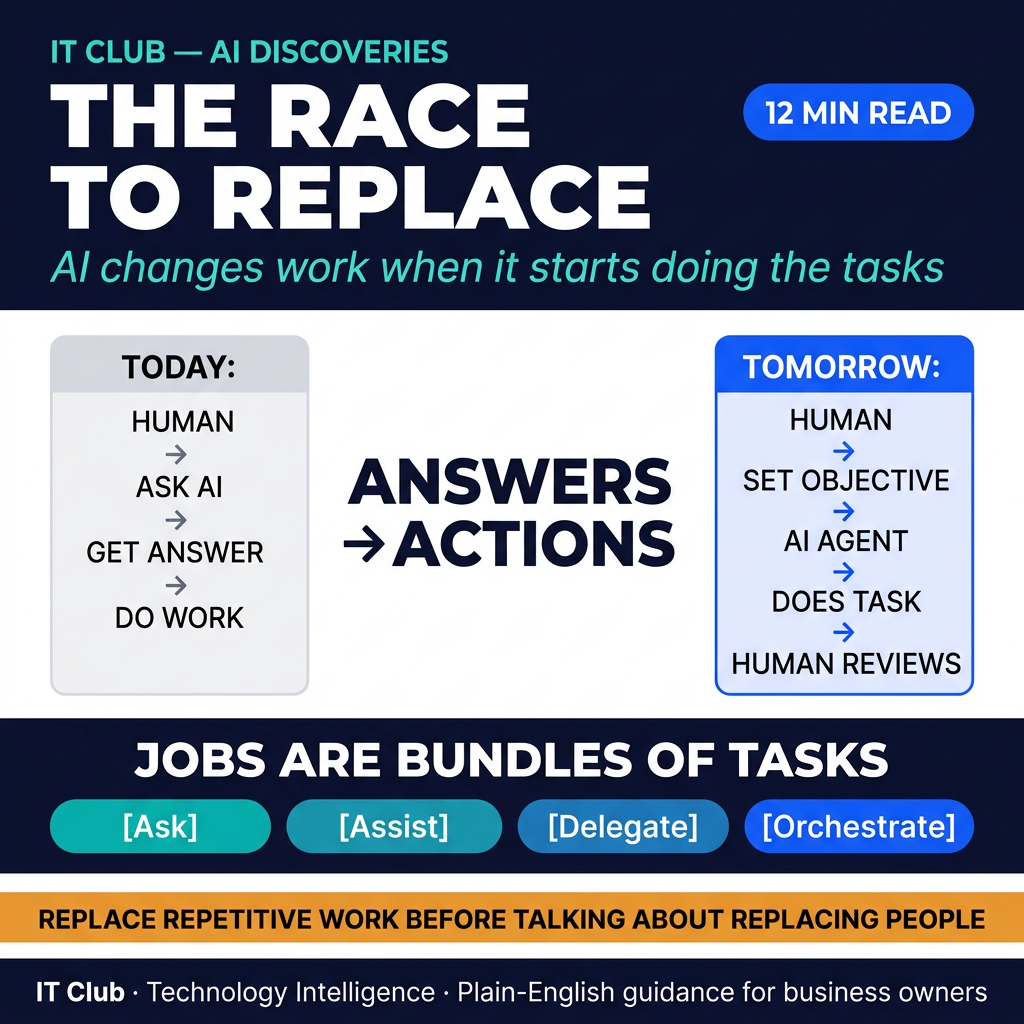
Tap to follow The IT Club Briefing on WhatsApp.
Related Articles
AI is getting a face. Will that make us trust it too much?
Google’s Live Avatar adds a generated face to spoken AI conversations. It may make an interface feel more natural, but a friendly expression is no evidence that an answer is right.
Read articleAI Just Spent 88 Hours Solving a Problem Humans Have Wrestled With for Decades. So What?
The important story is not only the mathematical result. It is the shift from asking AI for information to giving AI systems complex problems to investigate.
Read articleWould You Give AI the Company Credit Card?
As AI agents move from answering questions to taking actions, businesses need to decide what authority they are prepared to give them.
Read articleNeed help putting this into practice?
IT Club helps you understand the technology. If you need implementation, support or consultancy, the teams behind IT Club can help.
Altitude IT (opens in a new tab) — IT support, cyber security, Microsoft 365 and technology operations.
Altitude AI (opens in a new tab) — AI discovery, automation, governance and implementation.