America Loves AI — So Why Does It Hate the Data Centres That Power It?
IT Club — Powered by Altitude AI (opens in a new tab)

Keep up with IT Club
Add IT Club as a preferred source in Google Search.
AI services depend on large, power-hungry physical infrastructure that local communities increasingly oppose. This article examines the contradiction between widespread AI adoption and growing opposition to data centres, explains what the infrastructure actually requires, and considers what the debate means for businesses.
Imagine a typical working week. You use ChatGPT to draft a document. You search using AI. You use Copilot inside Microsoft 365. You generate an image. You ask an AI tool to summarise a report. Your phone suggests a reply. By Friday, you may have made dozens of AI requests without thinking about any of them.
Then a planning application appears. A technology company proposes a large AI data centre a few kilometres from your home.
The conversation changes completely. Now people are talking about electricity demand, water consumption, noise, transmission lines, generator emissions, land use, house prices, utility bills and tax concessions.
People experience AI as an app. Communities experience AI as infrastructure.
That contradiction is now measurable. And it is becoming one of the defining technology policy questions of the next decade.
The Quick Answer
AI Infrastructure: What Is the Tension?
AI services depend on enormous amounts of computing infrastructure. As AI usage increases, technology companies are building increasingly large data centres containing specialised computing hardware.
Those facilities can create investment, construction work, local tax revenue, digital infrastructure and new power generation. But they can also place pressure on electricity grids, water infrastructure, land, planning processes and communities.
That creates a growing political and economic problem: the public may want AI services while opposing the infrastructure required to run them locally.
There is no cloud without somebody else's building.
What the Polling Says
Gallup published polling in May 2026 based on research carried out in March 2026 into American attitudes towards AI data centre construction in local areas. The results were striking: approximately 71% of respondents opposed the construction of an AI data centre in their local area, with 48% strongly opposed. Approximately 27% supported the idea.
Notably, opposition was consistent across political affiliation — Republicans, Democrats and Independents all showed majority opposition. This is not a partisan issue. It is a community infrastructure issue.
Opposing a data centre nearby is not necessarily the same thing as opposing artificial intelligence.
This distinction matters. The polling measured attitudes towards local construction of a specific type of facility — not attitudes towards AI services themselves. A respondent who uses ChatGPT every day and also opposes a data centre being built near their home is not being contradictory in any simple sense. They are expressing a view about infrastructure location, not about whether AI should exist.
Verify current polling numbers and methodology at the Gallup website before drawing conclusions. Polling changes, questions evolve and methodology matters.
Why People Oppose Data Centres
Opposition to local data centre construction typically draws on a range of concerns. Most are legitimate rather than simply anti-technology.
Electricity Demand
Large AI facilities can create substantial new electricity demand on local and regional grids. This may require grid upgrades — new substations, transformers, power lines and possibly new generation capacity — that would not otherwise have been needed, or would have been needed on a much longer timescale.
Utility Costs
Communities sometimes worry that infrastructure investment costs will eventually appear in customer bills. The evidence here is genuinely mixed and depends heavily on electricity market structures, regulatory frameworks and how grid investment is allocated across customer groups. These structures differ significantly between US states and between the US and UK. It is not accurate to claim universally that data centres increase household bills — but the concern is not unreasonable.
Water
Some cooling systems use significant amounts of water. Impact varies substantially by facility design, climate, cooling technology, workload type and operating conditions. A coastal facility with air cooling in a cool climate has a very different water profile from an inland evaporative-cooling facility in a hot region. Treating all data centres as equivalent on water is a significant oversimplification.
Land, Noise and Visual Impact
Hyperscale campuses can occupy large sites. Operational noise from cooling equipment, generators, transformers and construction can affect nearby residents. Some facilities contain substantial backup-generation capability using diesel or other fuels. These are real physical effects with measurable consequences for local communities.
Jobs and Tax
Communities sometimes question whether the economic benefits — employment and tax revenue — justify the concessions and impacts. Data centres can create construction work and specialised permanent roles, but permanent site employment per unit of land may be lower than some alternative developments. Local authorities may also offer tax incentives to attract investment, which can generate debate about who ultimately benefits.
Why AI Needs So Much Infrastructure
Traditional cloud computing workloads already require substantial computing power. Generative AI can add significantly more because modern AI models require large amounts of computation for two distinct processes.
Training
Training is the process of building or improving an AI model. It involves processing enormous datasets through massive computing clusters — sometimes for weeks or months. Training runs are computationally intensive, but they are not constant. A model may be trained and then deployed.
Inference
Inference is what happens every time somebody uses a model. Each AI request — a question, a generated image, a summarised document — requires computation to produce a response. At the scale of millions or hundreds of millions of users, inference demand can be enormous.
Training creates spectacular computing projects. Everyday usage determines whether the infrastructure remains busy afterwards.
AI demand now spans text, images, audio, video, code generation, AI search, autonomous agents, reasoning models and enterprise AI tools. Each category represents continuous inference at scale. This is why AI infrastructure investment has grown so rapidly — and why it is increasingly visible to communities.
The GPU Problem
AI data centres increasingly contain specialised computing hardware — primarily graphics processing units (GPUs) and custom AI accelerators — rather than the standard server hardware used for most cloud computing.
These systems consume substantially more electricity per rack than traditional computing hardware. They generate substantial heat. They require high-capacity networking to move large amounts of data between processors quickly. They require upgraded cooling — traditional air cooling may not be sufficient for the densest AI configurations. And they require very reliable electrical supply, because interruptions to training runs or inference capacity can be costly.
The AI revolution is partly a software revolution and partly an electrical-engineering project.
This means AI infrastructure can require much more electrical capacity per building than earlier data centres. A hyperscale AI campus may need hundreds of megawatts — an amount that requires dedicated grid infrastructure rather than simply connecting to an existing local supply.
How Big Is AI Electricity Demand?
Precise figures are difficult because data-centre operators are not always required to disclose energy consumption, and forecasts vary significantly between organisations and scenarios. But several authoritative sources provide useful context.
The International Energy Agency (IEA) has published analysis indicating that global data-centre electricity demand is growing significantly, driven by cloud computing, streaming, enterprise services and — increasingly — AI workloads. The IEA notes that AI has become one of the fastest-growing contributors to data-centre energy demand, though data centres serve many purposes beyond AI.
Lawrence Berkeley National Laboratory and the US Department of Energy have produced estimates of US data-centre electricity consumption. These should be read with care: figures change as new facilities open, as efficiency improves and as workload mix shifts. Ranges are more honest than single point estimates.
The data-centre boom is broader than AI, but AI has become one of its fastest-growing sources of demand.
It is important to distinguish data-centre electricity from AI-specific electricity. Data centres support cloud services, streaming, enterprise computing, storage, traditional internet services and, in some datasets, cryptocurrency mining. Not all data-centre power is AI power. Presenting the two as equivalent overstates the AI contribution and obscures the broader infrastructure picture.
Electricity: The Real Bottleneck
The constraint on new AI data centres is increasingly not only chips, land or finance. It is power.
A megawatt is a unit of electrical power. A data centre requiring 100 megawatts needs continuous electrical supply equivalent to a significant industrial facility — not the kind of connection that can be arranged quickly from an existing local substation. Projects at this scale may require new substations, upgraded transmission lines, new grid connections and, in some cases, new generation capacity nearby.
You can buy GPUs faster than you can necessarily build the electricity infrastructure needed to run them.
Grid connection queues in some markets can extend for years. Technology companies that want to deploy computing capacity quickly can find that electrical infrastructure is the binding constraint — not the availability of computing hardware. This has driven interest in co-location with power generation, long-term power purchase agreements and, in some cases, exploration of dedicated generation including nuclear.
Water: A More Complicated Picture
Water use by data centres attracts significant public attention, but the picture is more complicated than it is sometimes presented.
Asking 'How much water does a data centre use?' without specifying its design and location can be almost meaningless.
Cooling approaches include evaporative cooling, air cooling, liquid cooling, closed-loop systems and hybrid designs. Each has a different water profile. A facility using evaporative cooling in a hot, dry climate may consume substantially more water than one using closed-loop liquid cooling in a northern European location.
It is also useful to distinguish direct water use — water consumed at the data-centre site itself — from indirect water use, which includes water associated with electricity generation or wider supply chains. These are different measurements of different things.
Viral claims about the amount of water required to answer a single AI question should be treated with significant caution. Per-prompt estimates often conflate different metrics, use worst-case facility designs and ignore the enormous variation between facilities and workloads. They may be directionally indicative but should not be presented as precise facts.
Who Pays for the Grid?
One of the most politically charged questions around large-scale data-centre development is infrastructure cost allocation. A huge new electricity consumer may require substations, distribution infrastructure, transmission upgrades and new generation. Somebody pays for this.
Possible funding models vary considerably. Costs may be carried by the data-centre developer, by the utility, by an energy producer, by the wider customer base or by some combination. Regulatory structures differ significantly between US states, between electricity markets and between countries.
The politically difficult question is not whether new infrastructure costs money. It is who should pay for it.
It is not accurate to claim universally that data centres increase household electricity bills — the outcome depends on market structure and regulatory decisions. But the concern that very large industrial consumers might shift infrastructure costs to residential customers is a legitimate policy question in many jurisdictions.
The Benefits of Data Centres
Opposition to data centres should not obscure real benefits. A balanced assessment includes both sides.
- Investment: large developments can attract billions in capital to a region.
- Construction employment: data-centre campuses require substantial construction and engineering work.
- Tax revenue: local jurisdictions may receive property tax, business taxation and other economic contributions.
- Energy investment: data-centre demand may accelerate investment in renewable energy, nuclear, storage and grid infrastructure that benefits wider communities.
- Digital capacity: data centres support cloud services, AI, enterprise computing, government systems, healthcare infrastructure and research.
- Technology ecosystem: infrastructure may attract connectivity investment, specialist suppliers and broader technology activity.
The debate is not infrastructure versus no benefit. It is whether the benefits and burdens are distributed fairly.
The Jobs Question
Large data centres can cost enormous sums to construct. But once operational they may employ fewer people than the headline investment figure suggests.
It is important to distinguish construction employment — potentially substantial but temporary — from permanent site employment, which is typically specialised and smaller. Indirect employment through suppliers, maintenance and wider economic activity adds further complexity. Communities that expect a large data centre to deliver large-scale permanent local employment may be disappointed.
A billion-pound investment and a billion-pound employment programme are not the same thing.
Local Costs, National Benefits
This tension has a familiar shape in infrastructure policy. Consider airports, power stations, wind farms, roads and transmission lines. All provide national or broad economic benefit. All have specific communities that host them and bear the local consequences.
Data centres follow the same pattern. National benefits may include AI capability, digital competitiveness, research infrastructure, cloud provision, economic output and tax. Local costs may include construction disruption, land use, power infrastructure, water demand, noise and visual impact.
AI creates global benefits using infrastructure that always has a postcode.
The NIMBY Question
NIMBY — Not In My Back Yard — is sometimes used dismissively to describe people who oppose local development while benefiting from the same type of facility elsewhere. It is worth using the term carefully.
Opposition to specific data-centre proposals may reflect genuinely legitimate concerns about local resources, planning process, infrastructure burden, noise, transparency and cost allocation. These are not inherently unreasonable positions.
But widespread opposition also creates a collective problem. If every community opposes infrastructure while every individual continues to use the services that require it, the result is not a sustainable policy position.
'Nobody build it near me' becomes difficult to sustain when everybody continues using what the infrastructure provides.
Is This Really Different From Other Infrastructure?
Power stations, wind farms, solar farms, transmission lines, airports, warehouses, roads, housing and telecoms masts all involve similar trade-offs. Communities have always weighed local costs against national or wider economic benefits.
What makes data centres unusual is the disconnect between visible benefit and invisible infrastructure. When somebody uses a wind farm's electricity, they see the turbines on the hill. When somebody uses AI, the computing may be happening hundreds or thousands of kilometres away — or nowhere near them at all. Digital services trained users to believe infrastructure had effectively disappeared.
Digital services trained users to believe infrastructure had disappeared. AI is making it visible again.
Can AI Become More Efficient?
There are genuine reasons to expect AI infrastructure to become more efficient. Smaller, more capable models may perform tasks that once required much larger ones. New AI accelerators may deliver more computation per watt than current hardware. Techniques such as quantisation and distillation can reduce the computation required for specific tasks. Inference software continues to improve. Data-centre design is advancing on cooling efficiency and electrical infrastructure.
Computing workloads can also be scheduled to run in locations where electricity is currently available, where it is cheaper, or where it comes from low-carbon sources.
Efficiency reduces the cost of each AI task. It does not guarantee that total AI electricity demand falls.
The Jevons Paradox
The Jevons Paradox, first observed in the economics of coal use in the nineteenth century, describes a recurring pattern: when a resource becomes more efficiently used and therefore cheaper to deploy, people and organisations tend to use more of it. Efficiency improvements can reduce the cost per unit while increasing total consumption.
Applied to AI: as generation becomes cheaper, faster and embedded in more products, businesses run more prompts, deploy more agents, generate more video and automate more processes. Total resource demand may increase even as each individual request becomes cheaper to serve.
Making AI cheaper may reduce the cost per answer while increasing the number of answers society asks for.
This is not an absolute law. Historical examples suggest rebound effects vary significantly by technology and market. But it is a sufficiently well-documented pattern to take seriously when evaluating efficiency improvements as a solution to AI electricity demand.
What About Nuclear Power?
Several major technology companies have publicly explored nuclear energy as a long-term power source for AI infrastructure. This has included interest in long-term power purchase agreements with existing nuclear stations, restarting previously closed facilities and, in some cases, investment in Small Modular Reactor (SMR) development.
The attraction is clear: nuclear generation is low-carbon, can operate continuously regardless of weather, and — once built — can provide large, predictable power blocks at reasonable cost. For an AI data centre that requires reliable continuous power, nuclear has obvious appeal compared with intermittent renewables.
AI's electricity problem cannot be solved by simply attaching a nuclear reactor to every data centre.
Nuclear development faces significant challenges: capital requirements, planning and regulatory timescales, construction complexity, grid connection and public acceptance. SMRs remain largely in development rather than commercial deployment. Existing nuclear agreements may provide future power purchase certainty, but they do not resolve immediate infrastructure constraints. The timescales involved — often a decade or more for new nuclear — are long relative to AI's pace of development.
What About Renewables?
Most large technology companies have made commitments to use renewable electricity. Many purchase renewable energy certificates or sign power purchase agreements with solar and wind projects. These commitments are real, but they require careful interpretation.
Buying enough renewable electricity over a year is different from having clean electricity available every hour the servers are running.
Annual matching — where a company contracts enough renewable generation to cover its annual electricity use — does not mean the facility is powered by renewables at every moment. Wind does not always blow. Solar does not generate at night. The electricity grid is a shared resource. When renewables are not producing, the facility draws from whatever is available on the grid.
Some companies are working towards 24/7 carbon-free energy — matching consumption with clean generation in the same region at every hour. This is significantly more demanding than annual matching and requires a combination of generation sources, storage and grid flexibility. It remains aspirational for many current facilities.
Renewable commitments are worth noting without treating annual renewable matching as equivalent to operating on clean energy around the clock.
The UK Angle
Britain wants AI. The government has articulated ambitions for the UK to become an AI and digital technology leader, attracting investment, growing the sector and using AI to modernise public services and improve productivity. Data centres have been classified as critical national infrastructure.
Britain cannot have an AI industrial strategy without an infrastructure strategy.
But the UK faces the same structural constraints as other countries. Electricity grid connection queues can be lengthy. The planning system for major infrastructure can be slow. Land near existing grid infrastructure in desirable locations is not unlimited. Water management considerations apply in some regions. And communities do not automatically welcome large industrial facilities regardless of how they are described.
Grid connection constraints in particular have been highlighted by National Grid and the National Energy System Operator (NESO) as a significant challenge for large new electricity consumers. Proposals for AI data centres may face multi-year waits for grid connections in some areas — not because the technology is unwelcome but because the physical infrastructure simply needs to be built.
The UK electricity market structure differs substantially from US utility models. Do not assume that policy conclusions drawn from American experience apply directly to Britain.
AI Growth Zones
The UK government has introduced a concept of AI Growth Zones — designated areas intended to streamline planning and infrastructure investment for AI-related development, including data centres. The policy is intended to concentrate infrastructure where it can be deployed more quickly, rather than requiring every application to navigate standard planning processes independently.
The purpose is to accelerate investment while managing infrastructure in a more coordinated way. Concentrating data-centre development in specific zones may help coordinate grid upgrades, streamline planning and attract investment. But concentration also means concentrating electricity demand, water use and local impact in the same locations.
Verify the current status of AI Growth Zone policy directly through UK government sources. Policy names, definitions and scope can change.
The Cloud Is Physical
It is worth being direct about what AI actually requires. When you submit a prompt, the sequence of events is roughly this:
- Your device sends the request over the internet
- The request reaches a data centre in a specific physical location
- AI accelerators — GPUs or custom processors — process the request
- This processing requires electricity, delivered by a grid connection from local or regional generation
- The processors generate heat requiring cooling infrastructure
- A response is sent back across the network to your device
The cloud is just somebody else's infrastructure.
AI makes that infrastructure larger, denser, more power-hungry and more visible. Every AI answer has a physical cost somewhere, even when the user never sees it.
AI may feel like a piece of software, but every prompt ultimately runs somewhere physical.
Warning Signs: Simplistic Arguments in Both Directions
The data-centre debate attracts exaggeration. Be sceptical in both directions.
Where somebody claims AI data centres will destroy the electricity grid, ask: which grid? Over what timescale? What infrastructure investment is planned? These are real constraints, but they are being actively managed in most markets.
Where somebody claims data centres do not materially affect communities, ask about electricity demand, water, planning processes and noise. These are real effects.
Common misrepresentations worth challenging include: quoting theoretical maximum power as actual consumption; presenting all data-centre electricity as AI; confusing water withdrawal with water consumption; using annual renewable matching as evidence of real-time clean energy supply; quoting headline investment as permanent job creation; and quoting per-prompt resource estimates without explaining the assumptions behind them.
The data-centre debate contains plenty of enormous numbers. Enormous numbers without context are mostly useful for frightening people.
What This Means for Ordinary Businesses
Most businesses using AI will never build a data centre. So why should they care about this debate?
Because AI infrastructure shapes what AI services cost, where they are available, how reliable they are and what the regulatory environment looks like. Businesses using AI are exposed to:
- AI and cloud pricing decisions influenced by infrastructure economics
- Regional availability of AI services — some capabilities may be limited to certain geographies
- Sustainability reporting — larger organisations may need to report AI-related emissions
- Supplier concentration risk — a small number of hyperscalers host most AI services
- Data residency requirements — where data physically sits may matter for compliance
- Service resilience — infrastructure constraints can affect availability
- Geopolitical factors — AI infrastructure is increasingly treated as strategic
AI infrastructure may be invisible to the user, but businesses ultimately pay for it through service price, availability and supplier risk.
The Cost of AI
Much consumer AI has historically been heavily subsidised by venture capital, hyperscaler investment and technology-company spending. Free or low-cost access to powerful AI models has been economically possible because the companies providing them have been willing to absorb significant infrastructure costs in pursuit of adoption and market position.
As infrastructure requirements grow and investment requirements increase, AI economics may eventually influence subscription pricing, usage models, token costs, advertising strategies, enterprise licensing and API pricing. How this unfolds is genuinely uncertain and will differ by provider, product and market.
Somebody always pays for the electricity, GPUs, buildings and engineers behind an AI response — even when the user sees a free chat box.
AI Governance and Infrastructure
Responsible AI governance frameworks typically focus on issues such as data confidentiality, hallucinations, bias, human oversight and agent behaviour. These remain important. But infrastructure is becoming an increasingly relevant governance consideration.
Larger organisations may increasingly include AI infrastructure considerations in procurement decisions, ESG reporting, supplier assessments and risk management frameworks. Questions worth asking include: which provider operates the AI? In which region? What are their sustainability commitments? What contractual terms govern resilience and availability? What happens if the provider changes its pricing or discontinues the service?
Responsible AI eventually extends beyond what the model says to what is required to keep the model running.
Practical Business Implications
- AI is physical infrastructure. Every AI request ultimately runs on computers somewhere with power, cooling and network requirements.
- AI demand means power demand. Greater use requires greater compute capacity, which requires greater electrical supply.
- Local communities experience the cost. Infrastructure has physical impacts at specific locations — noise, land, power, water.
- The benefits are wider. AI users may be thousands of kilometres from the facility running their requests.
- Efficiency will help but may not be sufficient. Jevons effects mean cheaper AI can mean more total AI.
- The grid may become an AI bottleneck. Chips alone cannot solve power constraints.
- Energy policy and AI policy are converging. Countries wanting AI leadership need generation and grid investment.
- Public acceptance matters. Infrastructure cannot simply be imposed indefinitely without political and planning consequences.
- The UK should pay attention. America may be showing the political problem before Britain experiences it at the same scale.
Operational Heartbeat
AI infrastructure conditions change. Usage grows. Providers change pricing. Models become larger or smaller. Efficiency improves. Grid constraints appear in new locations. Regulation develops. Sustainability information evolves. Service outages occur.
Business AI needs an Operational Heartbeat: usage, cost, providers, resilience, infrastructure dependencies and supplier changes should be reviewed rather than assumed to remain stable.
Businesses relying on AI services should periodically review: which AI providers they use and in which regions; usage patterns and cost trends; service resilience and contractual availability commitments; supplier concentration and alternatives; sustainability disclosures from key providers; and whether infrastructure changes — pricing, capacity, regulation — require any adjustment to their approach.
Administrator and Technical Note
For those with a deeper interest in the technical and infrastructure dimensions of AI data centres, this note summarises the key concepts at a useful conceptual level.
Compute and AI Processing
AI models process data in units called tokens — pieces of text, image patches or audio segments. During training, vast numbers of these tokens are processed repeatedly to adjust the model's internal parameters. During inference, each user request generates a sequence of tokens as output.
GPUs (Graphics Processing Units) are particularly effective for AI because they can perform many mathematical operations in parallel. Custom AI accelerators — such as Google TPUs, AWS Trainium and other proprietary chips — are purpose-designed for AI workloads and may achieve higher efficiency. High-bandwidth memory (HBM) adjacent to processors allows fast data access, which is critical for large models.
Power and Density
Traditional data-centre racks might require 5–15 kilowatts each. High-density AI GPU racks can require 30–100 kW or more, sometimes significantly more with next-generation hardware. This creates electrical and cooling challenges that standard data-centre designs were not built to handle.
Power Usage Effectiveness (PUE) measures total facility power divided by IT equipment power. A PUE of 1.0 would be perfect efficiency. Modern well-designed facilities can achieve PUEs below 1.2. Water Usage Effectiveness (WUE) is the equivalent measure for water.
Cooling
Cooling approaches include: traditional air cooling with raised floors and computer room air conditioning; liquid cooling with cold plates attached directly to processors (direct-to-chip); immersion cooling in dielectric fluid; and evaporative cooling using water evaporation for heat rejection. High rack density AI workloads increasingly require liquid cooling for the processors themselves, though the facility may still use air or evaporative cooling for overall heat rejection.
Connectivity
AI data centres require high-capacity fibre connectivity to internet exchange points and between facilities. Data-centre interconnects allow fast, low-latency communication between adjacent buildings or campuses — important when AI inference is distributed across multiple systems.
Cloud Regions and Availability Zones
Major cloud providers operate in geographic regions containing multiple data centres called availability zones. This allows services to continue if one physical facility has a problem. Users in London using a US-based AI service may have their requests served by a US availability zone unless the service is explicitly deployed in European infrastructure.
Power Infrastructure
Grid connections for large facilities require substations to step down transmission voltages. Uninterruptible Power Supplies (UPS) protect against brief interruptions. Diesel or gas generators provide backup for extended outages. Power Purchase Agreements (PPAs) contract future electricity from specific generation sources, often at fixed prices for long terms.
Renewable Energy and Carbon
Annual renewable matching covers total annual energy use with renewable procurement. 24/7 carbon-free energy aims to match clean energy supply with demand at every hour of the day in the same region. Demand response programmes allow data centres to reduce consumption during grid stress events in exchange for rate benefits or grid payments. Embodied carbon refers to emissions from manufacturing infrastructure — GPUs, servers, buildings, cabling — not just from electricity consumption.
Nuclear
Small Modular Reactors (SMRs) are nuclear reactor designs intended to be smaller, factory-built and faster to deploy than conventional large nuclear plants. Several designs are in advanced development in the US, UK and elsewhere. Commercial SMR deployment at scale remains some years away in most markets. Large nuclear plants offer long-term low-carbon power but involve decade-scale planning, construction and regulatory processes.
Water
Water withdrawal is total water drawn from a source, some of which may be returned. Water consumption is water that does not return — evaporated or otherwise removed from the local water cycle. A cooling tower that evaporates water for heat rejection consumes that water. A closed-loop heat exchanger that sends warmed water to a river returns it. These are very different environmental impacts often conflated in reporting.
The IT Club View
The contradiction is understandable. People like convenient digital services, instant AI responses and capable tools that improve their working day. People are less enthusiastic about power lines outside their windows, industrial buildings on green land, construction noise or the possibility of higher utility bills.
But AI forces society to confront something the cloud era allowed us to ignore for two decades. Digital services require physical infrastructure. Software runs somewhere. That somewhere has electricity, water, land, noise and grid connections.
We cannot demand infinite digital capacity while pretending the physical infrastructure should exist nowhere.
But the answer is not simply to tell communities to accept whatever infrastructure technology companies want to build. Communities should not be expected to absorb unlimited infrastructure costs because a technology company wants faster growth. Local concerns about electricity demand, water use, planning process and cost allocation are legitimate.
The sensible answer involves transparent planning, genuine infrastructure investment, fair allocation of costs and benefits, efficient computing, honest sustainability reporting and meaningful engagement with affected communities. None of that is simple. All of it is necessary.
The debate should not be 'AI or no AI'. It should be how much infrastructure we need, where it should go, who should pay for it and what local communities should receive in return.
Related Technology Intelligence
- Why Is AI Computing Power Becoming a Tradable Commodity? — /intelligence/ai-compute-gpu-futures-market
- AI Needs Guardrails — /intelligence/ai-needs-guardrails
- How AI Is Changing Work Roles — /intelligence/ai-era-work-roles
- The AI Vulnerability Wave — /intelligence/ai-vulnerability-patch-wave
- AI-Designed Viruses: What the Biosecurity Research Means — /intelligence/ai-designed-viruses-bacteriophages-biosecurity
Related Business Questions
37 questions about AI infrastructure, data centres and energy
Why does AI need data centres?
AI models require enormous amounts of computation both to build (training) and to run for each request (inference). Data centres house the specialised computing hardware — primarily GPUs and AI accelerators — that perform this computation at the scale required for commercial AI services.
Does ChatGPT run in a data centre?
Yes. ChatGPT and other OpenAI services run on infrastructure in Microsoft Azure data centres. Every query submitted by a user is processed by computing hardware in a physical facility with electricity, cooling and network infrastructure.
Why do AI data centres use so much electricity?
AI accelerators such as GPUs consume substantially more electricity per processor than conventional server hardware. At the scale required for large AI models serving millions of users, the total electricity demand becomes very large. A single large AI training run can consume as much electricity as thousands of households use in a year.
How much electricity does AI use?
Precise global figures are difficult to determine, but the IEA and other bodies have noted that AI is becoming one of the fastest-growing contributors to data-centre electricity demand. Estimates evolve rapidly as new facilities open and usage grows. Check current IEA and LBNL publications for the most recent analysis.
How much electricity do US data centres use?
Lawrence Berkeley National Laboratory and the US Department of Energy publish periodic estimates. US data centres as a whole consume a significant fraction of national electricity — estimates vary and change as facilities expand. AI workloads are a growing but not yet dominant share of total data-centre electricity in most estimates.
Are all data centres used for AI?
No. Data centres support cloud services, streaming video, enterprise computing, storage, email, websites, telecommunications infrastructure, financial systems and many other applications. AI is a growing and high-profile workload but is not the only or even necessarily the largest use of data-centre capacity globally.
What is an AI data centre?
An AI data centre is typically a facility purpose-designed or substantially upgraded to house high-density computing infrastructure — primarily GPU clusters and AI accelerators — with the high-capacity electrical supply and cooling systems those systems require.
What is a hyperscale data centre?
Hyperscale refers to very large data centres — typically those exceeding 100,000 square feet and containing tens of thousands of servers — operated by major cloud providers and technology companies. Hyperscale facilities can require tens or hundreds of megawatts of electrical supply.
What is a GPU data centre?
A GPU data centre is a facility primarily housing Graphics Processing Units used for AI training and inference rather than conventional server workloads. These facilities have substantially higher power and cooling requirements per rack than standard data centres.
Why do AI servers produce so much heat?
Electricity consumed by computing hardware is largely converted to heat. High-density AI GPU racks can generate 30–100 kW of heat per rack or more, compared with 5–15 kW for conventional server racks. This heat must be removed through cooling infrastructure to keep processors operating reliably.
Why do data centres use water?
Some cooling systems use water for heat rejection — evaporating water removes heat effectively and efficiently in certain climates and facility designs. Not all data centres use significant water for cooling. Facilities using air cooling or closed-loop liquid cooling may use much less water.
Does every data centre use water for cooling?
No. Cooling technology varies significantly. Some facilities use predominantly air cooling with no evaporative water consumption. Others use evaporative cooling towers. Others use closed-loop liquid cooling where water circulates but is not consumed. The appropriate comparison depends on facility design and local climate.
How much water does ChatGPT use?
Per-prompt water estimates vary widely depending on assumptions about facility design, cooling technology, climate, workload type and how indirect water use is calculated. Published estimates should be treated as indicative rather than precise, and should always specify which methodology was used and which facilities were assessed.
Is the viral bottle-of-water claim accurate?
Various claims about the number of water bottles equivalent to a single AI query have circulated widely. These estimates vary significantly by source and methodology, often conflate water withdrawal with water consumption, and rely on assumptions about specific facility designs that may not apply to the facility actually serving the request. They may be directionally informative but should not be treated as reliable precise figures.
Do data centres increase electricity prices?
The impact on electricity prices depends on electricity market structure, regulatory decisions about infrastructure cost allocation and local grid conditions. In some markets and circumstances, large new industrial consumers may contribute to grid infrastructure costs that appear in customer bills. In others, the additional demand and associated investment may have little direct impact on residential prices. There is no universal answer.
Who pays for new grid infrastructure?
Funding models vary by jurisdiction and regulatory framework. Costs may be borne by the data-centre developer, by the utility or grid operator, by energy producers or by wider customer groups. In some markets, large new consumers are required to contribute to connection infrastructure. In others, costs are socialised across the customer base. Regulatory structures differ significantly between US states and between countries.
How many people work in a data centre?
Permanent operational staffing at a large data centre may range from tens to a few hundred people, depending on facility size and degree of automation. This is substantially fewer than the headline investment figure often implies. Construction employment during building is larger but temporary.
Why do communities oppose data centres?
Opposition typically centres on electricity demand and grid infrastructure pressure, potential utility cost impacts, water use, land consumption, noise from cooling and backup generation equipment, visual impact and concerns about whether local economic benefits — employment, tax revenue — justify the local impacts and infrastructure concessions offered.
What does NIMBY mean?
NIMBY stands for Not In My Back Yard — a phrase describing opposition to local development by people who might support the same type of facility being built somewhere else. The term is sometimes used dismissively, but local concerns about data centres can reflect legitimate questions about infrastructure, planning and cost allocation rather than simple anti-development attitudes.
Why are Americans opposing AI data centres?
Local opposition typically reflects concerns about electricity demand on regional grids, potential utility cost impacts, water use, construction impacts, noise and backup generation equipment, and questions about whether tax incentives and employment commitments justify the facility's infrastructure requirements. These are infrastructure concerns, not necessarily opposition to AI technology itself.
How many Americans oppose local AI data centres?
Gallup polling from March 2026, published in May 2026, found approximately 71% of respondents opposed the construction of an AI data centre in their local area. Verify current figures and methodology at news.gallup.com before drawing conclusions.
Do Americans oppose AI itself?
The Gallup polling measured attitudes towards local construction of AI data centres — not attitudes towards AI services. Opposition to a specific physical facility near your home is not the same as opposing artificial intelligence as a technology. AI adoption in the US and globally continues to grow.
Can AI data centres run on renewable energy?
Many technology companies contract renewable electricity to cover their data-centre consumption, typically through annual matching or power purchase agreements. This does not necessarily mean the facility draws clean electricity at every moment — grid electricity mix varies by time of day and season. Some companies are working towards 24/7 carbon-free energy, which is more demanding and requires continuous matching of demand with clean supply.
Can nuclear power supply AI data centres?
Nuclear is technically attractive for AI data centres because it provides continuous, large-scale, low-carbon power. Several major technology companies have explored or signed agreements for nuclear power purchase. Practical challenges include regulatory and planning timescales, capital requirements, construction complexity and public acceptance.
What are Small Modular Reactors?
Small Modular Reactors are nuclear designs intended to be smaller, factory-built and faster to deploy than conventional large nuclear plants. Multiple designs are in advanced development in the UK, US and elsewhere. Commercial deployment at scale remains some years away in most markets.
Can data centres generate their own power?
Some facilities use on-site generation — solar panels, gas turbines or diesel generators — to supplement or partially replace grid supply. Backup generation (typically diesel or gas) is standard for resilience. Full self-sufficiency for a large AI data centre from on-site generation alone would require substantial dedicated generation capacity.
What is 24/7 carbon-free energy?
24/7 carbon-free energy (CFE) means matching electricity consumption with clean generation at every hour of the day in the same region — not simply buying enough renewable certificates over a full year. Achieving 24/7 CFE requires a mix of generation sources (wind, solar, nuclear, hydro) and storage, and is significantly more demanding than annual matching.
Will AI become more energy efficient?
AI hardware and software are improving in efficiency. Newer accelerators deliver more computation per watt than older ones. Smaller, more capable models reduce the compute needed for many tasks. Data-centre design is improving. These gains are real, but they do not automatically translate into falling total electricity demand if overall AI usage grows faster than efficiency improves.
What is Jevons Paradox?
The Jevons Paradox describes the historical pattern where improvements in the efficiency of using a resource lead to increased total consumption because the activity becomes cheaper and more people do more of it. First observed in coal use, it has been observed in fuel economy, computing and other areas. Applied to AI, it suggests that more efficient AI may enable more AI use rather than less total electricity demand.
Could efficient AI still increase electricity demand?
Yes. If AI becomes cheaper per request and is therefore embedded in more products, processes and services, total AI electricity demand may rise even as each individual request requires less energy. This is not inevitable — rebound effects vary — but it is a well-documented historical pattern worth monitoring.
What are AI Growth Zones?
AI Growth Zones are designated areas identified by the UK government where planning and infrastructure processes are intended to be streamlined to support AI-related development including data centres. The policy aims to concentrate infrastructure investment where it can be deployed more efficiently. Verify current details through UK government sources.
Are data centres critical infrastructure in the UK?
The UK government has classified data centres as critical national infrastructure, giving them a higher status in planning and emergency management frameworks. This reflects the extent to which digital services now underpin essential sectors including healthcare, finance, communications and government.
Does Britain have enough electricity for AI growth?
The UK has ambitions to grow its AI and data-centre sector significantly. Grid connection constraints — with multi-year queues in some areas — present a genuine challenge for rapid expansion. NESO and National Grid have highlighted this as an infrastructure priority. The UK's electricity grid is undergoing significant investment and expansion, but connecting large new consumers takes time.
Could Britain face local opposition to AI data centres?
Yes. As AI data-centre development increases in the UK, the same tensions between national economic benefit and local infrastructure impact that have emerged in the United States are likely to arise. Planning applications for large facilities will face scrutiny on electricity, water, land use and local impact.
Why should small businesses care about AI infrastructure?
Small businesses using AI services are exposed to the infrastructure economics even if they never build a data centre. Infrastructure constraints affect service pricing, availability, reliability, data location and supplier concentration. As AI becomes embedded in business operations, understanding the infrastructure dependency becomes part of sound technology governance.
Does AI infrastructure affect AI pricing?
Infrastructure economics — electricity costs, GPU availability, data-centre construction, grid connections — all contribute to the cost of running AI services. As infrastructure requirements grow, these economics may influence how AI is priced over time, though the relationship is not simple and depends on competition, investment strategies and market positioning.
Is cloud computing really physical?
Yes. Cloud computing is a service model for accessing computing resources over a network — but the computers themselves are real, physical machines in real, physical buildings with real, physical electrical supply and cooling. The term 'cloud' obscures the physical infrastructure from the user but does not eliminate it.
Can IT Club help explain AI infrastructure claims?
Yes. Use the Ask the Advisor service for questions about AI providers, cloud infrastructure, sustainability claims, AI pricing, resilience and what infrastructure changes could mean for your business.
Plain-English Takeaway
Artificial intelligence may feel like software, but it depends on very physical infrastructure: data centres, specialist processors, electricity, cooling, fibre networks and land. American polling shows strong opposition to AI data centres being built locally even as AI adoption continues to grow. That tension is likely to become more important as AI demand increases. The challenge is not simply building more data centres, but deciding where infrastructure should go, who pays for it and how the benefits and local costs should be shared.
Need the practical steps?
A short, instruction-led version of this topic is available in the Knowledge Centre.
View the Knowledge Centre Guide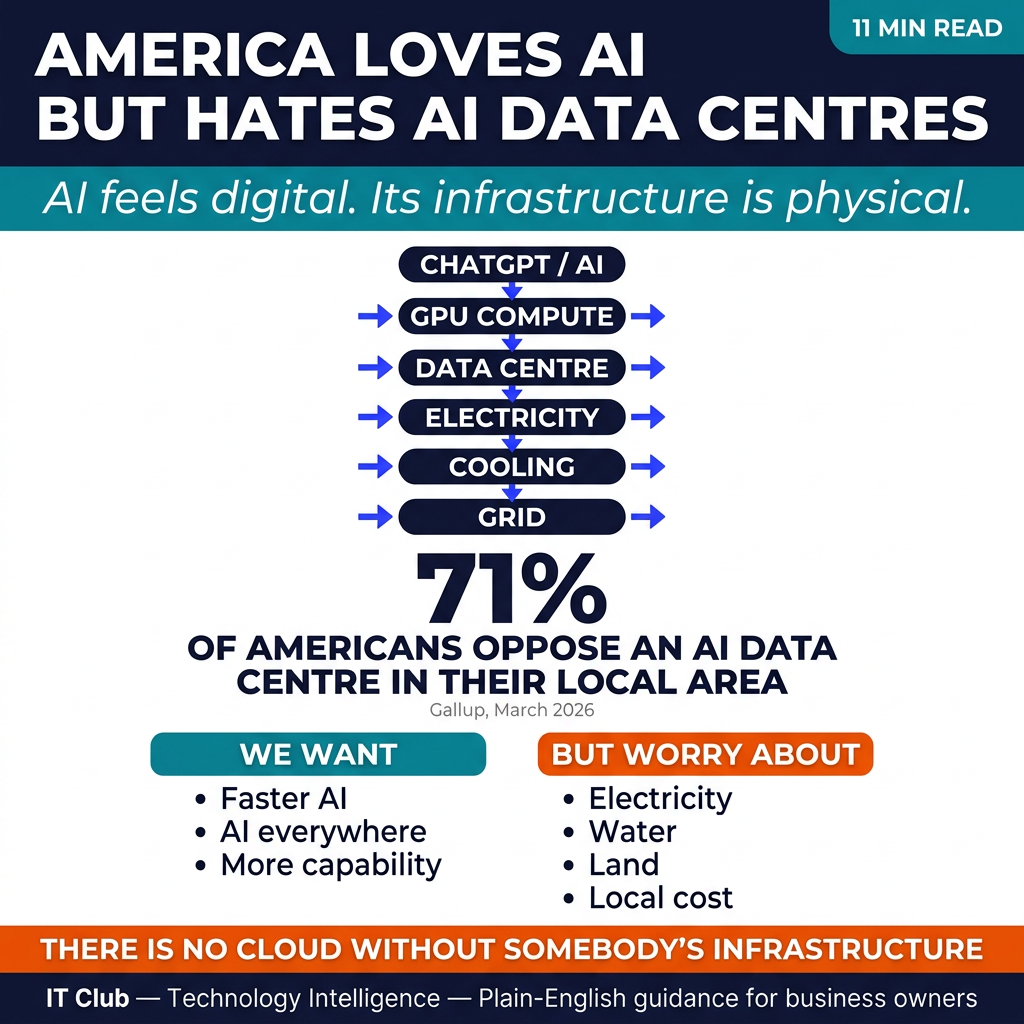
Tap to follow The IT Club Briefing on WhatsApp.
Related Articles
AI is getting a face. Will that make us trust it too much?
Google’s Live Avatar adds a generated face to spoken AI conversations. It may make an interface feel more natural, but a friendly expression is no evidence that an answer is right.
Read articleAI Just Spent 88 Hours Solving a Problem Humans Have Wrestled With for Decades. So What?
The important story is not only the mathematical result. It is the shift from asking AI for information to giving AI systems complex problems to investigate.
Read articleWould You Give AI the Company Credit Card?
As AI agents move from answering questions to taking actions, businesses need to decide what authority they are prepared to give them.
Read articleNeed help putting this into practice?
IT Club helps you understand the technology. If you need implementation, support or consultancy, the teams behind IT Club can help.
Altitude IT (opens in a new tab) — IT support, cyber security, Microsoft 365 and technology operations.
Altitude AI (opens in a new tab) — AI discovery, automation, governance and implementation.