AI Has Designed Working Viruses: Why This Matters
IT Club — Powered by Altitude AI (opens in a new tab)

Keep up with IT Club
Add IT Club as a preferred source in Google Search.
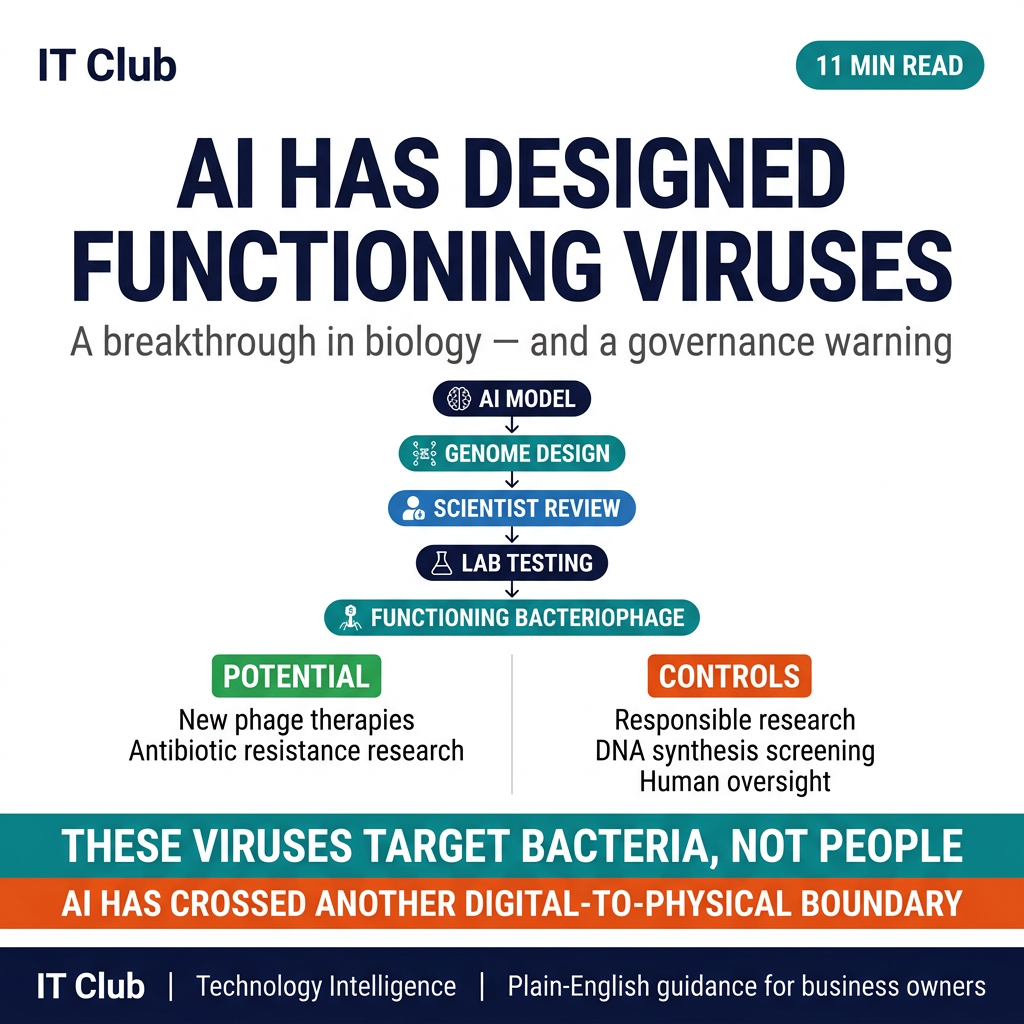
Researchers have used specialised AI models to generate bacteriophage genomes, some of which became functioning viruses in laboratory tests. The research could eventually contribute to phage therapy and antibiotic-resistance research. It also establishes an important capability milestone: generative AI can now produce biological designs that cross from digital information into functioning biology.
Over the past few years, generative AI has learned to produce text, images, audio, video, software code, proteins and molecular designs. Now researchers have demonstrated another step.
An AI model generated complete genetic designs. Scientists selected some of those designs. They were physically produced and tested in a laboratory. Some became functioning bacteriophages.
The output was not just a suggestion or simulation. Some of the AI-generated designs became functioning biological entities.
That makes this different from AI merely predicting biology on a screen. The important milestone is not that AI created a human pathogen. It is that AI-generated biological designs crossed from software output into functioning biology.
The Quick Answer
What happened, and why does it matter?
Scientists have reported creating viable bacteriophages from viral genomes designed using generative AI.
Bacteriophages infect bacteria rather than people.
The research may eventually help scientists develop new phage therapies, particularly against antibiotic-resistant infections.
But the work also establishes an important capability: AI-generated genome designs can cross the boundary from digital information into functioning biology.
That raises questions about:
- Model access and who can use powerful biological AI
- Biological design safeguards built into models and research processes
- DNA synthesis screening at the point of physical manufacture
- Laboratory controls and containment
- Research review and ethics oversight
- Dual-use science and governance
- International coordination
The study did not create an AI-designed human pandemic virus, and it does not prove that current AI systems can readily do so.
What Scientists Actually Created
The researchers did not ask a chatbot: 'Make a virus.' They used specialised biological AI models trained to understand patterns in genetic information.
Researchers working with models including Evo 1 and Evo 2 — genome language models developed at the Arc Institute in collaboration with researchers from Stanford University and the University of California, Berkeley — trained these systems on large quantities of bacteriophage genetic information. Critically, viral genomes associated with humans, animals and plants were deliberately excluded from the training data.
The systems generated thousands of candidate bacteriophage genome designs. Researchers then:
- Assessed candidate designs
- Selected a subset for physical testing
- Used controlled laboratory processes to produce the selected candidates
- Checked whether viable bacteriophages resulted
- Tested whether those bacteriophages could infect target bacteria
The key point
The AI generated candidate biological designs. Scientists still made the decisions, performed the laboratory work and evaluated the results.
Researchers reported testing nearly 300 candidate genomes. Of those, 16 produced viable bacteriophages. Some AI-designed phages demonstrated the ability to function against Escherichia coli. Researchers also reported that mixtures of AI-designed phages were capable of overcoming resistance in bacterial strains.
The study was published in Science, one of the world's leading peer-reviewed scientific journals. Verify current detail on the journal's official website and the researchers' institutional pages.
Last checked: 7 August 2026. Verify current scientific detail on the official journal website and researcher affiliations before relying on specific figures.
What a Bacteriophage Is
A bacteriophage — often shortened to phage — is a virus that infects bacteria. It cannot infect human cells in the way that viruses such as influenza or coronaviruses do.
| Term | Plain-English meaning |
|---|---|
| Bacteriophage | A virus that infects and can destroy bacteria. Does not infect human cells. |
| Pathogenic human virus | A virus capable of causing disease in people. |
| Genome | The complete genetic information of an organism or virus. |
| Generative biology model | An AI system trained on biological information that can generate new biological sequences or designs. |
| Genome language model | A model that learns statistical patterns in genetic sequences — similar in structure to a large language model but trained on genetic rather than text data. |
| Synthetic biology | Engineering or designing biological systems. |
| Phage therapy | The use of bacteriophages to target bacterial infections. |
| Antibiotic resistance | The ability of bacteria to survive medicines that would normally kill or inhibit them. |
| Biosafety | Measures intended to prevent accidental exposure, release or harm. |
| Biosecurity | Measures intended to prevent biological knowledge, materials or technology being deliberately misused. |
| Dual use | Research or technology with beneficial applications that could also be misused. |
How AI Was Used
Evo 1 and Evo 2 are genome language models — AI systems that learn statistical patterns in genetic sequences, in a similar manner to how large language models learn patterns in text. Instead of predicting the next word in a sentence, these models can generate the next section of a genome by learning from millions of existing genetic sequences.
The models were trained specifically on bacteriophage genetic information, with human, animal and plant viral sequences excluded. This deliberate constraint was part of the researchers' approach to keeping the work focused on bacteriophages and avoiding training the models on the kinds of viruses most likely to cause harm to people.
The models generated many thousands of candidate genome designs. Most of these were not selected for physical testing. Those that were selected went through a physical laboratory process in order to produce actual bacteriophages for testing.
What 'generating a genome design' means
A generated genome is a digital sequence of genetic information. It is not itself a virus. To become a biological object, the design must be physically produced — which requires laboratory infrastructure, materials, expertise, testing and evaluation. The digital output and the physical outcome are two separate stages.
What the Experiment Demonstrated
The study demonstrated that:
- Generative AI can produce some complete viral genome designs
- A subset of generated designs can be biologically viable when physically produced and tested
- AI may allow researchers to explore biological design spaces that humans would struggle to examine manually at this scale
- AI-designed phages may show useful functional properties
- AI-designed phages may eventually contribute to therapeutic research, particularly regarding antibiotic-resistant bacteria
A proof of capability is not proof that the capability generalises to every biological system.
What the Experiment Did Not Demonstrate
It is equally important to be clear about what the experiment did not demonstrate:
- AI can easily design every type of virus
- AI can readily produce human pathogens
- Human scientific expertise is no longer necessary
- The laboratory and physical manufacturing bottlenecks have disappeared
- Every generated design works — the majority of tested candidates did not produce viable phages
- Biological synthesis is now automatic
- Existing biosecurity countermeasures are obsolete
- Unrestricted AI access inevitably leads to biological weapons
The failure rate was significant. Researchers reported testing nearly 300 candidate genomes, of which 16 produced viable bacteriophages. That is a small proportion of those tested, and those tested were a small selection from thousands generated. Biological complexity remains a real barrier.
Bacteriophage genomes are also relatively small and compact compared with the genomes of many other biological systems. The challenge of designing larger, more complex biological systems would be substantially greater.
Why This Could Matter for Medicine
Bacteriophages are being researched and used in some settings as potential treatments for bacterial infections. Interest has grown considerably because of antibiotic resistance — the increasing ability of bacteria to survive medicines that would otherwise control them.
Potential advantages of phage therapy under research include:
- Targeting specific bacteria with precision
- Attacking antibiotic-resistant strains through different biological mechanisms
- Evolving alongside bacterial populations
- Complementing rather than replacing existing therapies
But phage therapy also faces significant challenges:
- Narrow target range — a phage effective against one bacterial strain may not work against others
- Bacteria can develop resistance to phages
- Immune responses may limit effectiveness
- Manufacturing and standardisation at scale
- Regulatory approval processes
- Clinical evidence requirements
The medical opportunity is real, but this research is an early scientific milestone rather than a new treatment available to patients.
Do not rely on this article for medical advice. Consult qualified healthcare professionals for decisions about treatment.
The Antibiotic Resistance Opportunity
Antibiotic resistance is a significant global health problem. Bacteria evolve, and some strains have developed the ability to survive medicines that previously controlled them reliably. In some cases, very few effective options remain.
Phage therapy may offer an additional route because bacteriophages can target bacteria through different biological mechanisms than antibiotics. AI could potentially help researchers:
- Explore larger biological design spaces than manual research can examine
- Identify candidate phages more efficiently
- Adapt designs to particular bacterial resistance patterns
- Shorten parts of the early research cycle
AI may expand the scientific toolbox. It does not remove the biological, clinical and regulatory problems that still need solving.
Why Scientists Are Raising Safety Concerns
The central concern is not that this particular experiment created a dangerous pandemic pathogen. It did not. The concern is about what the experiment demonstrates in principle.
Once an AI system has demonstrated the ability to generate functional biological designs, the same class of technology may eventually become relevant to:
- Beneficial medicine and phage therapy
- Industrial biotechnology
- Agriculture and food production
- Environmental science
- Harmful biological design
The same capability that helps researchers search for useful biology may eventually help somebody search for dangerous biology.
Experts commenting on the research have emphasised that the immediate risk from this study remains constrained by substantial barriers including:
- Deep scientific expertise required
- Biological complexity of more dangerous systems
- Physical synthesis — digital designs must be manufactured
- Specialist laboratory capability
- Testing and evaluation
- Containment requirements
These barriers matter now. But they may change over time as AI models improve and as access to biological infrastructure becomes more widely distributed.
Biosafety Versus Biosecurity
Biosafety is about preventing accidents. Biosecurity also asks what happens if powerful biological capabilities are deliberately misused.
| Concept | What it addresses |
|---|---|
| Biosafety | Preventing accidental exposure, release or harm during legitimate research. Covers laboratory procedures, containment levels, staff training, equipment, incident reporting and emergency response. |
| Biosecurity | Preventing biological knowledge, materials or technology being deliberately acquired or misused by individuals or groups seeking to cause harm. |
| Dual use | The same knowledge or technology may advance medicine and harm depending on who uses it and how. Most biological research is dual use to some degree. |
Most laboratory work focuses primarily on biosafety — the controls that prevent accidents. Biosecurity is a separate and sometimes harder problem: it is about deliberate misuse rather than accidental harm, and it requires thinking not only about the researchers in a specific institution but about who else might eventually access similar capabilities.
The Dual-Use Problem
Almost all biological research is dual use to some degree. Understanding how bacteria develop resistance to antibiotics is necessary for fighting infection — but the same knowledge could theoretically be applied to make infections harder to treat.
AI-assisted genome design intensifies this long-standing challenge. The same model that helps researchers design bacteriophages for therapeutic research might theoretically be guided towards less benign goals.
The dual-use principle
Restricting all biological research to eliminate every theoretical risk would prevent enormous medical and scientific benefit. Managing dual-use concerns means identifying proportionate controls for the most consequential capabilities rather than treating all biological knowledge as equally dangerous.
The Digital-to-Physical Boundary
Most generative AI risk discussions focus on information. Examples include misinformation, phishing emails, software code, persuasive text and copyrighted material. The harm happens in the information domain.
Biological AI adds a different dimension. A digital design can potentially become:
- A DNA sequence
- A protein
- A molecule
- A biological system
The safety question changes when an AI output can eventually become a physical biological object.
This transition requires physical infrastructure, specialist knowledge and laboratory controls. The physical world is the check at the moment. But as AI improves and biological infrastructure becomes more accessible, the significance of that physical checkpoint changes.
Why DNA Synthesis Is a Critical Control Point
Experts in biosecurity and responsible research increasingly focus on DNA synthesis providers. These companies sit at an important junction between a digital design and a physical biological object.
Why synthesis matters
A digital genome design cannot become a biological object without a physical manufacturing step. Responsible synthesis providers consider what is being made, who is making it and whether the request raises any concerns.
Responsible synthesis providers use screening systems intended to identify requests that may relate to controlled, dangerous or suspicious biological material. These systems involve assessing the sequence, the customer, the stated use and the applicable legal requirements.
Controlling biological risk cannot stop at the AI model. The physical manufacturing step matters too.
This article does not describe how synthesis screening works at a technical level, or how it might be circumvented. The point is that responsible providers recognise their role in the governance chain — and that role is significant.
Why AI Controls Alone Are Not Enough
It is tempting to think that the solution is simply to restrict access to AI models — or to add safety filters to the models themselves. These controls matter, but they are not sufficient on their own.
Biological AI risk is distributed across the full chain from model training to physical production. A model with good safety controls does not prevent somebody from using a different model, accessing scientific literature, using earlier open-source models or finding other routes to similar information.
No single safeguard is likely to control a technology that spans software, biology and physical manufacturing.
Layered Governance
Responsible approaches to AI-assisted biological research require governance at multiple levels simultaneously:
| Layer | What it covers |
|---|---|
| Model development | Training data choices, capability testing before release, dangerous-capability evaluation, and access restrictions. |
| Model access | User verification, usage monitoring, acceptable-use policies, and escalation routes for concerning use. |
| Research governance | Ethics review, dual-use assessment, specialist safety review, and institutional approval before sensitive work proceeds. |
| Biological synthesis | Provider screening of requested sequences, customer verification, and controlled fulfilment of legitimate orders. |
| Laboratory controls | Appropriate containment facilities, trained staff, physical inventory management, and incident procedures. |
| National and international oversight | Regulation, international scientific agreements, reporting requirements, cooperation between security and public-health agencies. |
These layers do not replace each other. Weakness in one layer places greater pressure on the others. A model with strong access controls does not remove the need for laboratory biosecurity, and laboratory controls do not eliminate the need for thoughtful governance of who can access the models in the first place.
What This Means for Businesses
Most businesses will never design biological systems. This research is not a direct operational risk for the vast majority of organisations.
But the experiment illustrates five governance lessons that apply broadly:
- 1AI CAPABILITIES ARE EXPANDING RAPIDLY — Policies written around text-generating chatbots may become outdated quickly as the same underlying technology extends into new domains.
- 2OUTPUT RISK DEPENDS ON CONSEQUENCE — Generating an email and generating a biological design require radically different controls. Governance should be calibrated to what the output can cause, not just what the tool looks like.
- 3HUMAN OVERSIGHT REMAINS ESSENTIAL — The researchers selected, tested and evaluated AI outputs at every stage. The AI generated candidates; humans made all the decisions about what to do with them.
- 4DIGITAL CONTROLS MAY NOT BE ENOUGH — Physical-world systems and suppliers may also need safeguards. The synthesis step in this research is one example; payment processing, physical access and supply chains provide others.
- 5GOVERNANCE MUST CHANGE WITH CAPABILITY — A tool approved for one purpose should not automatically remain approved when its capabilities expand or when it is connected to new systems.
The more consequential the output, the stronger the governance required around who can create it, approve it and turn it into action.
What This Means for AI Governance
AI governance frameworks developed around text generation and document automation are adequate for many ordinary business uses. But as AI demonstrates the ability to influence physical systems — whether through biological design, autonomous agents, physical robotics or infrastructure control — those frameworks require revision.
AI governance should consider what the system can cause to happen — not merely what appears in the chat window.
Powerful AI should be assessed according to:
- Capability — what can it actually do?
- Access — who can use it and under what conditions?
- Data — what information does it receive?
- Tools — what can it call or trigger?
- Downstream actions — what can happen as a result of its outputs?
- Irreversible consequences — what cannot be undone?
- Human approval — where must a person decide before action is taken?
- Monitoring — is activity observable and recorded?
- Specialist oversight — does this domain require expert review beyond standard IT governance?
The IT Club AI Governance hub covers these principles in more depth, including guidance on AI risk assessment, human review, supplier assessment, approved tools and incident response.
Explore the IT Club AI Governance Knowledge Centre →
How to Carry Out a Business AI Risk Assessment →
High-Consequence AI: When Outputs Affect the Physical World →
What This Means for Scientific Research
The research community is already engaged in active debate about how to handle AI-assisted biological design responsibly. Questions under active discussion include:
- Whether and how to publish dual-use research findings
- What pre-publication review is appropriate for AI-assisted genome research
- How to design safety evaluations for biological AI models
- How to govern access to powerful biological AI systems
- Whether existing international agreements adequately cover AI-assisted design
- How research institutions should update their oversight frameworks
- How synthesis providers should approach AI-generated sequences
- Who bears responsibility for downstream misuse of published research
These are not new questions — biological research has grappled with dual-use concerns for decades. But AI-assisted design may accelerate the pace at which capabilities become more broadly accessible, making the governance questions more urgent.
Warning Signs
Higher-risk AI deployments deserve specialist review where any of the following apply:
- AI output can directly create or influence physical outcomes
- Research involves biological, chemical or physical systems
- Generated material could affect public safety
- Irreversible actions are automated without human approval
- Specialist scientific or technical judgement is absent from the review process
- Tool capability changes without reassessment
- External suppliers form part of the safety boundary
- Audit trails are inadequate or absent
- Access to powerful AI tools is unnecessarily broad
- Dangerous or unusual capabilities have not been systematically tested
- Incidents cannot be quickly contained
- Responsibility for output is unclear
Practical Business Implications
AI has moved beyond content generation
Generative systems now produce designs for biological systems, molecules, materials and software components that can be physically produced. Governance frameworks should reflect this expanding capability rather than treating all AI as text generation.
The research is about bacteriophages
It did not demonstrate that AI can readily design human pandemic viruses. The distinction matters, and sensational headlines do not help organisations make proportionate decisions.
The medical potential is significant
AI-assisted phage design may eventually contribute to research against antibiotic-resistant bacteria. That benefit is worth supporting and not worth discarding because of governance concerns that can be addressed with appropriate controls.
The failure rate was high
Researchers reported that only 16 of nearly 300 tested AI-generated genomes produced viable bacteriophages. Most did not work. Biological complexity remains a real constraint on AI-assisted design.
Physical synthesis remains important
Digital AI capability does not remove the physical manufacturing stage. Responsible synthesis providers, laboratory controls and specialist expertise are all still required in the chain from design to biological object.
Biosecurity needs several layers
AI-model controls alone are not sufficient. Synthesis screening, laboratory containment, research ethics oversight, institutional review and international coordination all form part of an adequate governance response.
Governance must follow capability
As AI demonstrates the ability to produce more consequential designs, the controls around who can use it, what they can do with it and how outputs are reviewed must evolve to match.
The IT Club View
This is a significant scientific achievement. AI-designed bacteriophages may eventually contribute to better therapies, biotechnology tools and research approaches. Dismissing the medical potential would be as unhelpful as treating the experiment as evidence that AI poses an imminent pandemic threat.
But the experiment also demonstrates something that regulators and businesses should notice: AI is increasingly capable of producing designs that can be converted into real-world systems.
The more AI crosses from generating information into designing things that can act in the physical world, the less sensible it becomes to govern AI as though it were only a chatbot.
IT Club's view is that the appropriate response is to:
- Continue beneficial research — AI-assisted biological design has real medical and scientific value
- Avoid sensationalism — accurate framing helps organisations make proportionate decisions
- Evaluate dangerous capabilities systematically before releasing powerful models
- Involve specialist safety professionals in research review at the frontier
- Keep humans accountable for decisions made using AI designs
- Control access proportionately — higher-risk capabilities warrant more restricted access
- Maintain synthesis screening — the physical manufacturing step is a critical control point
- Maintain laboratory biosafety and biosecurity standards
- Use layered governance — no single control is sufficient on its own
- Review controls as capabilities evolve — governance written for yesterday's AI may be inadequate for today's
The objective should not be to stop AI-driven biological research. It should be to make sure scientific capability grows alongside the controls needed to use it responsibly.
Plain-English Takeaway
Researchers have demonstrated that generative AI can design complete bacteriophage genomes that become functioning viruses when produced and tested in a laboratory. These viruses target bacteria rather than humans, and the research could eventually help areas such as phage therapy and antibiotic resistance. The wider significance is that AI-generated biological designs can now cross from digital output into functioning biology, increasing the importance of model safeguards, responsible research, DNA-synthesis screening and laboratory biosecurity.
Administrator / Governance Technical Note
Technical and governance context for IT leads, advisors and policy teams
This note covers conceptual context relevant to technology leads, AI governance teams and policy advisors. It does not contain biological sequences, laboratory protocols or operational methods.
Generative biological models
Genome language models are a class of foundation model trained on biological sequence data rather than natural-language text. They apply similar transformer-based architectures to learn statistical patterns in genetic information — predicting likely biological sequences in the same way that large language models predict likely word sequences. Evo 1 and Evo 2 are examples developed at the Arc Institute.
Sequence generation and biological design
A genome language model can generate novel sequences that were not present in its training data. Whether a generated sequence corresponds to a biologically viable organism depends on biological factors that the model cannot fully evaluate itself — which is why laboratory testing is required to determine viability. The model generates candidates; science determines which candidates work.
Digital-to-physical transition
The transition from a digital genome design to a physical biological object requires physical infrastructure — DNA synthesis, laboratory equipment, materials, and the expertise to handle biological organisms safely. This physical requirement is currently one of the most significant practical constraints on misuse. However, that constraint is not fixed: the accessibility and cost of biological manufacturing infrastructure changes over time.
Dual-use research of concern
AI-assisted biological design falls within the established category of dual-use research of concern — work with legitimate scientific value that also carries biosecurity implications. Oversight frameworks for such research typically involve institutional biosafety committees, government oversight bodies, publication-review processes and international agreements.
Responsible innovation and capability evaluation
Responsible biological AI development includes testing models for dangerous capabilities before release, restricting access to higher-risk capabilities, designing training data with biosecurity considerations in mind, and conducting pre-publication dual-use review. These are analogous to the dangerous-capability evaluations that leading AI laboratories apply to frontier language models.
Access control and model governance
Access to biological AI models may be structured differently from consumer AI tools — with institutional verification, controlled API access, acceptable-use policies and monitoring. This reflects the higher-consequence nature of biological design outputs compared with text or image generation.
Synthesis screening
Responsible DNA synthesis providers operate screening processes intended to identify requests that may involve controlled or dangerous biological sequences. These processes involve sequence risk assessment, customer verification and legal compliance. They do not operate in isolation — their effectiveness depends on accurate sequence information, honest customer disclosures and legal frameworks that define what is controlled.
Laboratory containment
Physical laboratory work with biological organisms is governed by biosafety level requirements — a tiered classification system based on the risk profile of the organisms being handled. Working with bacteriophages in a research context typically involves lower biosafety levels than work with dangerous human pathogens. Containment, staff training, decontamination, waste disposal and incident reporting are all elements of responsible laboratory practice.
Audit trails and incident reporting
AI-assisted biological research should maintain clear records of model use, design decisions, selection criteria, physical production activities and test results. Audit trails support post-incident review and allow governance bodies to evaluate whether controls were followed. Incident reporting to appropriate institutional and regulatory bodies is required where biological safety or security concerns arise.
Human approval
The researcher role in this study — assessing generated designs, selecting candidates, conducting laboratory work, evaluating results — illustrates why human approval remains essential in AI-assisted biological research. AI extended the range of designs available for consideration; trained scientists determined what to test, how to test it and what the results meant.
Model updates and international coordination
Biological AI capabilities are not static. As models improve, as access expands and as biological infrastructure becomes more widely available, the risk profile of AI-assisted biological design may change. International coordination — between scientific communities, governments and security agencies — is required to ensure governance keeps pace with capability.
Operational Heartbeat
Advanced AI capability changes as models improve, new domains become accessible, tool access expands, output quality increases and physical-world integrations grow. Regulations change. Supplier safeguards change. Research reveals new capabilities and new risks.
High-consequence AI needs an Operational Heartbeat: capability, access, downstream actions, human approval, incidents and safeguards should be reviewed rather than assumed to remain appropriate.
A recurring high-consequence AI review should check:
- Approved purpose — is the AI still being used for what it was assessed for?
- Capability — has the model's capability changed since last review?
- Users — who has access, and is that still appropriate?
- Access — are permissions still correctly calibrated?
- Data — what information is entering the system?
- External tools — what can the AI call or trigger?
- Downstream actions — what can happen as a result of outputs?
- Human approval — are the right decisions still requiring human sign-off?
- Supplier safeguards — are the provider's controls still adequate?
- Incidents — have there been near-misses, errors or complaints?
- Research developments — has new work changed the risk picture?
- Regulatory changes — do new laws or guidance apply?
- Specialist review — has appropriate expert input been obtained?
- Corrective actions — are outstanding issues being addressed?
- Next review date — has a date been set and owner assigned?
Related Business Questions
31 questions business owners are asking — with plain-English answers
Has AI really designed a virus?
Researchers reported using genome language models to generate bacteriophage genomes, some of which became functioning viruses when physically produced and tested in a laboratory. The AI generated candidate designs; human scientists made the decisions, performed the laboratory work and evaluated the results.
Did AI create a human virus?
No. The research involved bacteriophages — viruses that infect bacteria rather than people. The researchers deliberately excluded viral genomes associated with humans, animals and plants from the training data.
What is a bacteriophage?
A bacteriophage is a virus that infects and can destroy bacteria. It does not infect human cells in the way that viruses such as influenza or coronaviruses do. Bacteriophages are found naturally throughout the environment and have been studied scientifically for over a century.
Can bacteriophages infect people?
Bacteriophages infect bacteria, not human cells. They are not the same as human-pathogenic viruses. Their specificity for bacteria is part of what makes them potentially useful in phage therapy.
What is phage therapy?
Phage therapy is the use of bacteriophages to target bacterial infections. It is an area of active research and has been used in some clinical settings, particularly where antibiotic-resistant infections are involved. It is not yet a widely approved standard treatment.
Can phages treat antibiotic-resistant infections?
Phage therapy is being researched as a potential approach to antibiotic-resistant infections. Some cases have been treated using phages where antibiotics had failed, but this remains experimental and highly specialist. Do not rely on this article for medical advice.
What did the AI-designed virus experiment demonstrate?
The study demonstrated that generative AI can design complete bacteriophage genomes, that a subset of generated designs can be biologically viable, and that AI-designed phages may show useful functional properties. It did not demonstrate that AI can readily design human pathogens or that biological complexity is no longer a barrier.
How many AI-designed phages worked?
Researchers reported testing nearly 300 candidate genomes selected from thousands generated by the models. Of those tested, 16 produced viable bacteriophages. That is a significant failure rate, which illustrates that biological design remains difficult even with AI assistance.
What models were used?
Researchers worked with Evo 1 and Evo 2, genome language models developed at the Arc Institute in collaboration with researchers from Stanford University and the University of California, Berkeley. Verify current detail on the researchers' institutional pages and the published paper.
What is a genome language model?
A genome language model applies an architecture similar to a large language model but trained on biological sequences rather than text. Instead of learning to predict the next word, it learns to generate likely biological sequences from patterns in genetic data.
Did the AI work without scientists?
No. The AI generated candidate designs. Researchers then assessed those candidates, selected a subset for testing, performed all the laboratory work, evaluated results and drew conclusions. Human expertise and decision-making were present throughout.
Can AI design biological systems?
This research demonstrates that AI can generate biologically viable designs for relatively compact systems such as bacteriophages. More complex biological systems remain substantially more challenging. The capability exists in principle and is improving; the practical barriers to applying it across all biological domains remain significant.
Is AI already designing proteins?
Yes. Protein structure prediction and protein design using AI has been an active research area for several years, with systems such as AlphaFold making significant contributions to structural biology. AI-designed bacteriophage genomes represent an extension of this into viral genome design.
What is synthetic biology?
Synthetic biology is the engineering or design of biological systems, often with the goal of creating new biological functions or improving existing ones. It combines insights from biology, chemistry, engineering and computer science.
What is generative biology?
Generative biology refers to the use of AI models to generate novel biological sequences, structures or designs — extending the generative capabilities seen in text and image AI into biological domains.
What is biosecurity?
Biosecurity refers to the measures intended to prevent biological knowledge, materials or technology from being deliberately acquired or misused by individuals or groups seeking to cause harm. It is distinct from biosafety, which covers preventing accidents.
What is biosafety?
Biosafety refers to the measures intended to prevent accidental exposure, release or harm during legitimate biological research. Laboratory biosafety includes containment levels, staff training, equipment, decontamination and incident reporting.
What is dual-use research?
Dual-use research is work with legitimate beneficial applications that could also potentially be misused. Most biological research is dual use to some degree. The challenge is identifying proportionate governance for the most consequential capabilities without preventing beneficial science.
Why is DNA synthesis important?
DNA synthesis is the physical process of manufacturing DNA from a digital sequence design. It sits at the junction between a digital biological design and a physical biological object, making synthesis providers a significant control point in the governance chain.
What is DNA synthesis screening?
DNA synthesis screening refers to the processes used by responsible synthesis providers to evaluate whether a requested sequence raises biosecurity concerns. This involves assessing the sequence itself, the customer's identity and the intended use. This article does not describe how screening works in operational detail.
Can AI create dangerous pathogens?
This is an area of genuine scientific and policy concern. The research demonstrates that AI can generate biologically viable designs for bacteriophages. Whether and how easily this capability could be extended to dangerous human pathogens is debated among experts, with the current consensus being that substantial scientific, technical and physical barriers remain — but those barriers may change over time.
Did this study demonstrate that capability?
No. The study demonstrated AI-assisted design of bacteriophages — viruses that infect bacteria, not people. It did not demonstrate the design of human-pathogenic viruses, and the researchers deliberately excluded such viruses from the training data.
Why were human and animal viruses excluded from the training data?
The researchers deliberately excluded viral genomes associated with humans, animals and plants from the training data as a safety measure. The intent was to keep the models focused on bacteriophages and to reduce the risk of training models on sequences associated with more dangerous biological systems.
Are AI biological models regulated?
The regulatory landscape for AI-assisted biological design is evolving. Existing biosafety and biosecurity frameworks apply to the laboratory and synthesis stages. Specific regulation of AI models used in biological research is still developing. Verify the current position with relevant UK and international regulatory authorities.
What safeguards are scientists proposing?
Discussions in the scientific community include: restricting access to the most powerful biological AI models; requiring institutional oversight for AI-assisted genome research; improving DNA synthesis screening; strengthening international coordination; developing evaluation frameworks for biological AI dangerous capabilities; and requiring pre-publication dual-use review for high-risk research.
Why are laboratory controls still important?
Digital AI capability does not remove the physical stage of biological work. Laboratory controls — containment, trained staff, physical inventory, decontamination and incident procedures — remain essential because the physical step from digital design to biological object is where safety and security controls meet the real world.
Should AI biological research be banned?
IT Club's view is that the appropriate response is proportionate governance — identifying controls that allow beneficial research to proceed safely — rather than a blanket prohibition that would prevent significant medical and scientific progress. The objective is to ensure capability grows alongside the safeguards needed to use it responsibly.
What does this mean for ordinary businesses?
Most businesses will never use biological AI. But the research illustrates broader governance principles: AI capabilities are expanding beyond text; output risk depends on consequence; human oversight remains essential; digital controls alone may be insufficient; and governance must evolve as capabilities do.
What does this mean for AI governance?
AI governance frameworks should consider what the system can cause to happen in the physical world, not just what appears on screen. For most businesses, that means ensuring AI tools are assessed for their downstream consequences — including automated actions, supplier integrations and physical-world outcomes — not just their text outputs.
Why does physical-world AI need stronger controls?
When AI output can directly become a physical object, a physical action or an irreversible consequence, the standards for human approval, audit trails and specialist review are higher than for AI that only produces text or images. The consequences of error or misuse are qualitatively different.
Can IT Club help explain AI-governance principles?
Yes. The IT Club AI Governance Knowledge Centre covers risk assessment, human review, approved tools, supplier assessment, incident response and high-consequence AI. Ask the IT Club Advisor for guidance on AI governance questions relevant to your business.
What does this kind of AI capability mean for ordinary businesses?
Ask the IT Club Advisor about AI governance, high-consequence automation, human approval, risk assessment or how to decide which AI uses need stronger controls.
Free to ask. No credit card. No sales pressure. Fair usage applies.
Plain-English Takeaway
Researchers have demonstrated that generative AI can design complete bacteriophage genomes that become functioning viruses when produced and tested in a laboratory. These viruses target bacteria rather than humans, and the research could eventually help areas such as phage therapy and antibiotic resistance. The wider significance is that AI-generated biological designs can now cross from digital output into functioning biology, increasing the importance of model safeguards, responsible research, DNA-synthesis screening and laboratory biosecurity.
Tap to follow The IT Club Briefing on WhatsApp.
Related Articles
AI is getting a face. Will that make us trust it too much?
Google’s Live Avatar adds a generated face to spoken AI conversations. It may make an interface feel more natural, but a friendly expression is no evidence that an answer is right.
Read articleAI Just Spent 88 Hours Solving a Problem Humans Have Wrestled With for Decades. So What?
The important story is not only the mathematical result. It is the shift from asking AI for information to giving AI systems complex problems to investigate.
Read articleWould You Give AI the Company Credit Card?
As AI agents move from answering questions to taking actions, businesses need to decide what authority they are prepared to give them.
Read articleNeed help putting this into practice?
IT Club helps you understand the technology. If you need implementation, support or consultancy, the teams behind IT Club can help.
Altitude IT (opens in a new tab) — IT support, cyber security, Microsoft 365 and technology operations.
Altitude AI (opens in a new tab) — AI discovery, automation, governance and implementation.