What Business Information Should Never Be Entered Into Public AI Tools?
IT Club provides practical technology guidance, not legal advice. Laws, contractual obligations and regulatory requirements vary according to the organisation, sector, data, location and use case. Obtain appropriate legal, data-protection, employment or regulatory advice where required.
Some information should not go into a public AI tool regardless of settings, because the risk is not only what the model remembers — it is that the business has disclosed the information to an outside service at all. This guide lists the categories, explains why they matter, and shows the practical alternatives that let the work still get done.
The categories to keep out of public tools
- Customer information — identities, orders, complaints, account details
- Employee matters — performance, grievances, health, salaries
- Passwords, API keys, recovery codes and security configurations
- Bank details and payment information
- Unannounced products, plans and pricing strategies
- Legal disputes, board papers and privileged correspondence
- Contracts and commercially sensitive supplier terms
- Bids and tenders where confidentiality is a condition of participation
- Health and safeguarding information about any person
- Intellectual property the business has not chosen to publish
Why these categories are different
Three obligations sit behind the list. Confidentiality obligations — many businesses hold information under non-disclosure agreements, client contracts or professional duties, and entering it into an outside service can itself breach those obligations, whatever the service later does with it. Contractual restrictions — supplier and customer contracts frequently limit who information may be shared with, and an AI provider is a third party like any other. Client expectations — a client who discovers their dispute, bid or health matter was pasted into a free chatbot rarely asks whether the training toggle was off.
Credentials are the extreme case. Passwords, API keys and recovery codes entered anywhere outside your password manager or the system they belong to should be treated as exposed, and rotated. No prompt wording makes sharing a credential safe.
Anonymisation is harder than deleting a name
Removing a person's name may not make the information anonymous when the surrounding details still identify them. “A senior manager at our Norwich branch who raised a grievance in March” identifies one person to anybody who knows the business. Genuine anonymisation removes every combination of details that could identify someone — role, dates, locations, distinctive events. Where that is not possible, rewrite the scenario in general terms before asking the question.
How to get the work done anyway
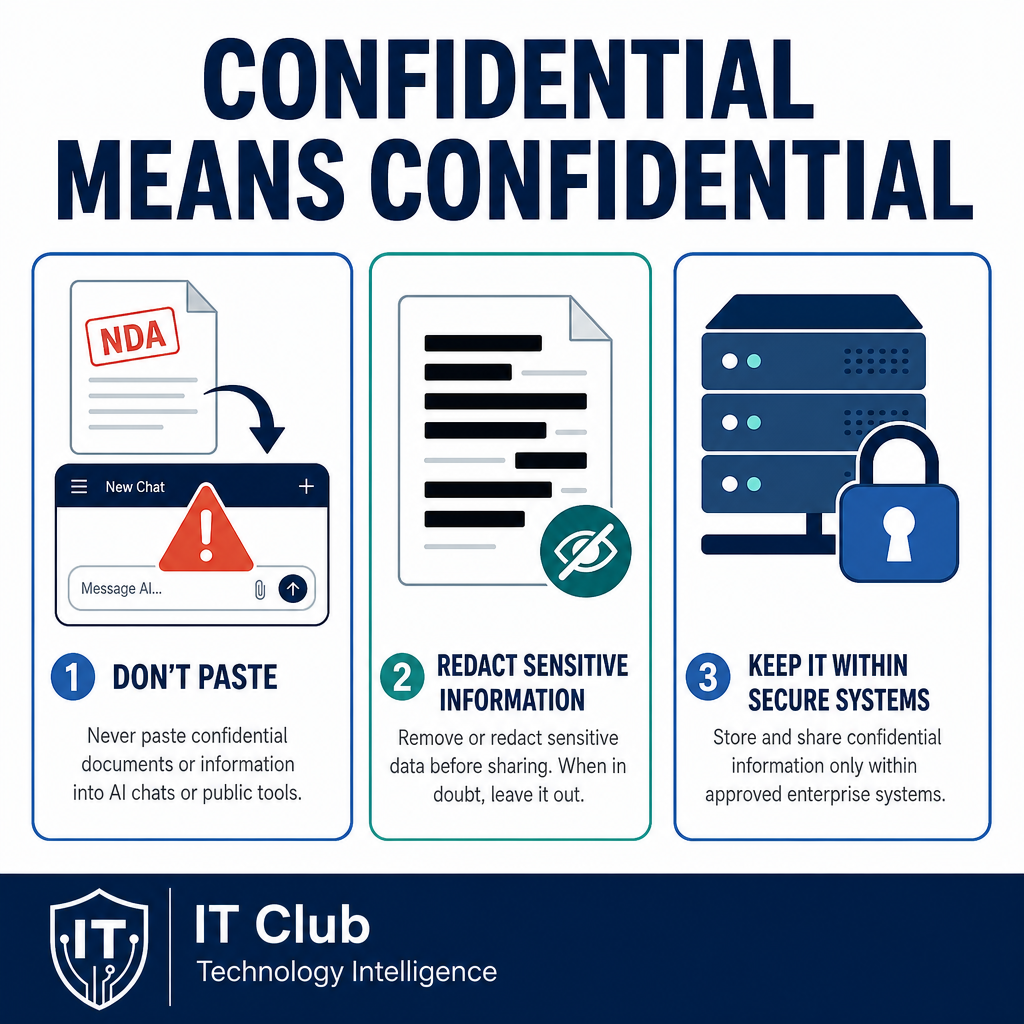
- 1Use placeholders — “[Customer]”, “[Supplier]”, “[£amount]” — and reinsert the real details after the AI has done its work.
- 2Redact documents before uploading: strip names, addresses, account numbers and metadata, not just the obvious fields.
- 3Generalise the scenario: ask about “a services business handling a late-payment dispute” rather than pasting the actual letter.
- 4Use need-to-know discipline: the person prompting should only be handling information they are entitled to see in the first place.
- 5Move genuinely sensitive work to an approved secure environment — an enterprise deployment with contractual commitments, admin controls and agreed data handling — rather than to a public tool.
Public tools and business tools are not the same
This guide is about public, consumer-grade AI tools. Enterprise services under a proper contract, with agreed retention, access controls and security commitments, can be appropriate homes for some confidential work — that is exactly what the supplier-assessment guide in this hub is for. The mistake is treating a free consumer account as if it carried enterprise protections. Free AI tools are not private business vaults.
Plain-English Takeaway
If information is confidential, regulated, or belongs to somebody else, the default is that it stays out of public AI tools. Use placeholders, redaction and generalised scenarios for everyday work, and reserve genuinely sensitive material for approved environments with contractual protection.
Related intelligence
A Technology Intelligence article that goes deeper on this topic
The Free AI Account That Cost a Client Relationship
Read the articleSources and further reading
- NCSC — AI and cyber security: what you need to know
- ICO — Anonymisation guidance
- NCSC — Working with AI chatbots: guidance for organisations
External guidance changes. Check the source itself for the current position before acting on it.