Who Is Responsible When Business AI Gets Something Wrong?
IT Club provides practical technology guidance, not legal advice. Laws, contractual obligations and regulatory requirements vary according to the organisation, sector, data, location and use case. Obtain appropriate legal, data-protection, employment or regulatory advice where required.
When AI output causes a problem — a chatbot misstates a refund policy, generated content misdescribes a product, an automated recommendation goes wrong — the customer's relationship is with the business, not with the software. This guide explains how responsibility tends to flow, and what a small business can practically do about it.
The starting point: your name is on the output
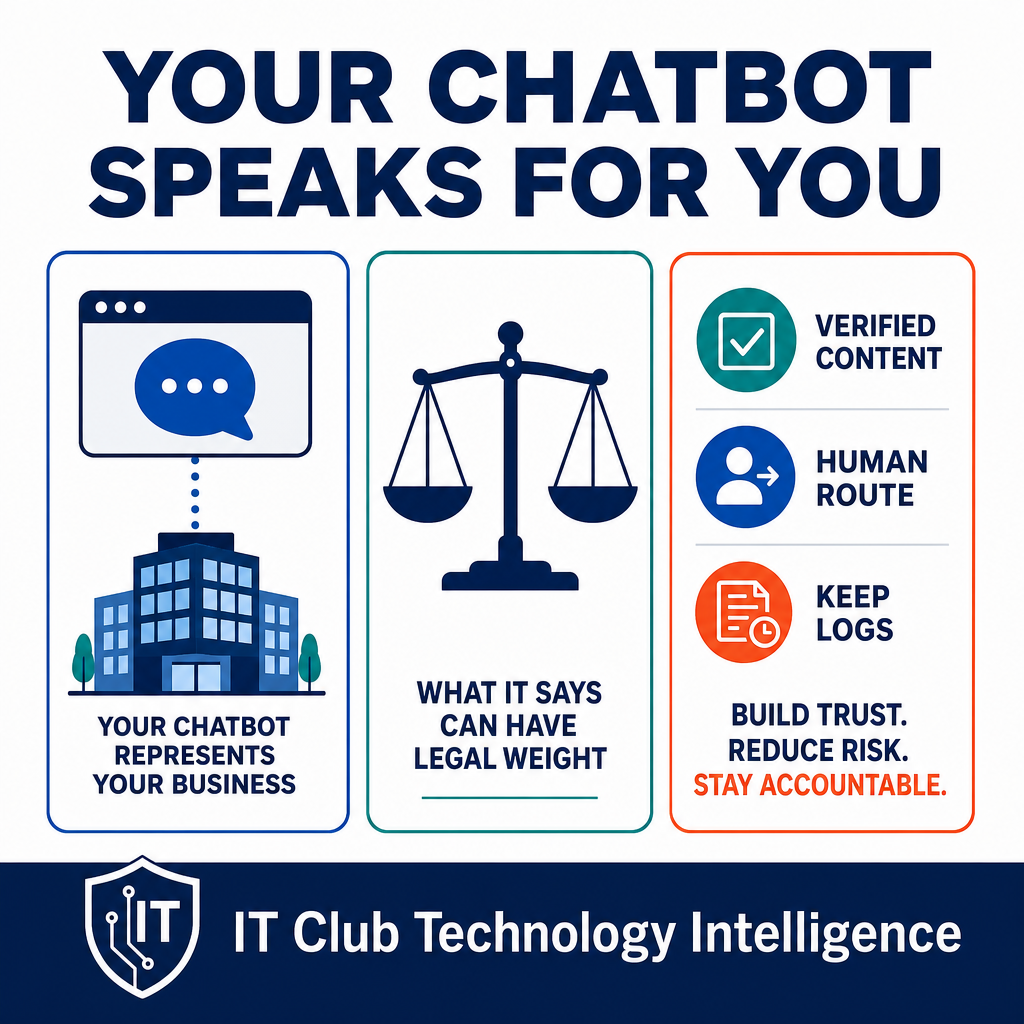
A business that publishes information, makes promises or gives recommendations is generally responsible for them under consumer law, contract and ordinary professional standards — however the words were produced. A business will usually struggle to defend poor customer information by saying “the chatbot wrote it.” UK consumer protection law prohibits misleading actions and omissions regardless of whether a person or a system generated the misleading content.
A cautionary example: the Air Canada chatbot
In Moffatt v Air Canada (2024), Canada's British Columbia Civil Resolution Tribunal ordered the airline to compensate a customer after its website chatbot gave incorrect information about bereavement fares. The tribunal rejected the airline's argument that the chatbot was responsible for its own statements, treating the chatbot as part of the company's website for which the company was accountable. It is a small-claims tribunal decision from another jurisdiction, not binding precedent in the UK — but it illustrates a direction of travel that few businesses would want to test: customers are entitled to rely on what your systems tell them.
Where AI liability questions actually arise
- Customer-facing chatbots making statements about prices, policies or availability
- Automated recommendations that customers act on
- Inaccurate AI-generated content in marketing, quotes or documentation
- Professional services where AI-assisted work carries a duty of care
- Contractual promises drafted or summarised by AI and not checked
The supplier gap
Your supplier may limit its liability to you, while your customer still expects you to put the problem right. AI platform terms typically disclaim warranties about accuracy and cap the provider's liability. The gap between what your customer can claim from you and what you can recover from the supplier is carried by the business.
This is why supplier assessment matters before adoption: read the liability and indemnity clauses, understand what the provider does and does not stand behind, and price that gap into the decision. For high-consequence uses, the gap may be the reason to keep a human in the loop.
What disclaimers can and cannot do
A disclaimer does not automatically remove liability. Consumer rights cannot generally be excluded by small print, and unfair terms are unenforceable. Clear, honest signposting still has value — telling customers a chatbot may make mistakes and offering a route to a human sets expectations and reduces harm — but it is a mitigation, not a shield. Do not rely on wording alone where the consequences of error are serious.
Practical protections for a small business
- 1Human oversight where it counts: route pricing, commitments and complaints to people, not bots.
- 2Constrain customer-facing AI to answer only from your verified content, and test it against awkward questions before launch.
- 3Keep audit records: what the system said, when, and what it was based on — you cannot investigate a complaint about a conversation you did not keep.
- 4Treat AI-related complaints as early warnings: correct the customer-facing information first, then fix the control that let it happen.
- 5Talk to your insurer or broker: cover for AI-related errors varies between professional indemnity and cyber policies, and assumptions are not cover. Insurance may help — but only if the policy actually responds.
- 6For significant commitments, obtain legal advice on your terms and customer journey. This guide is technology governance, not contract drafting.
Plain-English Takeaway
Plan on the basis that your business owns what its AI says and does. Keep humans on the decisions that matter, constrain and test customer-facing tools, keep records, and check that contracts and insurance actually cover the gap between customer expectations and supplier liability limits.
Related intelligence
A Technology Intelligence article that goes deeper on this topic
What the Air Canada Chatbot Case Means for Your Website
Read the articleSources and further reading
- Moffatt v Air Canada, 2024 BCCRT 149 (Civil Resolution Tribunal, British Columbia, 14 February 2024)
- CMA — AI foundation models: initial review
- GOV.UK — Digital Markets, Competition and Consumers Act 2024: consumer protection
External guidance changes. Check the source itself for the current position before acting on it.