AI Is Helping Planes Avoid Contrails — And Britain Is About to Test It at Scale
IT Club — Powered by Altitude AI (opens in a new tab)

Keep up with IT Club
Add IT Club as a preferred source in Google Search.
Google and American Airlines have tested AI-based contrail forecasts, and the UK-backed Operation Blue Skies is taking the idea into North Atlantic airspace. This plain-English guide explains what the AI predicts, what the trials found, why it is not flying the aircraft and what businesses can learn from small, measurable interventions.
This is a current research and trial story. Google-reported percentages are not universal guarantees, and any aviation decision remains subject to safety, air-traffic control, weather, aircraft performance and established operating procedures.
The direct answer
Persistent aircraft contrails form only under particular atmospheric conditions. AI models can analyse weather, satellite and flight data to predict areas where warming contrails are more likely to form. Flight planners, pilots or air-traffic professionals can then consider targeted route or altitude adjustments for selected flights.
Google and American Airlines have already tested the approach. In August 2026, Google and UK aviation partners announced Operation Blue Skies, a 30-month programme intended to test contrail avoidance across part of the North Atlantic airspace.
The AI does not fly the plane. It helps identify the part of the sky a flight may want to avoid. Aviation professionals decide.
Most conversations about making flying less climate-intensive begin with new aircraft, sustainable aviation fuel, electric aircraft or hydrogen. Those technologies may all matter. But researchers are also asking whether some flights could reduce their climate impact through a much smaller intervention: flying slightly higher or lower when the atmosphere ahead is likely to produce a persistent contrail.
That sounds simple only after the hard part has been done. The useful question is not whether a computer can draw a line around a cloud. It is whether a system can make a reliable forecast, put it into the workflow that aviation professionals already use, allow a safe decision and then verify what happened.
What exactly is a contrail?
Contrail means condensation trail. The familiar white line behind an aircraft forms when hot, moist exhaust mixes with sufficiently cold and humid air at altitude. Water vapour condenses and freezes around soot particles and other aerosols in the exhaust, producing ice crystals that can be visible from the ground.
Some contrails disappear within minutes. Others persist for hours and spread into thin, cirrus-like cloud. That difference matters. A short-lived line and a persistent ice cloud are not the same climate event, and an aircraft does not create a persistent contrail everywhere it flies.
The atmosphere is not a flat map with one fixed “contrail zone”. Temperature, humidity, pressure, wind, aircraft characteristics, engine exhaust and the timing of the flight all affect what happens. This is why any avoidance system has to make a forecast about a changing three-dimensional environment rather than apply one permanent rule.
Do contrails really warm the planet?
They can have both warming and cooling effects. Ice clouds can reflect some incoming sunlight back to space, which is a cooling influence. They can also trap outgoing heat, which is a warming influence. For persistent contrails, the overall effect is generally estimated to be net warming, but the size of the effect depends on the cloud, the time of day, the surface below, the weather and how the calculation is made.
Nighttime contrails are especially interesting because there is no incoming sunlight for the cloud to reflect. Their shortwave cooling opportunity is absent, while the longwave heat-trapping effect remains. That does not mean every nighttime contrail has the same impact, but it helps explain why timing and location matter.
Google currently describes warming contrails as accounting for roughly one third of aviation's total climate impact. That is a useful indication of why the problem attracts attention, not an exact universally agreed percentage. Peer-reviewed work models the effect with ranges and scenarios rather than one permanent number. A 2026 Nature Communications study, for example, describes both the opportunity from avoidance and the uncertainty around future aviation growth, climate response and implementation.
“Contrails warm the planet” is too blunt if it hides the uncertainty. The careful version is that some persistent contrails have a net warming effect and that their impact is significant enough to justify better forecasting and measurement.
Nature Communications: The climate opportunities and risks of contrail avoidance →
Google Research: Project Contrails →
Why this is a prediction problem
Aircraft do not produce persistent contrails everywhere. They form in particular atmospheric regions, sometimes narrow layers that a flight will pass through for only part of its journey. The opportunity is therefore selective: do not change every flight; identify the flights and sections of sky where a small intervention might matter.
WEATHER DATA
      +
SATELLITE IMAGERY
      +
FLIGHT DATA
      +
CONTRAIL OBSERVATIONS
      ↓
AI CONTRAIL-RISK FORECAST
      ↓
FLIGHT PLANNING
      ↓
SMALL ROUTE OR ALTITUDE CHANGE
      ↓
DID A CONTRAIL FORM?
      ↓
SATELLITE VERIFICATION
      ↓
LEARN
AI is useful here because the system is combining large, changing datasets. Weather models describe the atmosphere. Satellite imagery can show where contrails actually formed. Flight data describes the aircraft's route and operating context. Historical observations help a model learn which combinations of conditions are more likely to create persistent contrails.
The output is not “the aircraft must go here”. It is closer to “this part of the planned path has a higher predicted risk, and this nearby alternative may be worth considering”. The forecast has to be useful at the moment a real flight plan is made, not only accurate in a research paper after the event.
The first American Airlines trial
In 2023, Google Research, American Airlines and Breakthrough Energy tested whether commercial pilots could use AI-based contrail forecasts in practice. Google and American described a small group of pilots flying 70 flights over six months. The forecasts used large datasets including satellite imagery, weather data and flight-path data.
Google reported a 54% reduction in contrails, measured by distance, on flights where pilots used the predictions compared with flights where they did not. It also reported approximately 2% more fuel for the adjusted flights. The reduction was verified using satellite imagery, which matters because the test needed to measure whether a contrail actually formed rather than merely record that a route had changed.
| Google-reported result | What it means |
|---|---|
| 54% fewer contrails across 70 flights | A small first proof point that commercial flights could use forecasts to avoid some contrails, measured by distance |
| Approximately 2% more fuel on adjusted flights | A reminder that avoiding a contrail can create an operational and emissions trade-off on the individual flight |
| Satellite-verified outcome | The claim was checked against observed imagery rather than relying only on the planned route |
The qualifier is as important as the percentage. This was a small test, not a claim that every flight can avoid every contrail with the same result. American Airlines called the findings encouraging while noting that more questions remained about how to operationalise the approach across the industry.
American Airlines: first-of-its-kind contrail avoidance research →
Google Research: AI is helping airlines mitigate the climate impact of contrails →
The bigger 2026 test
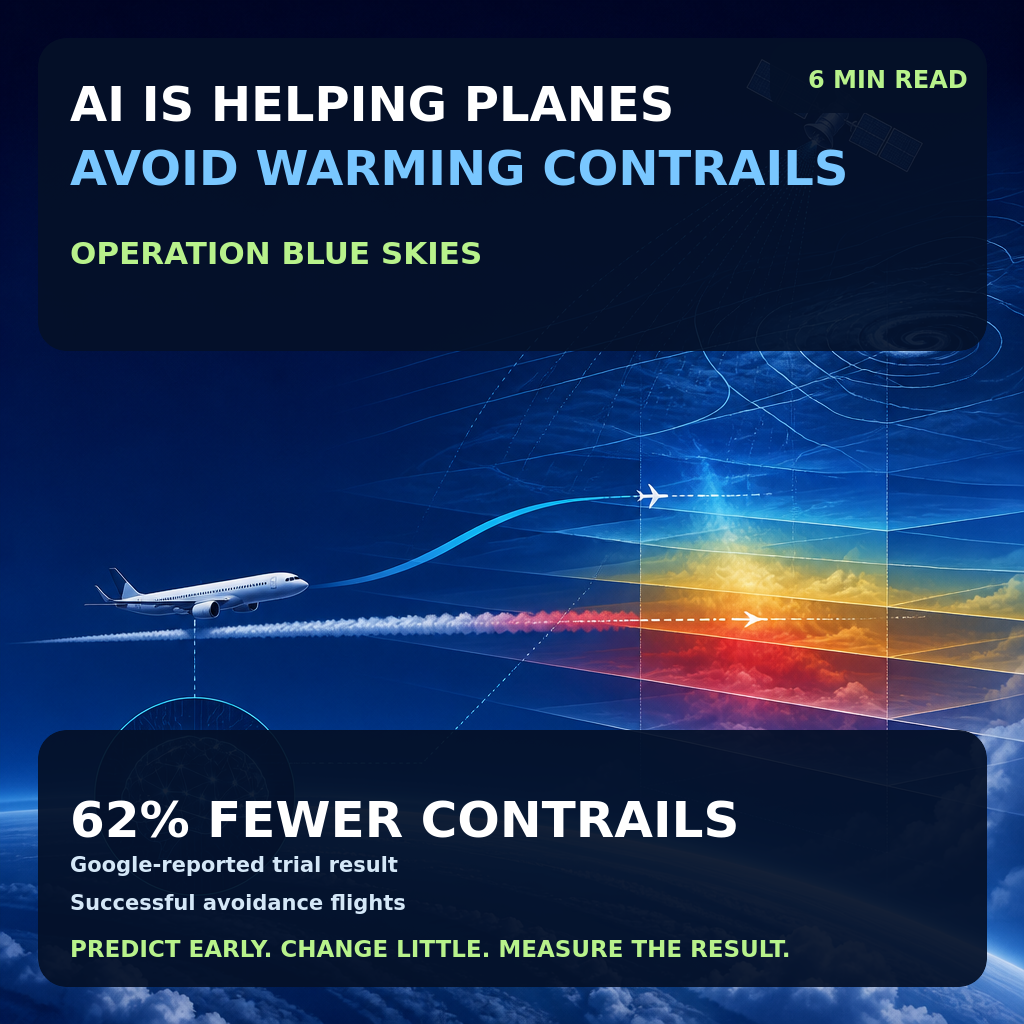
The next step was not simply to make the model produce a better map. Google integrated its contrail forecasts into American Airlines' normal flight-planning software. A 2026 Google report describes a trial involving 2,400 transatlantic flights that were part of the airline's standard schedule.
For the flights that successfully flew the contrail-avoidance plans, Google reported a 62% reduction in contrail formation rate compared with the control group. “Successfully flew” is not a footnote to discard. It tells us that the result is about the interventions that made it through the real operational system, not a promise that every proposed plan can be flown exactly as forecast.
The important step was workflow integration
The capability moved from a special research workflow towards the flight-planning tools people already use. That is often the difference between an impressive demonstration and a system that can be tested repeatedly in the real world.
The lesson applies outside aviation: the best AI tool may be the one users do not have to go somewhere else to use.
There is still a gap between a large trial and global deployment. The 2,400-flight result helps answer whether the approach can fit a normal planning process. It does not settle the climate accounting, the economics, the international coordination or the performance of every airline, route, season and forecast.
Google Research: Our new study explores how AI can reduce the climate impact of air travel →
American Airlines: sustainability and contrail avoidance research →
Operation Blue Skies brings the test to UK airspace
In August 2026, Google and UK aviation partners announced Operation Blue Skies. It is described as a 30-month, UK-backed programme to test AI-driven contrail avoidance across oceanic airspace rather than only on a small set of individually coordinated flights.
What has been published so far?
As of 30 August 2026, the primary Blue Skies publications describe the programme's launch, partners, funding, trial design and planned winter testing windows. They do not report measured results from those operational windows yet. The 62% figure belongs to Google's separate American Airlines study and should not be presented as an Operation Blue Skies outcome.
The first Blue Skies window is scheduled for winter 2026/27, with further testing planned for winter 2027/28. Google, NATS, the Met Office, Contrails.org, Imperial College London and the University of Cambridge describe the work as a test of whether contrail avoidance can be safe, measurable and practical at airspace scale.
The programme is focused on Shanwick Oceanic airspace, the eastern part of the North Atlantic corridor where NATS provides air-traffic-control services. Google says this area accounts for approximately 5% of global contrail warming. The announced programme includes operational testing windows across the 2026/27 and 2027/28 winter periods, with the intention of producing evidence about whether small changes can be safe, measurable and useful at airspace scale.
| Partner or group | Role in the programme |
|---|---|
| Google and Google UK | Contrail forecasting, AI research and programme leadership |
| NATS | Air-traffic-management and operational expertise in the relevant North Atlantic airspace |
| Met Office | Weather and atmospheric-science support for the forecast and trial |
| Contrails.org | Contrail forecasting, assessment, integration and data-analysis support |
| Imperial College London and University of Cambridge | Independent scientific and operational assessment |
| UK Government and the ATI Programme | Department for Transport funding through the ATI Programme; academic, non-profit and aviation partners receive the government grant funding |
The programme is described by NATS and the ATI Programme as a £5 million, 30-month project, with £2.65 million from the Department for Transport through the ATI Programme. Google UK says it is contributing £1.4 million in-kind on a pro-bono basis. Imperial College London and the University of Cambridge are responsible for evaluating trial outcomes and independently checking the climate impact, so the eventual result should not be reduced to a single vendor-reported percentage.
Google says around 10,000 flights are expected to pass through the relevant airspace during trial hours each year, while only a small percentage are expected to encounter contrail-sensitive areas and be considered for adjustment. That is the “clever bit”: the programme is not proposing to change every flight. It is testing whether the flights that matter can be identified early enough for a safe, small decision.
Operation Blue Skies is an operational research programme, not permission for an airline or software vendor to make unsupervised route changes. Safety and air-traffic requirements remain primary.
Google: Operation Blue Skies →
NATS: Operation Blue Skies contrail-avoidance trial →
Met Office: Operation Blue Skies and weather intelligence →
Aerospace Technology Institute: Operation Blue Skies →
What would actually happen to the plane?
The intervention is deliberately less dramatic than the headline. Where operationally appropriate, a flight may be considered for a small altitude change or a slight route adjustment to avoid a forecast-sensitive region. Aircraft already change altitude for weather, turbulence, traffic and other operating reasons, so a passenger may notice nothing unusual.
There is no universal “contrail avoidance manoeuvre”. The right option depends on the aircraft, the weather, nearby traffic, airspace rules, fuel, crew procedures, the forecast confidence and the consequences of being wrong. An AI forecast can inform the choice; it cannot waive the checks that make aviation safe.
AI advises. Aviation professionals decide.
This is a useful example of decision-support AI rather than autonomous AI. The model predicts a risk. A flight dispatcher or other qualified professional may compare alternatives. The pilot, air-traffic controller and established operating systems retain the authority to decide what can actually happen.
| Capability | What it says | Who owns the decision |
|---|---|---|
| Predictive AI | This atmospheric situation is more likely to create a persistent contrail | The forecast supports a decision |
| Decision support | These nearby route or altitude options may reduce the predicted risk | Aviation professionals apply safety and operating constraints |
| Automation | The system has made the approved change | Only within a narrowly authorised workflow and its controls |
| Agentic AI | The system identified a problem, selected an action and carried it out | Not what Operation Blue Skies is describing |
That boundary is important for any business adopting predictive AI. “The model recommended it” is not a safety case, a permission or an ownership transfer. The organisation still needs to define who can act, what they must check and when the recommendation should be ignored.
The fuel paradox
Avoiding a contrail may sometimes require slightly more fuel. That can sound counterproductive when the goal is to reduce aviation's climate impact, but it is a multi-variable optimisation problem. The comparison is between a small amount of additional carbon dioxide from a route or altitude change and the warming effect of a persistent contrail that might otherwise form.
The answer is not settled identically in every situation. A forecast can be wrong. A route change can affect fuel burn in a different way than expected. A contrail can dissipate sooner or last longer than predicted. The climate accounting also involves timescales and effects that are harder to compare than a simple fuel receipt.
Optimisation does not always mean minimising one thing
Sometimes it means balancing several things: safety, traffic, fuel, punctuality, emissions, forecast confidence and the likelihood that a persistent contrail would have formed.
The business lesson: change the flights that matter
Most businesses hear “AI” and ask what job it can replace. This project asks a different question: what small decision could AI help us make better before the expensive outcome happens?
The AI is not flying the aircraft. It is improving when, where and whether a small operational adjustment should be considered. That pattern can apply to support, finance, equipment, logistics and customer service. A system might predict which tickets will escalate, which invoices will become overdue, which machine is likely to fail or which delivery is likely to miss its window.
The Small Change, Big Outcome test
- 1What outcome are we trying to improve?
- 2Can we predict when the problem is likely to occur?
- 3Can we intervene before it happens?
- 4Is the intervention small and reversible?
- 5Can we measure whether it worked?
Predict early. Change little. Measure the result. If the system cannot answer what changed and whether the outcome improved, it may be producing activity rather than useful intelligence.
Read the IT Club guide to AI triage and better business workflows →
Read the IT Club guide to AI creating more work instead of less →
Prediction needs a feedback loop
A contrail forecast is valuable partly because satellite imagery can help determine whether the predicted contrail actually formed. That creates a loop: predict, act, observe and improve. Without the observation step, a team can mistake a plausible recommendation for a proven result.
- 1Predict where and when the risk is higher.
- 2Act only when a qualified person accepts a safe, proportionate intervention.
- 3Observe what happened using an independent signal where possible.
- 4Improve the forecast, workflow or decision rule using the evidence.
The same principle applies to an SME's predictive project. If an AI flags a likely overdue invoice, record whether it actually became overdue and whether the early intervention helped. If it flags a likely support escalation, measure the resolution outcome rather than only counting how many alerts were generated.
What we do not know yet
Operation Blue Skies exists partly because the important questions remain open. The early trials show that contrail avoidance can be tested and measured. They do not establish that one forecast model, route policy or performance percentage will transfer unchanged to every airspace and airline.
- How accurate the forecasts remain across different weather patterns and seasons
- How many false positives and false negatives occur in operational use
- How much fuel and carbon dioxide a particular adjustment adds
- Whether airspace capacity and traffic coordination support wider adoption
- How much climate benefit remains after full lifecycle accounting
- How different aircraft, airlines, routes and planning systems behave
- What international coordination is required beyond one airspace
- Whether the economics make sense for routine use
Promising is not the same as proven at global scale. The value of the larger test is that it can produce evidence about safety, operations, measurement and climate impact together.
The Operational Heartbeat
Predictive AI needs an Operational Heartbeat. The environment changes, and a prediction that was useful last season may not remain useful after a model update, route change, weather-pattern shift or data-source problem.
- Prediction accuracy: did the forecast identify the event it was meant to identify?
- False positives: how often did the system call for attention when the risk was not meaningful?
- False negatives: what important events did it miss?
- Intervention cost: what fuel, time, money or operational friction did the response create?
- Outcome achieved: did the small change improve the thing the organisation cared about?
- Changing data: are the weather, flight, customer, equipment or transaction inputs still comparable?
- Human overrides: when did professionals reject the recommendation, and why?
- Unexpected consequences: did solving one problem create another?
The heartbeat is not a quarterly dashboard that nobody owns. It is a recurring review of whether the prediction is still useful, whether the intervention remains proportionate and whether people can safely override it. In aviation, that discipline is non-negotiable. In business, it is still the difference between decision support and automated guesswork.
The IT Club view
The interesting technology story is not that AI is taking control of aircraft. It is that weather science, satellite imagery, flight data and aviation operations are being combined to help humans make very small decisions that may have a larger cumulative effect.
AI does not always need to do something big. Sometimes it just needs to tell us when a small change matters. The test for a business is straightforward: predict early, change little and measure the result.
Primary sources and further reading
This article was researched from current primary and peer-reviewed sources. Google-generated performance figures are identified as Google-reported results, and the programme descriptions are attributed to the organisations involved.
Google Research — Operation Blue Skies: Reducing aviation climate impact with AI →
Google Research — AI contrail avoidance study with American Airlines →
American Airlines — 2023 contrail avoidance research →
American Airlines — contrail avoidance programme →
Met Office — Operation Blue Skies →
Aerospace Technology Institute — Operation Blue Skies →
University of Cambridge — Operation Blue Skies trial →
Contrails.org — Operation Blue Skies launch and trial design →
Nature Communications — The climate opportunities and risks of contrail avoidance →
Plain-English Takeaway
Some of the most useful AI may never do the job. It may simply predict when a small change matters, help a qualified person choose an option and provide a feedback loop that shows whether the intervention worked.
Frequently asked questions
What is an aircraft contrail?
A contrail is a condensation trail: a cloud-like line formed when water vapour in jet exhaust condenses and freezes around soot particles in cold, humid air at altitude. Some disappear quickly, while persistent contrails can spread into cirrus-like cloud.
Do contrails contribute to global warming?
Some persistent contrails have a net warming effect because they trap outgoing heat, although clouds can also reflect incoming sunlight and create a cooling effect. The overall impact depends on conditions, timing and location, so individual estimates are not a universal fixed number. Google describes warming contrails as roughly one third of aviation's total climate impact, while peer-reviewed research continues to quantify uncertainty.
How can AI help planes avoid contrails?
AI can combine weather data, satellite imagery, flight paths and observations to forecast where persistent contrails are more likely to form. Flight dispatchers, pilots or air-traffic professionals can then consider a small route or altitude adjustment for selected flights, subject to safety, traffic, weather, fuel and operational constraints.
Is AI controlling the aircraft?
No. Operation Blue Skies and the Google/American Airlines work concern prediction and decision support. AI produces a forecast or recommendation; aviation professionals and established air-traffic procedures decide whether any change is safe and appropriate.
What did the American Airlines contrail trial find?
Google reported that a 2023 trial involving 70 American Airlines flights found 54% fewer contrails, measured by distance, on flights where pilots used AI-based forecasts compared with flights that did not use the predictions. Google also reported approximately 2% more fuel for the adjusted flights. It described the result as a small first proof point that needed further research, not a universal fleet-wide result.
What did the 2026 Google contrail study find?
Google reported that its AI contrail forecasts were integrated into American Airlines' existing flight-planning software and used in a trial of 2,400 scheduled transatlantic flights. For the flights that successfully flew the contrail-avoidance plans, Google reported a 62% reduction in contrail formation rate compared with a control group. The qualifier matters: not every planned intervention necessarily succeeded.
What is Operation Blue Skies?
Operation Blue Skies is a UK-backed 30-month programme testing AI-driven contrail avoidance across Shanwick airspace, the eastern part of the North Atlantic corridor. Google, NATS, the Met Office, Contrails.org, Imperial College London and the University of Cambridge are among the partners, with UK Government support through the Aerospace Technology Institute Programme.
Where will Operation Blue Skies take place?
The programme is focused on Shanwick Oceanic airspace in the eastern half of the North Atlantic corridor. Google says that area represents approximately 5% of global contrail warming. The trial is intended to test the idea in a coordinated oceanic airspace environment rather than in a small, isolated research workflow.
Will passengers notice planes changing altitude to avoid contrails?
Passengers may notice nothing unusual because aircraft already change altitude for weather, turbulence, traffic and other operational reasons. Any route or altitude adjustment would need to be selected by aviation professionals and remain subordinate to safety, air-traffic requirements, weather and the aircraft's operating limits.
Does avoiding contrails use more fuel?
It can. A small altitude or route change may increase fuel use on an individual flight. The climate question is whether a modest additional amount of carbon dioxide is outweighed by avoiding a persistent warming contrail, and that calculation is not settled identically for every flight or condition. It is one of the questions the larger trials are designed to measure.
Can contrail avoidance work at scale?
The early results are promising but do not prove global-scale performance. Scaling requires accurate forecasts, safe integration with flight planning and air-traffic management, reliable satellite verification, workable fuel trade-offs, good weather data, international coordination and clear evidence that the climate benefit persists in real operations.
Tap to follow The IT Club Channel on WhatsApp.
Related Articles
Could AI Create the Next Financial Crisis? The Bank of England’s Warning
The Bank of England says interconnected financial risks have increased. AI debt is one exposure—not a prediction of an inevitable crash.
Read articleCould AI Charge You More Than the Next Customer?
The reporting concerns restaurant-specific price recommendations—not evidence that McDonald’s charges individual customers different prices.
Read articleThe Pentagon Plans an Autonomous Warfare Command. Who Remains in Control?
A planned US command will focus on unmanned and autonomous systems. That is an organisational plan, not proof that weapons act without human oversight.
Read articleNeed help putting this into practice?
IT Club helps you understand the technology. If you need implementation, support or consultancy, the teams behind IT Club can help.
Altitude IT (opens in a new tab) — IT support, cyber security, Microsoft 365 and technology operations.
Altitude AI (opens in a new tab) — AI discovery, automation, governance and implementation.