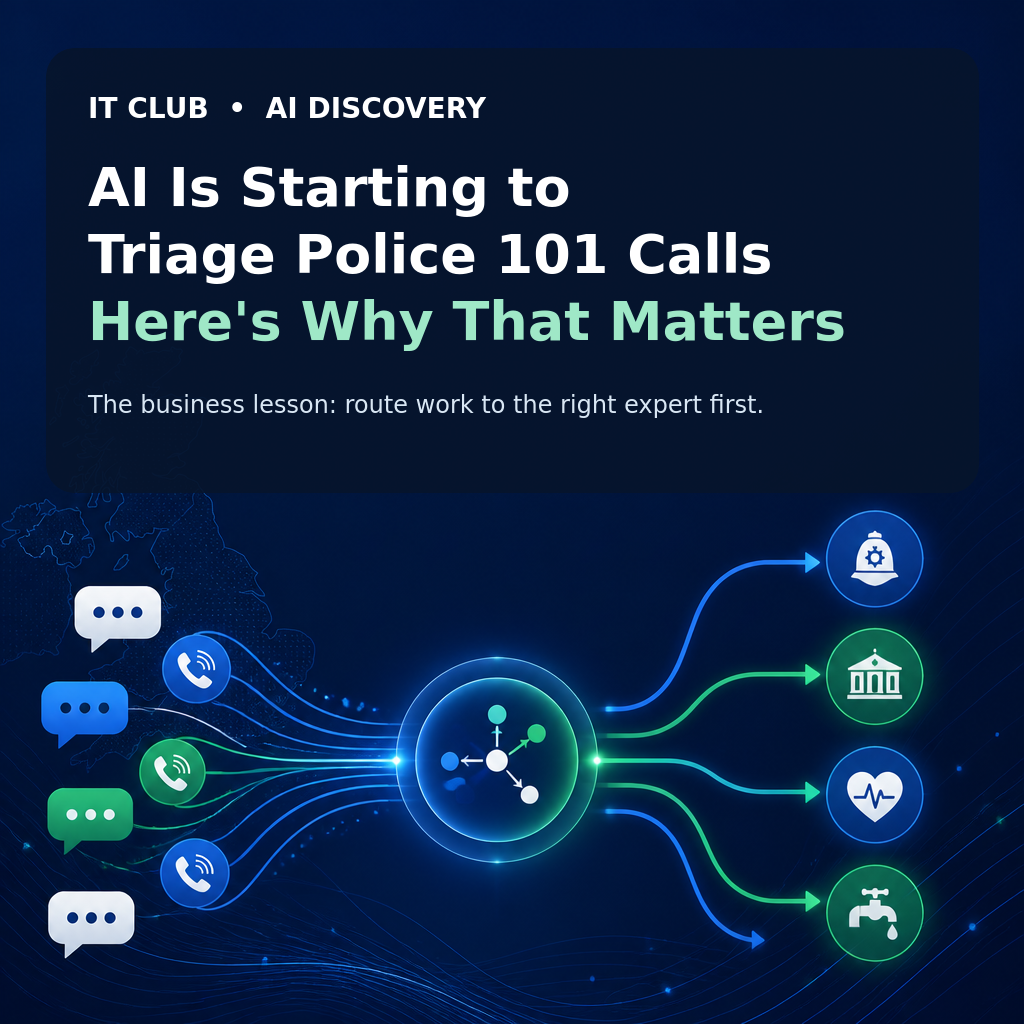
AI Is Starting to Triage Police 101 Calls — Here's Why That Matters
IT Club — Powered by Altitude AI (opens in a new tab)

Keep up with IT Club
Add IT Club as a preferred source in Google Search.
The UK's police 101 AI pilot is designed to classify and route non-emergency calls, not to replace call handlers or make final policing decisions. This practical guide explains the triage flow, human oversight, confidence and risk controls, accessibility questions and the business workflow lesson any SME can use.
This article explains a public-sector AI pilot and draws out a business workflow lesson. It is not a statement that AI makes policing decisions, replaces 101 call handlers or handles 999 calls. Check the latest official material before relying on pilot scope, savings or participating forces.
Quick Answer
The Home Office says an AI system is being piloted to help classify and route non-emergency police 101 calls. The system is meant to identify whether a caller needs policing or another organisation, so the request can reach the right destination sooner.
The important business lesson is broader: do not make your most expensive or specialised person read every incoming request just to discover where it belongs. Use a narrow, explainable first-pass triage layer, then keep human ownership for ambiguity, urgency and consequences.
- AI can classify and suggest a route; it should not quietly become the final decision-maker.
- Low confidence and high-risk cases need a human or safer fallback.
- A good hand-off preserves context, ownership, urgency and an audit trail.
- The measure of success is a better outcome, not simply fewer human interactions.
Why a Police 101 Pilot Is a Business Story
A public announcement about police call routing can sound like a specialist technology story. It is also a familiar operations problem: a high-volume front door receives requests that belong to several different destinations. If every request is handled by the same scarce team, the organisation spends skilled time on sorting instead of solving.
The Home Office says around 20 million 101 calls are made each year. Around 20%, or about 4 million, are intended for non-policing organisations. The pilot is designed to help identify that kind of demand and route it towards the organisation that can provide the appropriate help.
The same shape appears in a business inbox, website chat, service desk or shared phone line. “Can someone help?” may actually mean a locked account, a billing question, a facilities fault, a safeguarding concern or a request for a specialist review. The first job is not to generate a clever answer. It is to work out what kind of work has arrived and who should own it.
Home Office — PoliceAI to speed up investigations and fight crime →
What the Pilot Is Intended to Do
The public description is about triage and routing. The Home Office says the system was developed by the Home Office and NPCC with Vodafone Business and that pilots are taking place across 15 police forces. It reports estimated potential savings of up to £8.5 million annually if the approach is adopted more widely.
Those figures describe a potential public-service benefit, not a guaranteed result and not a business case that transfers unchanged to every organisation. The useful design pattern is the boundary: the AI is a front-door classifier and router. The receiving service remains responsible for handling the request.
| What the announcement supports | What it does not support |
|---|---|
| A pilot to classify and route non-emergency 101 demand | A claim that AI answers 999 calls |
| A focus on calls intended for policing or another organisation | A claim that AI replaces trained call handlers |
| A reported £1.4m government investment and 15-force pilot | A guarantee that the estimated £8.5m annual saving will occur |
| A partnership involving the Home Office, NPCC and Vodafone Business | A licence for businesses to copy the design without testing risk, access or data use |
Do not turn a routing pilot into a story about autonomous policing. The distinction matters: classification, recommendation and hand-off are different capabilities from deciding what action should be taken.
The Triage Flow, Step by Step
A safe triage flow is easier to govern when its steps are visible. Whether the input is a phone conversation, email, form or chat message, document the path from arrival to ownership.
- 1Receive the request and explain what the first-pass system is doing, especially if a recording, transcript or automated interaction is involved.
- 2Extract only the information needed to identify the request type, urgency and likely destination.
- 3Classify against a small, maintained set of categories instead of asking the model to invent an open-ended taxonomy.
- 4Check confidence, risk and any hard-stop signals. A high-confidence label is not enough if a wrong route could cause serious harm.
- 5Route the request with its relevant context, the reason for the route and the identity of the receiving queue or person.
- 6Let the receiving team correct the route and record the correction so categories and examples can improve.
- 7Escalate, replay or review the case when the model is uncertain, the user disagrees, the service is unavailable or the request falls outside the approved scope.
A useful hand-off contains more than a label
- The original request or a link to the source record
- The proposed category and destination
- Any urgency or safeguarding flag, with the rule that triggered it
- The model or workflow version and time of classification
- The confidence band and any missing information
- The named human or team that now owns the next step
- A clear route back to a human if the caller or recipient disagrees
A destination without context creates a second triage problem. The receiving team should not have to ask the customer to repeat everything simply because the automated hand-off dropped the evidence.
Human in the Loop Is a Design, Not a Disclaimer
“A human remains involved” is too vague to be a control. Decide where the human acts, what they can override, how quickly they must respond and what happens when they are unavailable. A person who can only accept an AI route after the fact is not the same as a person who can stop an unsafe route before harm occurs.
| Point in the flow | Human responsibility | Useful evidence |
|---|---|---|
| Before launch | Approve categories, exclusions, fallback routes and data use | A signed workflow and risk record |
| During triage | Review low-confidence or high-consequence requests | Queue, threshold and override logs |
| At hand-off | Accept, correct or reject the proposed destination | Reason for override and receiving owner |
| After the event | Investigate misses, complaints and unequal performance | Sampled cases, outcomes and incident records |
The human should also be able to see that a route was machine-assisted. That does not mean exposing an opaque technical score to every user. It does mean giving the responsible operator enough information to question the recommendation rather than treating it as an instruction.
College of Policing — Building AI-enabled tools and systems →
Confidence Is Not the Same as Safety
AI systems often produce a confidence score or ranking. That can be useful, but it is not a magic measure of correctness. A model can be confidently wrong, and the cost of a wrong route can vary dramatically by category.
| Case | Default route | Why |
|---|---|---|
| High confidence, low consequence | Automated queueing with sampling | A wrong route is inconvenient but easy to correct |
| Low confidence, low consequence | Clarifying question or generalist queue | Gather missing context before specialist time is used |
| High confidence, high consequence | Human review before action | Confidence does not remove the cost of a dangerous miss |
| Low confidence, high consequence | Immediate human or established safety fallback | Do not experiment with an ambiguous request at the edge of the system |
For a business workflow, write the threshold in operational language: “If the system is unsure whether this is a payroll access issue or a suspected account compromise, route to the security owner.” That is more useful than “the model is 80% confident”, because it connects uncertainty to a person and a response time.
Accessibility and Fairness Are Routing Requirements
A triage system can fail before the queue is reached. Speech recognition may perform differently across accents, speech impairments, noisy environments or different microphones. A language classifier may misunderstand someone using limited English, a regional term or a communication aid. A fixed menu may force a person to choose a category that does not describe their situation. In a police or public-service context, a missed safeguarding signal can have consequences well beyond a delayed ticket, so it belongs in the hard-stop and human-escalation design rather than being treated as an ordinary classification error.
The answer is not to promise that the model is neutral. Test the complete route with the people who will use it and the people who may be disproportionately misrouted. Keep a visible human alternative, allow correction without making the person start again and monitor abandonment as well as classification accuracy.
- Offer a human route that is easy to find and does not require arguing with the bot.
- Support text, relay, interpreter and other accessible channels where the service requires them.
- Test accents, speech differences, background noise, code-switching and common local language.
- Record when a person corrects a category or destination, not just whether the model produced a label.
- Check whether some groups wait longer, abandon more often or are routed to lower-quality help.
- Make the fallback usable during an outage, model change or supplier incident.
GOV.UK — Inclusive design principles →
The Business Lesson: Route Before You Spend Expertise
Many SMEs have a version of a 101 queue. It may be the owner’s inbox, a shared helpdesk, an accounts mailbox or a senior engineer’s phone. The hidden cost is not only the minutes spent answering. It is the interruption, the context switch and the delay for the work that genuinely needed that person.
A triage layer can protect expert time by answering a narrower question first: which queue should own this? That can be a form with required fields, a rules engine, a mailbox classifier or an AI assistant that proposes a category for a person to approve. The technology matters less than the boundary and the feedback loop.
The IT Club Triage Model
Use four simple questions for every incoming item: what is it, how urgent or risky is it, who should own the next step and what context must travel with it? This works for an email, an IT ticket or a customer enquiry without pretending that every request needs a chatbot.
| Front door | Classify first | Safe next step |
|---|---|---|
| Shared email: “Can someone help?” | Account access, billing, facilities, sales or security concern | Add the category and route reason, then send it to the named queue |
| IT ticket: “My laptop is broken” | Device fault, access issue, suspected compromise or warranty case | Ask only for the missing diagnostic detail; escalate suspected compromise |
| Customer enquiry: “Which package is right for us?” | New sale, renewal, technical fit, procurement or support | Give the sales or technical owner the customer’s stated need and deadline |
| Phone or chat: “I need this changed today” | Routine request, deadline-sensitive work, fraud signal or emergency | Verify identity and route high-consequence changes for human approval |
- Identify: describe the work in the organisation’s own categories.
- Protect: spot urgency, safeguarding, fraud, privacy or security signals before optimising speed.
- Route: send the request and its context to one named owner.
- Learn: record corrections and outcomes so the queue improves without hiding mistakes.
| Incoming work | First-pass route | Expert time is reserved for |
|---|---|---|
| “My laptop is broken” | Device support, access issue, suspected security incident or warranty queue | Diagnosis and remediation rather than asking what the request means |
| “Can you look at this contract?” | Commercial review, privacy question, legal escalation or admin request | The part that actually needs qualified judgement |
| “The website is down” | Known outage, local connectivity, domain/DNS, application or security incident | Restoring service with the right technical context |
| “Please change this bank detail” | Finance verification and fraud-control route | A controlled approval, never an unchecked automated change |
The last example is deliberate. Good triage does not mean automating every next step. Some categories should be recognised precisely so they can be slowed down, verified and kept away from an autonomous action.
Read: How AI Agents Can Create More Work Instead of Less →
Triage Is Not the Same as Agentic AI
A classifier that puts a ticket in the right queue is not automatically an AI agent. Triage is usually a bounded decision about category, priority or destination. An agentic system may plan across several steps, use tools, update records, send messages or continue working towards a goal.
That distinction helps with risk. Start with the least autonomous capability that solves the bottleneck. If the business problem is that requests arrive in the wrong inbox, a classifier and a review queue may be enough. Giving the system permission to change customer records, issue refunds or alter security settings is a separate decision with a much larger blast radius.
A useful autonomy ladder
- Suggest: show a category and destination to a human.
- Queue: place low-risk work in a destination while recording the route.
- Ask: request missing information using approved prompts.
- Act: perform a narrowly defined downstream action with controls.
- Orchestrate: plan and execute several tool calls towards a goal.
Move up the ladder only when the lower level is understood, measured and reversible. A routing success is not evidence that a system should be allowed to take consequential actions.
Read: Your AI Agent Did Something Illegal. Who Is Responsible? →
A Practical SME Checklist
Before adding AI to a shared inbox, phone line or service desk, use this checklist. If the answer to a question is “not sure”, that is a reason to narrow the pilot, not to hide the uncertainty.
- 1Name the queue problem: which requests arrive together today, and which expert is interrupted by sorting them?
- 2Define the approved categories and write examples of what belongs outside each category.
- 3List hard-stop routes for emergencies, safeguarding, suspected fraud, security incidents and other high-consequence cases.
- 4Decide whether the AI suggests a route, makes a low-risk queueing decision or can take a downstream action. Do not blur these levels.
- 5Choose the minimum data needed. Record whether calls, transcripts, prompts, metadata or attachments are retained and who can access them.
- 6Set the low-confidence and disagreement routes before collecting production traffic.
- 7Design an accessible human fallback and test it during a supplier outage or system failure.
- 8Give the receiving team the original context, route reason, confidence band and a way to correct the classification.
- 9Sample both successful and failed routes. Look for missed urgent cases, repeated hand-offs, abandonment and unequal outcomes.
- 10Set a review date, owner and stop condition. A pilot should be easy to pause, change or remove.
Operational Heartbeat
Triage is not a one-off software purchase. Categories drift, suppliers change models, customers describe problems in new ways and the receiving teams change. Give the workflow a small operational heartbeat: a named owner checks a sample of routes, watches the exceptions and confirms that the fallback still works.
| Signal | Question to ask | Action if it worsens |
|---|---|---|
| Route accuracy | Did the receiving team agree with the destination? | Review examples and change categories or thresholds |
| Time to ownership | Did the request reach a named team faster? | Remove queues that create extra hand-offs |
| High-risk misses | Did an urgent or sensitive request enter an unsafe route? | Pause the affected category and investigate before continuing |
| Human override rate | Are people correcting the system repeatedly? | Treat the corrections as product requirements, not user error |
| Access and fairness | Do some callers abandon or wait longer? | Test the channel, model and fallback with affected users |
| Data and supplier health | Are retention, access and service boundaries still as approved? | Review the provider change and update the risk record |
The strongest automation is often deliberately boring. It makes the next owner obvious, carries the right context, exposes uncertainty and leaves a person in control when the consequences are serious.
Related Reading
The Bottom Line
The police 101 pilot is a useful reminder that AI does not need to answer the whole question to create value. It can help identify what has arrived and send it to the right place. That is a powerful business capability when the route is narrow, the ownership is clear and the fallbacks are real.
Before buying an AI agent, look for the queue your best people are currently sorting by hand. Then ask whether a transparent triage step could protect their time without hiding risk from them or from the person asking for help.
Sources and Further Reading
The public-sector facts and figures in this article were checked in August 2026. Pilot scope, participating forces, supplier arrangements and reported estimates may change. The business examples and checklist are editorial guidance, not legal, policing or procurement advice.
Home Office — PoliceAI to speed up investigations and fight crime →
Home Office — Police use of artificial intelligence (AI): factsheet (accessible) →
National Police Chiefs’ Council — Police and AI →
Police Digital Service — About us →
College of Policing — Building AI-enabled tools and systems →
Plain-English Takeaway
The valuable part of AI is often not answering the whole request. It is identifying what has arrived, spotting urgency and routing the work to the right person or organisation before a scarce expert spends time on the wrong queue. Keep the hand-off visible, define safe fallbacks and measure whether the route actually improved.
Frequently asked questions
What is the UK police 101 AI pilot?
The Home Office says it is investing £1.4 million in an AI system developed with the National Police Chiefs’ Council and Vodafone Business to help classify and route non-emergency 101 calls. The pilot covers 15 police forces. It is intended to help callers reach the right service, including organisations outside policing, rather than replace 101 call handlers.
Is AI answering 999 calls?
No. The Home Office says the government does not currently support police using AI to answer 999 emergency calls. This pilot concerns non-emergency 101 demand and its routing, not emergency call handling. A business should make an equivalent boundary explicit: urgent or safety-critical requests must go through the established human or emergency route.
Will AI replace police 101 call handlers?
That is not what the pilot description says. The system is described as supporting the classification and routing of calls, while human call handlers and police services remain part of the process. It should not be described as an autonomous replacement for trained staff.
Why are so many 101 calls being routed elsewhere?
The Home Office says around 20 million 101 calls are made each year and about 20%, or roughly 4 million, are intended for non-policing organisations. Better routing could help those callers reach the organisation that can actually solve the problem, rather than using police capacity as a general information queue.
What does AI triage mean in a business?
AI triage means using software to classify an incoming request against a defined set of queues, priorities or destinations, then sending it to the right next step. It can use text, speech or form data, but the safe design still defines confidence thresholds, escalation routes, audit records and human ownership.
Is AI triage the same as an AI agent?
No. A triage system may classify a request and recommend or perform a narrowly defined hand-off. An AI agent usually has a broader goal and may plan, call tools or take several actions. Triage can be a component inside an agentic workflow, but it does not need agent-level autonomy.
What happens when the triage model is unsure?
The safe answer is defined before launch: ask a clarifying question, route to a generalist, send it to a trained human, or use an urgent fallback. Do not silently send a low-confidence request to the most convenient queue. Confidence should be combined with the possible harm of being wrong.
Could AI triage discriminate against callers?
It could produce unequal outcomes if speech recognition, language understanding, categories, training data or escalation rules work less well for some callers. Testing should include accents, speech impairments, noisy environments, limited English, different communication preferences and people who need a human route. The system should preserve access to a person.
What data protection issues apply to AI triage?
The organisation needs a clear purpose, lawful basis, data minimisation, retention period, access controls, supplier terms and a plan for recordings, transcripts, metadata and onward sharing. A voice or transcript may contain personal or sensitive information. The service boundary and any third-party speech or AI provider need to be documented rather than assumed.
Can a small business use AI triage without building a custom model?
Often, yes. A business may be able to use rules, forms, a helpdesk classifier or a vendor workflow with carefully defined categories. Start with a narrow, reversible queueing problem and test it with real examples. Buying a feature is not the same as outsourcing accountability: someone still owns the categories, exceptions, access and review.
Tap to follow The IT Club Channel on WhatsApp.
Related Articles
Could AI Create the Next Financial Crisis? The Bank of England’s Warning
The Bank of England says interconnected financial risks have increased. AI debt is one exposure—not a prediction of an inevitable crash.
Read articleCould AI Charge You More Than the Next Customer?
The reporting concerns restaurant-specific price recommendations—not evidence that McDonald’s charges individual customers different prices.
Read articleThe Pentagon Plans an Autonomous Warfare Command. Who Remains in Control?
A planned US command will focus on unmanned and autonomous systems. That is an organisational plan, not proof that weapons act without human oversight.
Read articleNeed help putting this into practice?
IT Club helps you understand the technology. If you need implementation, support or consultancy, the teams behind IT Club can help.
Altitude IT (opens in a new tab) — IT support, cyber security, Microsoft 365 and technology operations.
Altitude AI (opens in a new tab) — AI discovery, automation, governance and implementation.