Google Maps Is Becoming an AI Agent — Why Local Businesses Should Care
IT Club — Powered by Altitude AI (opens in a new tab)

Keep up with IT Club
Add IT Club as a preferred source in Google Search.
Google Maps is becoming more conversational and increasingly agentic through Ask Maps, allowing users to describe what they want while AI handles more of the discovery and next-step process. For local businesses, the practical implication is that accurate profiles, clear websites, genuine reviews and working action links may become more commercially important as AI systems begin to narrow customer choices before the customer manually compares businesses themselves.
Think about what happens when someone searches for a Thai restaurant. The traditional Google Maps experience returns a list of nearby businesses, ratings, reviews, opening hours and a link to the menu. The customer then scans the map, reads a few reviews, checks whether the restaurant is open, finds the menu, and eventually places an order — or picks up the phone.
Now imagine a different starting point: "I want spicy seafood noodles. Find somewhere open on my route home and get an order ready for pickup."
That is the kind of request Ask Maps — Google's conversational AI experience inside Google Maps — is increasingly designed to handle. Rather than returning a list, it understands the intent, accounts for context and helps move the user towards an outcome. Every step the AI completes is one less step the customer has to perform manually.
The important change is not that Google Maps can answer a better question. It is that the answer can increasingly lead directly into an action.
Last checked: 13 August 2026. Feature names, capabilities, partner integrations and availability all vary by market and are subject to ongoing change as Google continues to develop these services.
The quick answer
Google Maps is evolving from a place-search tool into a conversational AI assistant that can increasingly help users take action.
Ask Maps already supports complex conversational questions about places. Google has announced or begun rolling out capabilities including food-order assistance, hotel discovery, local-event discovery, personalised recommendations, real-time transit information and connected personal context.
Some capabilities are currently limited by country, platform, account type, rollout stage and participating partners.
For businesses, the important trend is this: your future customer may not manually compare ten businesses. An AI agent may narrow the choice before the customer ever sees the map.
The direction is clear. The exact rollout is not uniform worldwide.
What is Ask Maps?
Ask Maps is Google's conversational AI experience inside Google Maps, powered by Gemini. Rather than typing keywords into a search box and applying filters, users can ask complex questions in plain language — the kind of questions a knowledgeable local friend might handle.
- "Find a restaurant with outdoor seating, good vegetarian options and under thirty minutes from where I am."
- "What should I do for an afternoon in Edinburgh with two young children?"
- "Is there a gym near my meeting tomorrow with day passes?"
- "Find me a hotel within walking distance of the conference centre with a decent breakfast."
- "Follow-up: does any of them have parking?"
Google says Ask Maps combines Gemini with its Maps data — including information about hundreds of millions of places — and draws on user-contributed reviews, photographs and other signals. The result is a conversational experience that can handle multi-part questions, follow-up queries and contextual adjustments.
Ask Maps turns local search from a list of filters into a conversation about what the person is actually trying to achieve.
From conversational to agentic
There is an important distinction between a conversational AI and an agentic one — and Google Maps is increasingly moving from the first towards the second.
| Conversational AI | Agentic AI |
|---|---|
| User asks: "Where could I eat tonight?" | User says: "Find somewhere suitable and help me take the next step." |
| AI provides suggestions | AI may search, compare, check availability and prepare an action |
| Human decides, acts, books | Human reviews the prepared action and confirms |
| Many manual steps remain | Fewer steps between intent and outcome |
Conversational AI helps you decide. Agentic AI starts helping you do.
Ask Maps began as the conversational model — a better way to ask questions about places. The agentic direction is where Google is increasingly pointing it. The transition is gradual and uneven across markets, but the trajectory matters more than the current feature set.
Food ordering
Google has announced and begun testing Ask Maps functionality that can help users describe a meal they want, account for current location or route, identify suitable restaurants, and in supported situations prepare items in a cart ready for order completion.
Google has reported partnerships with point-of-sale and ordering platforms including Square and Toast as initial integrations, with further integrations announced. These allow the Maps system to interact with a restaurant's ordering infrastructure rather than simply linking to a website.
The commercial shift is from 'Here are some restaurants' towards 'Here is the restaurant and the order ready for you to approve.'
The user always controls final purchase confirmation. Ask Maps does not purchase on behalf of a user without explicit approval. These ordering capabilities are primarily available in the United States at the time of writing and depend on participating restaurant partners and platforms. UK availability is not confirmed for the ordering features specifically.
Hotels and events
Ask Maps can handle more complex hotel and event searches that go beyond simple proximity. A user might describe several requirements at once — a hotel that is quiet, within walking distance of a specific venue, with availability on specific dates — and receive contextually useful recommendations rather than a generic filtered list.
For events, Ask Maps can handle queries that account for current plans, location, timing and interests simultaneously. The experience moves away from manually configuring filters towards describing the outcome a person wants.
AI search becomes more powerful when the customer can describe the outcome rather than manually configure filters.
Verification note: Specific hotel booking integrations and event discovery capabilities vary by market and platform. Check Google Maps directly for current availability in your country.
Personal Intelligence
Google is working to integrate Personal Intelligence into Ask Maps in supported markets. This allows Gemini to consider contextual information from connected Google services — with explicit user permission — to make recommendations more relevant to what the user is actually trying to accomplish.
Current examples that have been publicly described include connections to Gmail and planned Calendar integration. A practical illustration:
How Personal Intelligence could work
A user asks: "Where should we eat before my flight?"
With Personal Intelligence enabled, the AI may already know the flight time and location from Gmail booking confirmations, current location, and any existing plans — allowing it to make a recommendation that accounts for travel time without requiring the user to provide every detail manually.
The recommendation may increasingly depend not only on where the customer is, but on what the AI already knows about what they are trying to do.
Important caveats: connection to Gmail and other services is user-controlled, not automatic. Availability varies by market and account. Privacy settings matter and determine what information is accessible. Businesses do not receive access to the private user information that generates a personalised recommendation.
Personalised recommendations do not mean businesses gain access to the personal information used to generate them.
The bigger agentic Google picture
Ask Maps is not developing in isolation. Google is gradually building agentic capability across multiple products simultaneously — Search, Gemini, Maps, Chrome and commerce infrastructure.
Google's AI Mode in Search already supports agentic functionality for areas including restaurant availability, local appointments, service research and product availability in supported markets. Google Actions Center provides a platform through which participating businesses and platforms can expose actions — dining reservations, food ordering, appointments, things-to-do bookings, lodging, local services, shopping — that AI systems can initiate on a user's behalf.
Maps is not becoming agentic in isolation. Google is gradually connecting search, location, personal context and transaction systems.
The practical consequence for local businesses is that visibility across these systems — Maps, Search, Business Profile, website, action integrations — increasingly functions as a connected whole rather than separate channels.
Why this matters to local businesses
Traditional local-search optimisation focused on a single question: can the customer find you? Agentic local discovery adds two more questions that are becoming commercially significant.
Three layers of local AI visibility
Layer 1 — Findable
Can Google correctly identify and locate the business? Signals include a correct and complete Business Profile, accurate location data, appropriate categories, a working website and normal search indexing.
Layer 2 — Understandable
Can Google understand what the business does, what it offers, when it is open, what its menu or service list contains, what facilities it has, and whether it matches a specific customer requirement?
Layer 3 — Actionable
Can the system help a customer place an order, make a reservation, book an appointment, send an enquiry or check availability? Are the required integrations, links and systems working?
Being visible on a map is useful. Being usable by an AI agent may become commercially more important.
Google Business Profile quality matters more, not less
As AI systems take on more of the discovery and comparison work that customers used to do manually, the quality of the information those systems can access becomes more commercially significant. Google Business Profile is one of the primary data sources AI uses when reasoning about local businesses.
Fields worth reviewing carefully:
- Business name — exactly as the business trades, without keyword stuffing
- Primary category — the most accurate description of the main business type
- Secondary categories — genuine additional services, not a keyword list
- Address or service area — correct and specific
- Opening hours — current, including special hours for holidays and exceptions
- Telephone number — working and monitored
- Website URL — correct and loading properly
- Products and services — clearly described with accurate names and prices where appropriate
- Menu — current, structured and machine-readable where the profile supports it
- Attributes — facilities, accessibility features, payment methods and other relevant characteristics
- Photographs — current, representative and clearly showing the business
- Booking links — working, current and pointing to the right booking system
- Ordering links — correct, current and leading to a working ordering flow
If Google cannot confidently understand what your business offers, an AI agent has less reliable information to work with.
Website content still matters
The obvious bad conclusion from the rise of AI discovery is that websites no longer matter. That conclusion is wrong, and the reasoning behind it is flawed.
Google's AI systems can draw information from Maps, Business Profiles, websites, reviews, partner data and structured information simultaneously. A website remains an important source — particularly for information that a Business Profile cannot hold in detail, such as service descriptions, pricing structures, team credentials, policies, FAQs and booking systems.
A website should clearly describe: services and products, location and service area, opening hours, prices where appropriate, facilities, policies, FAQs, booking and enquiry routes, and how to take the next step.
AI discovery does not make your website irrelevant. It makes unclear websites more expensive.
A website that buries the service description in paragraph eight of an about page, hides pricing behind a contact form and has no clear booking route is already a problem for human visitors. It becomes a more significant problem when an AI agent is trying to understand whether the business matches a customer's requirements.
Structured actions: Google Actions Center
Google Actions Center is the platform through which participating businesses and partner platforms can expose machine-readable actions to Google's systems. When a business is connected through a supported partner, Google can present booking links, ordering options or appointment availability directly within Maps, Search and other Google surfaces.
Action types supported through Google Actions Center include: restaurant reservations, food ordering, appointments and bookings, things-to-do experiences, lodging enquiries, local services and shopping.
Most businesses connect through a supported partner platform — a booking system, reservation service or ordering platform that already integrates with Google Actions Center — rather than integrating directly. If the business uses a booking or ordering system, checking whether that system is a Google Actions Center partner is worthwhile.
The future local-search advantage may increasingly depend on whether the AI can complete the next step, not merely describe the business.
What about service businesses?
The agentic local-search conversation tends to centre on restaurants because food ordering is the most mature integration. But the same principle applies to a much wider range of businesses once booking and availability systems become machine-accessible.
Potential agentic local searches that matter beyond restaurants:
- "Find an electrician who can come tomorrow."
- "Find a garage that can service my car this week."
- "Find a hairdresser with an appointment after work on Thursday."
- "Find a hotel within walking distance of my meeting with parking."
- "Find a restaurant suitable for six people at 7pm with a private area."
- "Find a local accountant who handles self-assessment for sole traders."
- "Find a dog groomer who can take a Border Collie on Saturday morning."
Google AI Mode already supports or is testing workflows around local availability, services and appointment matching in supported markets. The direction points towards every type of local service business, not only those in hospitality.
Agentic local search matters to plumbers, garages, salons and professional services just as much as restaurants — once booking and availability systems become machine-accessible.
The customer journey is changing
The traditional and emerging customer journeys look fundamentally different in their structure:
| Traditional local search | Agentic local discovery |
|---|---|
| Customer searches keywords | Customer describes an outcome |
| Google returns a list | AI understands intent and context |
| Customer opens map and pins | AI identifies suitable businesses |
| Customer reads reviews manually | AI summarises and compares |
| Customer visits several websites | AI checks available information |
| Customer finds booking route | AI prepares an action option |
| Customer books or orders | Customer reviews and confirms |
Human involvement increasingly moves towards final approval rather than every intermediate step. The agent may increasingly become the first customer to read your business information.
Reviews: substance matters more than star count
Reviews have always provided useful information about a business — customer experience, service quality, recurring themes and whether the business matches particular requirements. AI systems can now read and summarise hundreds of reviews quickly, which changes the way review content matters.
AI can read hundreds of customer comments faster than a human can. That makes the substance of reviews increasingly useful, not just the star count.
What matters more in an agentic context: accuracy (do reviews describe the business as it currently operates?), freshness (are recent reviews present, not just old ones?), genuine reviews (authentic customer experiences, not manufactured ratings), business responses (do responses demonstrate that the business reads and acts on feedback?), and recurring themes (consistent mentions of specific qualities help AI systems understand what the business does particularly well or consistently poorly).
Do not conclude that more reviews or higher star ratings alone determine AI selection. Google has not disclosed that reviews are a single dominant signal in agentic recommendations. Review substance is one input among many.
The data quality problem
Agentic systems depend on accurate, current information more than traditional search does. A traditional search result showing slightly wrong opening hours is irritating — the customer sees it, adjusts mentally and may call to check. An AI agent working through options on behalf of a customer may simply move on to the next business.
Common data problems that create risks in an agentic context:
- Wrong opening hours — particularly after seasonal changes, holiday periods or operational changes
- Outdated menu or service list — items removed or renamed without updating the profile or website
- Incorrect prices — showing old prices after changes
- Wrong or outdated location — particularly after a move or addition of service areas
- Dead booking or ordering links — pointing to expired systems or removed pages
- Unavailable services still listed — services no longer offered but still described
- Duplicate listings — multiple Business Profile entries creating conflicting information
- Outdated photographs — images showing a previous version of the premises or staff
- Inconsistent information across platforms — different addresses, hours or descriptions in different places
When AI filters options for the customer, bad data can remove you from consideration before you get the chance to explain.
Machine-readable business information
Structured data — markup added to a website's code that helps search engines and AI systems understand the content accurately — can help make business information clearer to automated systems. The relevant vocabulary comes from schema.org, an open standard supported by Google, Microsoft and others.
Schema types worth considering for local businesses, depending on business type:
- LocalBusiness — the base type for any local business, including name, address, opening hours, telephone, website and geographic coordinates
- Restaurant — extends LocalBusiness with menu, cuisine type, reservation availability and food-specific attributes
- Hotel / LodgingBusiness — covers accommodation-specific attributes including amenities and room types
- Service / ProfessionalService — for service businesses, covering service descriptions and service areas
- Product and Offer — for businesses with specific products and prices
- openingHoursSpecification — structured opening hours, including special hours
- hasMap — a link to a maps page showing the business location
Structured data should describe the real business more clearly — not tell search engines a different story from the page customers see.
Only implement schema that accurately reflects visible content. Do not add fake reviews, fabricated ratings, hidden content or misleading markup. Google's guidelines are explicit on this and violations can result in manual actions.
Local AI Agent Readiness: a practical framework
Rather than thinking about AI search preparation as a single checklist, it helps to think in stages. A business needs to move through several layers of readiness before an AI agent can confidently recommend it and help a customer take the next step.
IDENTIFY → UNDERSTAND → TRUST → MATCH → ACT → VERIFY → REVIEW
- 1IDENTIFY — Can Google correctly identify the business? Business name, location, categories and website must be accurate and consistent.
- 2UNDERSTAND — Can it clearly understand what you offer? Services, products, menu, facilities, service area and opening hours must be clearly described.
- 3TRUST — Is information consistent and supported by genuine reviews, a real website and accurate Business Profile data?
- 4MATCH — Can AI match the business to a specific customer requirement? Detailed service descriptions, attributes and accurate information support this.
- 5ACT — Can the customer book, order, reserve or enquire easily through a working booking or ordering route?
- 6VERIFY — Are opening hours, prices, menus and availability current? Outdated information creates errors in AI recommendations.
- 7REVIEW — Is this information checked regularly? Business information changes; it must be actively maintained.
Checklist: could an AI agent confidently recommend your business?
Business Profile
- □ Correct, exact business name
- □ Correct primary category
- □ Accurate secondary categories
- □ Correct address or service area
- □ Accurate opening hours (including special hours)
- □ Working telephone number
- □ Correct website URL
Services and products
- □ Services clearly described with accurate names
- □ Products clearly described
- □ Facilities and attributes documented
- □ Important restrictions explained
- □ Pricing shown where appropriate
- □ Menu current and accurate (where applicable)
Website
- □ Business location clearly stated
- □ Service pages exist and describe services accurately
- □ Structured headings used
- □ Important FAQs answered
- □ Mobile site works correctly
- □ Booking or contact route works and is easy to find
Reviews
- □ Recent genuine reviews are present
- □ Recurring feedback themes are monitored
- □ Business responds to reviews
Actions
- □ Booking link works and is current
- □ Ordering link works and is current (where applicable)
- □ Appointment route works correctly
- □ Enquiry route works correctly
- □ Partner integrations reviewed
Data quality
- □ Duplicate listings identified and resolved
- □ Outdated information removed
- □ Structured data matches visible content
- □ Information reviewed after any operational change
Common mistakes
- Incomplete Google Business Profile — missing categories, old opening hours, no services listed
- Wrong opening hours — particularly after changes that were updated on the door but not in the profile
- Duplicate profiles — multiple listings for the same business creating conflicting information
- Broad or incorrect business categories — choosing 'Restaurant' instead of the specific cuisine type, or using categories to keyword-stuff
- Relying only on Instagram or Facebook — social profiles are not a substitute for a correct Business Profile and a clear website
- Hiding services inside PDF menus — AI systems may not reliably read content locked inside PDF files
- No clear service pages — a homepage that says 'we do everything' without describing any specific service
- Booking or ordering links that fail — expired systems, removed pages or broken redirect chains
- Poor mobile experience — particularly relevant as most local searches happen on mobile devices
- Inconsistent information across platforms — different addresses, telephone numbers or opening hours on different websites
- Fake review tactics — manufactured reviews violate Google's policies and risk profile suspension
- Obsessing only over star count while ignoring review substance
- Assuming traditional local ranking guarantees agent selection — they are related but not identical
- Assuming AI visibility means websites no longer matter
- Failing to update information after business changes — menu changes, new services, changed hours
An AI agent cannot recommend accurately from information the business never bothered to maintain.
What this could mean for local SEO
Traditional local SEO remains relevant. Google's systems still need to discover, crawl, understand and assess business information before any AI system can use it. The established practices — accurate citations, consistent NAP (name, address, phone), website quality, genuine backlinks, relevant content — remain important foundations.
But an additional layer is emerging alongside traditional optimisation: agent readiness. The question is shifting from 'Can I rank in local search results?' to 'Can an AI understand enough about my business to choose it for a specific task and help the customer take the next step?'
Local SEO is gradually moving from visibility optimisation towards decision-readiness.
This is not Google's official SEO framework or terminology. It is an IT Club interpretation of a direction we observe across Google's published developments.
UK availability
Ask Maps has been rolling out progressively beyond its initial US launch. As of the time of writing, Ask Maps conversational features are available in supported markets including the UK in the Google Maps app, though specific capabilities available in any given market may differ from the full US feature set.
| Feature | Status as of 13 August 2026 |
|---|---|
| Ask Maps conversational search | Available in supported markets, including UK rollout |
| Agentic food ordering (Square/Toast) | Primarily United States; UK availability not confirmed |
| Personal Intelligence (Gmail) | Initially US; limited international availability |
| Calendar integration | Announced; availability varies by market |
| Hotel discovery via Ask Maps | Available in supported markets |
| Event discovery via Ask Maps | Available in supported markets |
| Google Actions Center (restaurants, bookings) | Primarily United States and selected markets; check partner platforms for UK coverage |
| AI Mode agentic features | Primarily United States; international rollout ongoing |
The commercial direction matters even where a particular feature has not yet reached Britain. The businesses that will be best positioned when these capabilities arrive are those that have already ensured their information is accurate, complete and actionable.
Feature availability changes frequently. Check Google Maps support pages and Google's official blog for current status in your market before making decisions based on specific feature availability.
Ask Maps and AI Mode: different products
Ask Maps is Google's conversational and increasingly agentic experience inside Google Maps. AI Mode is Google Search's wider AI experience, accessible from Google's search interface. Both may draw on web information, Maps data and partner integrations, but they are different products with different development timelines and rollout schedules.
Google is adding agentic capability in several places at once, but the products and rollout schedules are not identical.
For businesses, the practical consequence is that optimising for one does not guarantee visibility in the other. A business that has correct Maps data but a poor website may do well in Ask Maps but poorly in AI Mode. Good underlying data quality — accurate profile, clear website, genuine reviews, working actions — benefits both.
Privacy and personalisation
More personalised AI recommendations may use connected information from a user's Google account — with their explicit permission — to make suggestions more contextually relevant. A user who has connected their Gmail account may receive recommendations that account for upcoming travel plans or scheduled events.
- Connection to personal services is user-controlled, not automatic
- Privacy settings determine what information is accessible to the AI
- The AI may make incorrect assumptions based on connected data
- Users can disconnect services or limit what information is used
Personalised recommendations do not mean businesses gain access to the personal information used to generate them.
For business owners, there is no special action required in response to Personal Intelligence. Accurate business information — describing what you offer clearly, keeping hours and services current — is the best preparation for recommendations based on any context the AI has about the user.
What this means for small businesses
Most small businesses do not need an 'AI Maps strategy'. They need accurate business information that both people and machines can understand.
A practical sequence:
- 1Fix the Google Business Profile — correct name, right categories, current hours, working website, photos that show the real business
- 2Fix the website — clear service pages, location, opening hours, mobile-friendly, working contact and booking routes
- 3Make services explicit — do not hide services in a PDF or describe everything vaguely; name what you do and who it is for
- 4Keep opening hours current — update them every time they change, including temporary changes and special periods
- 5Maintain reviews — respond to reviews, encourage genuine feedback, address recurring themes
- 6Test booking and contact routes — confirm links work from an external device, not just from the business's own network
- 7Add valid structured data — where technically feasible, ensure schema markup accurately describes the business
- 8Watch how AI search develops — follow Google's official announcements rather than third-party speculation, and revisit business information periodically
The IT Club View
Ask Maps is another sign that AI is moving from answers to actions. The interesting commercial consequence is not that Maps has become conversational — it is that the AI increasingly sits between customer intent and business transaction.
The future local-search winner may not simply be the business the customer finds. It may be the business the customer's AI agent can understand, trust and act with.
Businesses should not abandon websites, Business Profiles, local SEO, reviews or good customer service in response to this. Instead, those assets need to become accurate, structured and actionable — maintained as working systems rather than set-and-forget marketing elements.
The best preparation for agentic local search is surprisingly boring: make it completely obvious what your business does, where it operates, when it is open and how somebody can take the next step.
Plain-English takeaway
Google Maps is evolving from a place-search tool into a conversational and increasingly agentic service that can help users find suitable businesses and, in supported situations, move towards actions such as ordering, reserving or booking. For local businesses, the practical implication is that accurate profiles, clear websites, genuine reviews and working action links may become increasingly important because AI systems can narrow the customer's choices before the customer manually compares businesses themselves.
Download the Local AI Agent Readiness Checklist →
Related Reading
Related Business Questions
What is Ask Maps?
Ask Maps is Google's conversational AI experience inside Google Maps, powered by Gemini. Users can ask complex, multi-part questions about local places rather than entering keywords and applying filters manually. Google has been rolling it out progressively from its initial US launch.
Is Ask Maps powered by Gemini?
Yes. Google states that Ask Maps combines Gemini with its Maps data, including information about hundreds of millions of places worldwide.
Is Ask Maps available in the UK?
Ask Maps conversational features have been rolling out to supported markets including the UK. However, specific agentic capabilities such as food ordering integrations are more limited outside the United States. Check Google Maps directly for current feature availability in your area.
Can Google Maps order food?
Google has been testing and rolling out food ordering assistance through Ask Maps in the United States, working with partners including Square and Toast. The user still controls and confirms the final order. This functionality is primarily US-focused at the time of writing. UK availability is not confirmed for ordering features.
Can Google Maps book restaurants?
Google supports restaurant reservation integrations through Google Actions Center and various partner booking platforms. Availability depends on whether the specific restaurant uses a supported booking partner. This is more developed in the United States than in the UK at present.
What is Personal Intelligence in Google Maps?
Personal Intelligence is a Google feature that, with user permission, allows Gemini to consider information from connected Google services such as Gmail to make more contextually relevant recommendations. Connection is user-controlled, availability varies by market, and businesses do not receive access to the private information used to generate personalised recommendations.
What is agentic AI?
Agentic AI refers to AI systems that can take sequences of actions towards a goal — not just answer questions but use tools, check information, prepare actions and interact with other systems on a user's behalf. Ask Maps is moving in this direction, from conversational search towards helping users complete next steps.
What is the difference between Ask Maps and AI Mode?
Ask Maps is the conversational and agentic AI experience inside Google Maps specifically. AI Mode is Google Search's wider AI experience, available from the Google search interface. Both are developing agentic capabilities but are separate products with different rollout schedules.
What is Google Actions Center?
Google Actions Center is a platform through which participating businesses and partner services can expose machine-readable actions to Google's systems — including restaurant reservations, food ordering, appointments, things-to-do bookings and local service enquiries. Most businesses connect through a supported partner platform rather than integrating directly.
Does Google Business Profile matter for AI search?
Yes. Google Business Profile is one of the primary data sources AI systems use when reasoning about local businesses. Incomplete, inaccurate or outdated profile information reduces the quality of information available to AI systems comparing options on behalf of customers.
Do reviews matter to Ask Maps?
Reviews are one useful input. AI systems can read and summarise review content to understand recurring themes about a business. The substance of reviews — what they say about the experience — matters, not only the star rating. However, Google has not confirmed that reviews are the dominant signal in agentic recommendations.
Does a business website still matter?
Yes. Google's AI systems draw information from multiple sources including websites. A website that clearly describes services, location, opening hours, pricing and booking routes remains an important source of information for both human visitors and AI systems assessing a business.
Will AI agents replace Google Maps listings?
AI agents and Google Maps listings are not alternatives — agentic systems like Ask Maps use Maps data as their foundation. The shift is in how that data is consumed and acted on, not in whether local business data matters.
How can a business prepare for agentic local search?
Start with accurate and complete Google Business Profile data, clear website service pages, current opening hours, working booking and ordering links, and genuine review maintenance. These foundations benefit both traditional local search and agentic discovery. The seven-stage framework in this article — Identify, Understand, Trust, Match, Act, Verify, Review — provides a structured approach.
Can IT Club help review business profile and local search readiness?
Yes. Ask the IT Club Advisor about Google Business Profile quality, local search, AI visibility and how agentic search could affect the way customers find your business.
Administrator and Marketing Technical Note
This note covers technical considerations for administrators and marketing teams responsible for local search and AI discovery performance.
Google Business Profile management
Verify and maintain the primary category — this is the most significant categorisation signal. Secondary categories should reflect genuine additional services, not keyword additions. NAP consistency (Name, Address, Phone) must be identical across the Business Profile, website and all other directory listings. Service area settings must accurately reflect where the business actually operates. Opening hours must be current and include special hours for public holidays and exceptional closures. Booking links and order links must be tested regularly from external devices.
Google Actions Center
Google Actions Center supports structured actions including dining reservations, food ordering, appointments, things-to-do, lodging, local services and shopping. Businesses connect primarily through partner platforms rather than direct integration. Check whether the business's booking or ordering system is a current Google Actions Center partner. Merchant matching — the process by which Google associates an Actions Center partner with the correct Business Profile — requires consistent business identity information across both systems. Mismatches in business name, address or category can break the association.
Structured data and schema.org
Implement schema.org markup that accurately describes visible content. Relevant types include LocalBusiness (base type), Restaurant (food service businesses), LodgingBusiness (accommodation), ProfessionalService (professional and trade services), Product and Offer (specific products with prices), openingHoursSpecification (structured hours including exceptions), and hasMap (map reference). The sameAs property can link the Business Profile, website and other authoritative directory listings to help search engines resolve entity identity. Canonical URLs must be consistent — ensure the canonical tag, Business Profile website link and hreflang (where applicable) all point to the same URL. Structured data must reflect visible page content; hidden content or data-only markup that does not correspond to what users see violates Google's guidelines.
Menu and service information
Menus and service lists embedded as image-only or locked inside PDF files are less reliably processed by AI systems. Where possible, describe services and menu items as crawlable, readable text. Google's menu links in Business Profile accept both direct menu URLs and connections to supported menu platforms.
Mobile rendering and crawlability
Most local searches occur on mobile devices. Google's systems index the mobile version of pages (mobile-first indexing). Ensure the mobile version of the website contains the same content as the desktop version, including service descriptions, contact information and booking routes. Where service pages or booking systems use significant JavaScript rendering, verify that content is accessible to crawlers. Google's URL Inspection tool in Search Console can help verify what Googlebot can see.
Business identity and entity consistency
Google builds an understanding of a business as an entity — a distinct object with properties — rather than simply as a set of keywords. Consistent entity signals help Google and its AI systems confidently identify and understand a business. Signals that contribute to entity recognition include: exact business name used consistently everywhere, consistent address format, consistent telephone number (including international format for international businesses), consistent website URL (https, www or non-www — pick one and stick to it), sameAs links in structured data pointing to authoritative sources, Wikipedia page (where applicable), official social profiles, and consistent categorisation across platforms.
Review signals
Genuine, first-hand customer reviews are the only reviews that should be sought. Offering incentives for positive reviews, posting fake reviews, posting reviews about competitors, or any other manipulation violates Google's review policies and risks profile suspension. Responses to reviews should be professional, specific and timely. Business responses that reference the specific service or situation — rather than generic thank-you text — may provide additional context about the business's operations.
Agentic interfaces and future readiness
As agentic AI systems develop, they increasingly use multiple access patterns beyond standard web crawling — including APIs, partner feeds, structured action integrations and in some contexts model context protocol (MCP) connections. A business does not need to build custom agentic interfaces: the primary preparation is accurate data in standard locations (Business Profile, website, booking systems, schema markup). However, technical administrators should follow Google's developer documentation (developers.google.com/maps/ai and developers.google.com/actions-center) for emerging integration opportunities relevant to the business type.
What to avoid
- Do not invent ranking factors — Google has not published a definitive list of signals for agentic recommendations
- Do not implement schema markup that misrepresents the business or is not visible to users
- Do not manufacture review signals — violations risk Business Profile suspension
- Do not add llms.txt and assume it affects Google Maps visibility — there is no current evidence supporting this
- Do not create duplicate Business Profile listings — resolve them through the Business Profile dashboard
Operational Heartbeat: keeping local information current
Local digital visibility needs an Operational Heartbeat: business information, reviews, action links, structured data and new AI discovery features should be reviewed rather than assumed to remain accurate.
Business information changes because opening hours change, staff change, services change, prices change, booking systems change, menus change, locations change, reviews accumulate, third-party listings drift and Google regularly introduces new features that create new optimisation opportunities.
A local digital presence review should check:
- Google Business Profile — name, categories, opening hours, website link, photographs
- Service pages — descriptions, pricing, availability
- Booking links — tested from an external device
- Ordering links — tested from an external device
- Reviews — recent responses, recurring themes
- Structured data — validated with Google's Rich Results Test
- Duplicate listings — checked and resolved
- AI visibility and new agentic features — reviewed for any new integration opportunities
- Corrective actions — recorded and assigned
- Next review date — scheduled, not assumed
Could an AI agent confidently recommend your business?
Ask the IT Club Advisor about Google Business Profile, local search, AI visibility, structured business information or how agentic search could affect the way customers find and choose your business.
Free to ask. No credit card. No sales pressure. Fair usage applies.
3 Google Maps Tricks You Should Try Today
Find more practical technology videos on the IT Club YouTube channel.
Visit our YouTube channelPlain-English Takeaway
Google Maps is evolving from a place-search tool into a conversational and increasingly agentic service that can help users find suitable businesses and, in supported situations, move towards actions such as ordering, reserving or booking. For local businesses, the practical implication is that accurate profiles, clear websites, genuine reviews and working action links may become increasingly important because AI systems can narrow the customer's choices before the customer manually compares businesses themselves.
Need the practical steps?
A short, instruction-led version of this topic is available in the Knowledge Centre.
View the Knowledge Centre Guide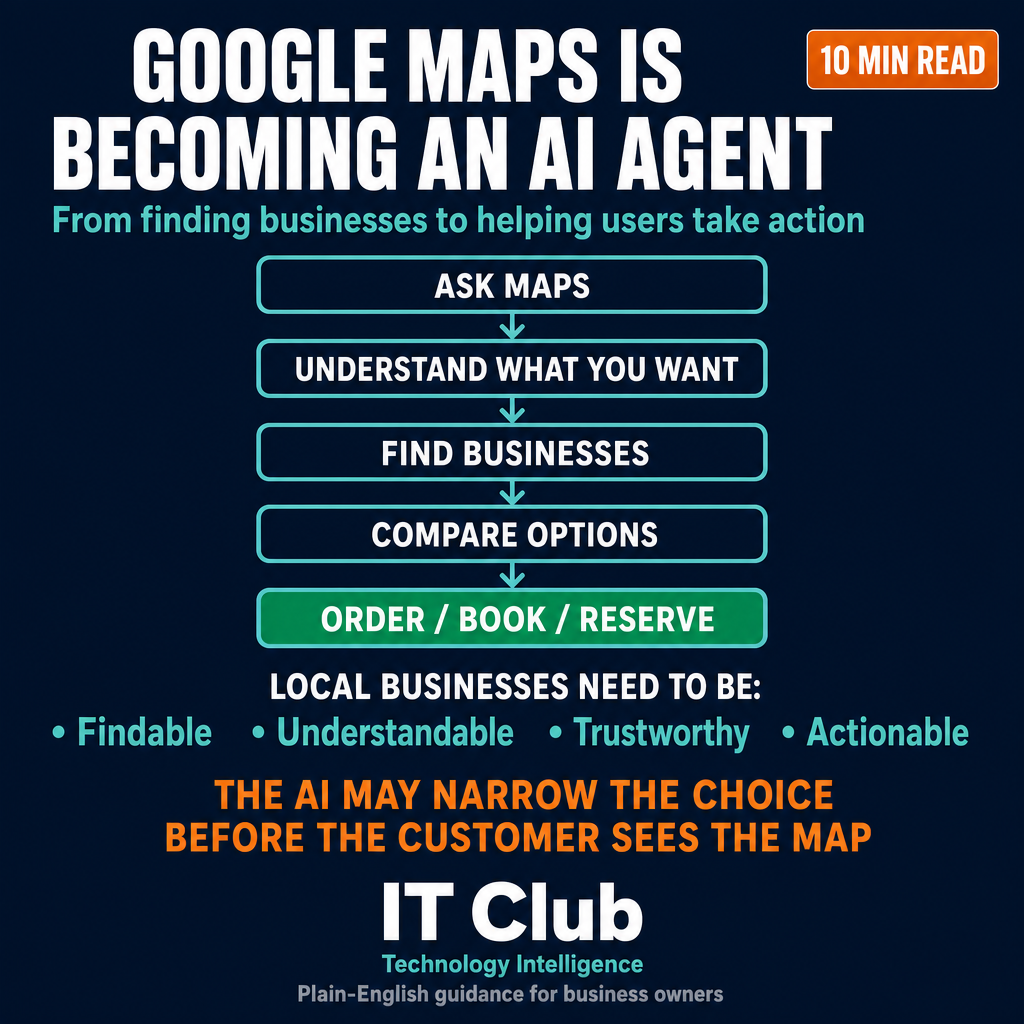
Tap to follow The IT Club Briefing on WhatsApp.
Related Articles
AI is getting a face. Will that make us trust it too much?
Google’s Live Avatar adds a generated face to spoken AI conversations. It may make an interface feel more natural, but a friendly expression is no evidence that an answer is right.
Read articleAI Just Spent 88 Hours Solving a Problem Humans Have Wrestled With for Decades. So What?
The important story is not only the mathematical result. It is the shift from asking AI for information to giving AI systems complex problems to investigate.
Read articleWould You Give AI the Company Credit Card?
As AI agents move from answering questions to taking actions, businesses need to decide what authority they are prepared to give them.
Read articleNeed help putting this into practice?
IT Club helps you understand the technology. If you need implementation, support or consultancy, the teams behind IT Club can help.
Altitude IT (opens in a new tab) — IT support, cyber security, Microsoft 365 and technology operations.
Altitude AI (opens in a new tab) — AI discovery, automation, governance and implementation.