Using AI Safely in a Small Business
IT Club provides practical technology guidance, not legal advice. Laws, contractual obligations and regulatory requirements vary according to the organisation, sector, data, location and use case. Obtain appropriate legal, data-protection, employment or regulatory advice where required.
AI governance sounds like something for large corporations. In practice it means answering a handful of ordinary business questions: which tools are we using, what information goes into them, who checks the output, and who is responsible when something goes wrong. This guide walks through those questions for a small business.
What AI governance actually means
AI governance is the set of decisions and habits that keep AI use under the control of the business. It is not a legal document, a committee or a technology purchase. For a small business it usually fits on a few pages: an agreed list of tools, clear rules about what information may enter them, a defined level of checking for outputs, and a named person who owns the subject.
The reason it matters is speed. A weak process performed manually may cause one problem before somebody notices. The same process automated through AI can create hundreds of problems in the time it takes to make a cup of tea. AI does not remove business responsibility. It increases the speed at which good and bad decisions can spread.
The business remains accountable
When a business sends a quotation, publishes a web page, answers a customer or screens a job application, the business is responsible for that action — whether a person or a tool produced the words. Regulators, customers and courts deal with the organisation, not with its software. That is why every other control in this hub exists: because the consequences of AI output land on the business that used it.
Approved and unapproved tools
Most AI problems in small businesses start with tools nobody approved: a free account created in a lunch break, a browser extension, an AI feature quietly switched on inside existing software. Keep a short list of approved tools, name the account owner for each, and make it easy for staff to request a new one. A popular AI tool is not automatically an approved business system.
Personal data and confidential information
Two separate boundaries matter. Personal data — information about identifiable people — is regulated under UK data protection law, and putting it into an AI service is a disclosure that needs the same justification as any other disclosure. Confidential business information — contracts, pricing, bids, disputes, credentials — may carry contractual and professional obligations even where no personal data is involved. The dedicated guides on personal data and confidential information cover both in detail.
Checking output before it is used
AI systems produce fluent, confident text that can be wrong. Decide in advance what level of checking each kind of work needs: light review for formatting and tone, full review for anything factual, and qualified human review for anything touching legal, financial, health, employment or safety decisions. Use AI to support work — not to remove ownership of the work.
A simple decision before any AI task
Before using AI, ask:
- What are we asking it to do?
- What information will it receive?
- Could a person be harmed by an error?
- Will somebody check the output?
- Is this tool approved?
- Is the intended use documented?
Supplier terms, training and disclosure
Three habits complete the picture. First, read what the supplier's terms actually say about your data — training settings, retention, and where data is stored — rather than assuming. Second, give staff short, practical training: which tools are approved, what must stay out of prompts, and how to report a mistake without blame. Third, be honest with customers where AI materially shapes what they receive; sector rules and contracts sometimes require disclosure, and customer trust usually rewards it.
Records and periodic review
Keep light records: which tools are approved, who owns them, what they are used for and when they were last reviewed. The downloadable AI Tool Register in this hub is designed for exactly this. Then review periodically — tools change, terms change, staff change and pilots quietly become permanent. Good AI governance connects every tool to a defined purpose, an accountable person and a repeatable review.
Plain-English Takeaway
AI governance for a small business is not paperwork for its own sake. It is knowing which tools are in use, what information enters them, who checks the output and who owns the consequences — written down simply enough that everybody can follow it.
Related intelligence
A Technology Intelligence article that goes deeper on this topic
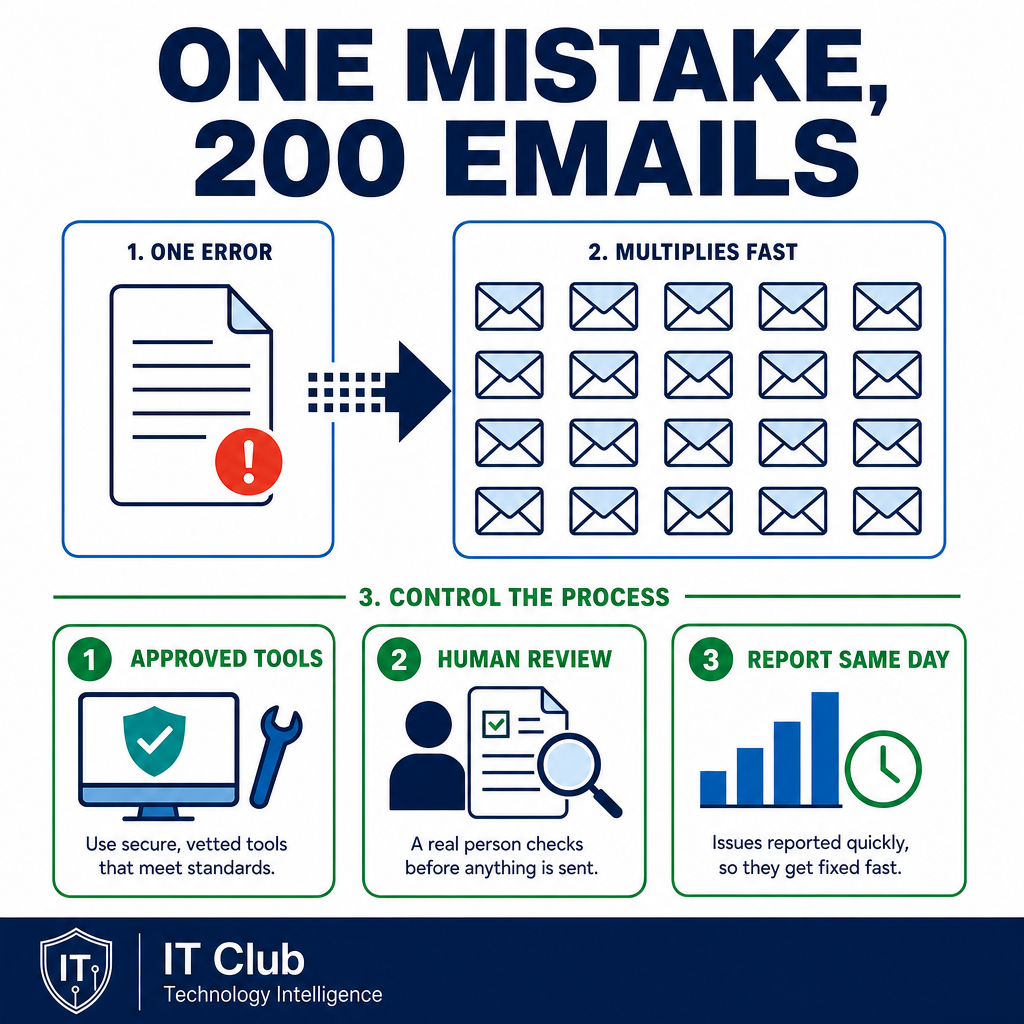
The Small Business That Automated Its Biggest Mistake
Read the articleSources and further reading
- ICO — Artificial intelligence guidance and resources
- NCSC — AI and cyber security: what you need to know
- GOV.UK — AI regulation: a pro-innovation approach
External guidance changes. Check the source itself for the current position before acting on it.