Drone Delivery Has Arrived in Britain — Is This Finally Becoming Normal?
IT Club — Powered by Altitude AI (opens in a new tab)

Keep up with IT Club
Add IT Club as a preferred source in Google Search.
Amazon says Prime Air will reach nearly 500 US cities and towns by the end of 2026, a sixfold increase from its current footprint. Its Darlington site is already delivering eligible parcels in the UK. This independent IT Club guide explains what is live, what is planned, how the MK30 and its autonomous systems work, where UK and US regulation differ, and what businesses can learn from removing meaningful waiting time.
Checked: August 2026. This article uses Amazon's own operational and performance claims where stated and separates them from independent regulatory context. Prime Air availability, coverage, delivery times, eligible products, weather limits, privacy documentation and expansion plans can change.
Quick Answer
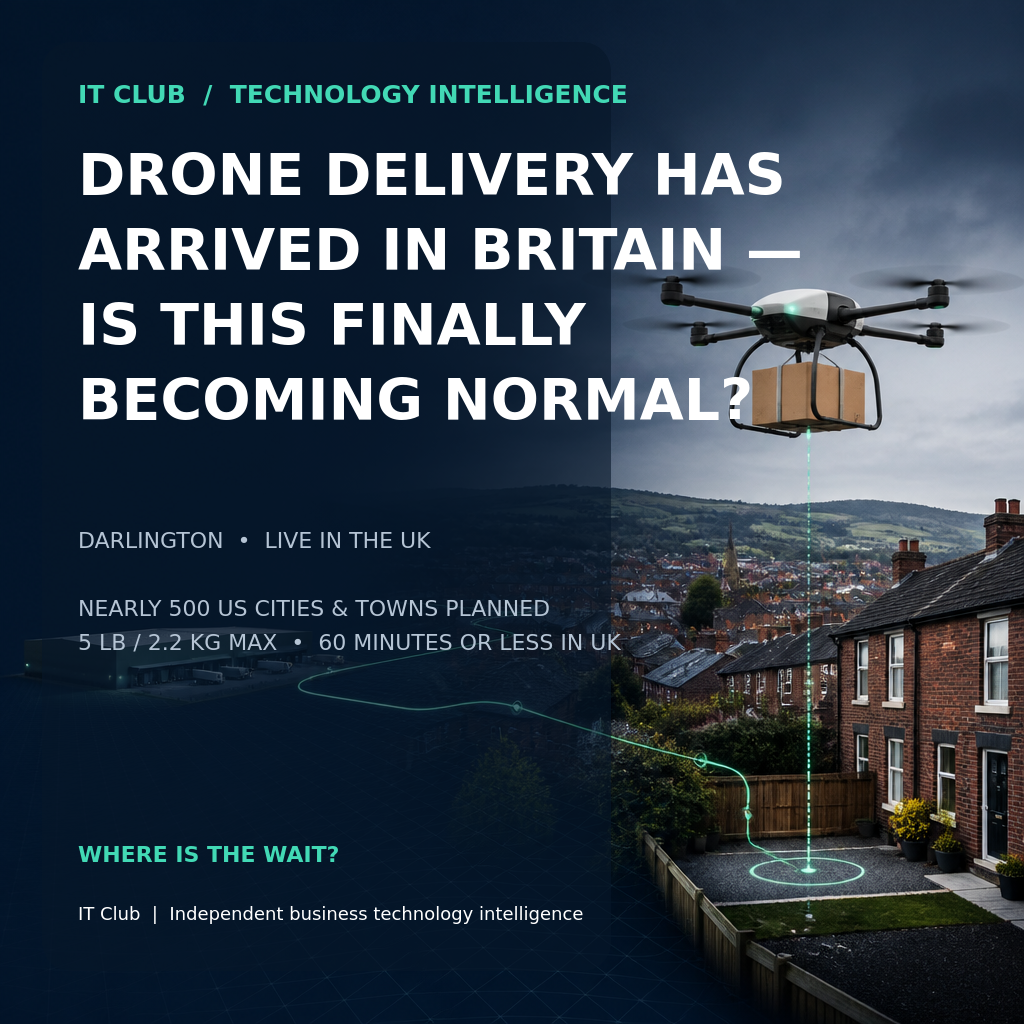
Yes, drone delivery has arrived in Britain — but in a deliberately small and constrained form. Amazon says its Darlington fulfilment site has been delivering eligible parcels by Prime Air since February 2026, for customers within a 7.5-mile (12 km) radius who have a suitable garden, yard or driveway.
At the same time, Amazon says Prime Air plans to reach nearly 500 US cities and towns by the end of 2026, around six times its current footprint. That is a significant expansion ambition, not proof that drone delivery is already a routine option everywhere.
- The UK service is live in a limited Darlington area.
- Amazon says UK deliveries can arrive within 60 minutes or less when the option is available.
- The MK30 is designed for packages up to 5 lb (2.2 kg), approximately a large shoebox.
- AI and autonomous systems help map delivery zones and navigate, but the service still depends on people, regulation and recovery procedures.
- The business lesson is to ask where customers wait and whether technology can remove the waiting time that matters.
From Demonstration to Delivery Network
For more than a decade, drone delivery has occupied a familiar place in technology coverage. A demonstration would show a drone lifting a parcel, flying a short route and placing it on the ground. The next question was always whether that could become a dependable service rather than a memorable test.
The interesting change is not simply that a drone can fly. It is that Amazon is trying to connect aircraft, mapping, fulfilment, checkout, airspace, safety systems and customer expectations into one delivery option. That is a much harder problem than making one aircraft carry one box.
A useful test for any emerging technology is therefore not “has this been demonstrated?” It is “can this operate repeatedly, safely, affordably and conveniently enough to become part of an ordinary workflow?”
What Amazon Has Announced
In its August 2026 expansion announcement, Amazon says Prime Air plans to serve nearly 500 US cities and towns by the end of 2026. Amazon describes that as a sixfold increase from its current footprint and says the service will reach communities containing tens of millions of customers.
Amazon also says its US service is already operating across seven states, with further metro areas planned, that thousands of deliveries are taking place daily at its highest-volume sites and that hundreds of thousands of packages have been delivered by drone during 2026. It says eligible items can arrive in as fast as 30 minutes.
These are Amazon's stated figures and targets. “Nearly 500 by the end of 2026” is planned coverage, not current coverage. “As fast as 30 minutes” is a best-case service claim, not a universal delivery promise. Achieved package counts and daily volumes should not be silently converted into independent measurements.
| Claim or condition | How to read it |
|---|---|
| Nearly 500 US cities and towns by end of 2026 | Amazon's expansion plan; not 500 live locations today |
| Sixfold increase | Amazon's description of the change from its current footprint |
| Hundreds of thousands delivered in 2026 | An Amazon-reported achieved volume; the time period and definition matter |
| Thousands of deliveries daily | Amazon's description of the highest-volume US sites, not every site |
| As fast as 30 minutes | A stated upper-speed outcome for eligible US orders, not a guaranteed average |
Amazon — Prime Air drone delivery is expanding to nearly 500 US cities and towns →
Britain Is Already in the Story
This is not purely an American technology story. Amazon's current account of its first UK Prime Air site places it in Darlington, England. Amazon says the site has been delivering parcels since February 2026 and is the first place outside the United States where customers can use Prime Air.
The current UK service is intentionally narrow. Amazon says customers need to be within a 7.5-mile (12 km) radius of the Darlington fulfilment centre and need an appropriate garden, yard or driveway. At checkout, eligible customers see a mapped delivery zone selected from options around their property.
Amazon says the UK service uses the MK30 drone, eligible packages need to weigh 5 lb (2.2 kg) or less and fit in approximately a large shoebox, and qualifying orders can arrive within 60 minutes or less. It also says millions of items are potentially eligible, but that does not mean every item is available for drone delivery in every location or condition.
The important UK distinction
Drone delivery is a real option for some customers in one defined part of Britain. It is not yet a general UK delivery service, and the current Darlington requirement for a garden, yard or driveway is a reminder that the property is part of the logistics system.
Amazon — Inside the first Prime Air drone delivery site in the UK →
How the Customer Journey Works
The technology becomes more interesting when it disappears into the normal shopping flow. A customer does not need to phone a drone operator, book a specialist courier or understand how an aircraft is controlled. The delivery option appears as part of the ordinary checkout when the order and property qualify.
- 1The customer orders an eligible small item through the normal Amazon shopping experience.
- 2The system checks whether the item, destination, property and operating conditions support Prime Air.
- 3The customer sees one or more mapped delivery zones around the property and selects the appropriate option.
- 4The package is prepared in the fulfilment site and loaded into a Prime Air box and drone.
- 5The MK30 lifts vertically, transitions to forward flight and follows its planned route.
- 6On arrival, onboard perception checks the area and the drone descends only when its delivery conditions are met.
- 7The package is released, the aircraft returns to base and the operation records the outcome.
That sequence contains several systems that customers may never see: inventory selection, fulfilment, digital mapping, airspace management, aircraft health checks, navigation, obstacle detection, delivery-zone selection and recovery planning. “The parcel arrived quickly” is the visible result of a much larger operating model.
The MK30: More Than a Flying Parcel Box
Amazon describes the MK30 as a hybrid aircraft. It takes off and lands vertically like a helicopter, then flies horizontally like an aeroplane. Amazon's published description places it at roughly five feet tall with a wingspan of about five and a half feet and a payload of up to 5 lb (2.2 kg).
| Published characteristic | Why it matters |
|---|---|
| Up to 5 lb / 2.2 kg payload | It targets small and light items, not general parcel replacement |
| Approximately 5 ft tall and 5.5 ft wingspan | The aircraft and its operating space have a physical footprint |
| Vertical take-off and landing | A suitable launch and delivery area matters more than a conventional runway |
| Up to approximately 70 mph | Speed helps over short direct routes, but does not remove checks and constraints |
| Detect-and-avoid and perception systems | The aircraft must respond to changing air and ground conditions |
| Designed to operate in light rain and a wider temperature range | Weather resilience improves availability but does not make operation weather-proof |
The MK30 is not the whole story. The service also needs the fulfilment site, trained ground staff, aircraft inspection, software, mapped routes, communication, monitoring, maintenance, packaging, permissions, customer guidance and a plan for what happens when the planned delivery cannot safely take place.
Amazon — How Amazon delivers packages using its MK30 drone →
Where AI and Autonomy Fit
The AI component is practical rather than theatrical. Amazon says satellite imagery, digital mapping and AI systems help identify potential delivery zones around a customer's property. Customers can see mapped options at checkout without a physical survey of the garden or driveway.
During flight and delivery, Amazon describes the aircraft as highly autonomous. Cameras, radar, sensors and onboard perception help it understand the surroundings, monitor for obstacles and decide whether the selected area is suitable. Amazon says a trained operations team monitors the path of every flight, while the aircraft's navigation system can make landing decisions in response to conditions.
| System layer | Role |
|---|---|
| Digital mapping and AI | Identify possible delivery zones around a property |
| Flight planning | Select and manage a route between the fulfilment site and destination |
| Onboard cameras, radar and sensors | Perceive people, animals, vehicles, buildings and other obstacles |
| Detect-and-avoid | Help the aircraft maintain separation and respond to changing conditions |
| Operations team | Monitor flights, support exceptions and recover an aircraft when required |
This is an important distinction for businesses adopting AI. “Autonomous” does not mean “unmanaged”. It means some decisions are delegated to a system within a wider set of controls, boundaries, monitoring, recovery procedures and human responsibilities.
Amazon — How Amazon is building its drone delivery system →
Beyond Visual Line of Sight
A delivery network cannot rely on an operator standing where every aircraft can be seen directly. Beyond Visual Line of Sight, or BVLOS, describes drone operation outside the pilot's direct line of sight. That raises questions about airspace integration, communication, detect-and-avoid capability, ground risk and what happens when conditions change.
The UK and US must be kept separate. The FAA describes package delivery by drone as an advanced operation involving operator certification, airspace authorisation, a hub, delivery infrastructure, environmental review and compliance with state and local requirements. Its package-delivery material also describes low-altitude operations and the future role of unmanned traffic management.
The UK CAA says it is working to address the remaining regulatory challenges that would enable authorised operators to conduct BVLOS operations in a scaled and sustainable way. Its roadmap points towards routine BVLOS operations by 2027, while emphasising protection for other airspace users and minimising risk to people and property on the ground.
An FAA permission or US operating model does not automatically authorise a UK service. The aircraft, operator, route, airspace and safety case still have to satisfy the relevant national framework.
UK Civil Aviation Authority — Beyond Visual Line of Sight →
FAA — Package Delivery by Drone (Part 135) →
Safety Means Planning for the Unexpected
Amazon says its Prime Air safety system combines the aircraft, a detect-and-avoid system and an automated drone-management system. It says the aircraft can detect and avoid other aircraft, people and pets, while flight planning maintains safe distances and follows aviation rules.
Amazon also describes a Safe Contingent Landing for situations such as severe weather, an unexpected object or a changed landing area. In that scenario, the aircraft can transition to vertical flight, use onboard perception to search for a suitable nearby place and land in a controlled way. A recovery team can then locate and retrieve it, sometimes working with residents or local authorities.
The right way to read those claims is not “the drone is safe, therefore the problem is solved.” It is “the operator has designed procedures for a range of failure and exception cases, and those procedures need testing, oversight, evidence and regulatory acceptance.”
| Unexpected condition | Responsible design question |
|---|---|
| A person, dog or vehicle enters the landing area | Can the aircraft detect it, avoid it and choose a safe alternative? |
| Weather changes during flight | What triggers a hold, return or controlled landing? |
| A sensor or flight-critical component fails | What redundancy and recovery behaviour is available? |
| The aircraft lands away from the planned property | Who recovers it, how is access obtained and how is the incident recorded? |
Amazon — Prime Air safety systems and Safe Contingent Landing →
What If Something Is in the Way?
A delivery zone that was clear when it was mapped may not be clear when the aircraft arrives. A car may be parked there. A garden chair may have moved. A child or dog may be outside. A branch may have fallen. A gust of wind may change the conditions.
Amazon says its system does not simply follow a pre-loaded map. It uses onboard cameras and radar to scan for people, animals, buildings, poles, vehicles, terrain and vegetation. If the original delivery location is not clear, it may look for a nearby alternative or use its Safe Contingent Landing procedure.
That illustrates a general automation principle: the happy path is not the system. The system includes what happens when the input is wrong, the environment changes, the user does not follow the instruction or the service cannot complete the action.
Privacy: the Aircraft Needs to See the World
Autonomous delivery needs perception. The aircraft must understand enough of its surroundings to avoid people, animals, buildings, vehicles and unsafe terrain. That makes cameras and sensors part of the privacy story, even when their primary purpose is navigation rather than recording a person.
Amazon says relevant perception and navigation processing occurs onboard in its published descriptions. That is useful information, but it does not answer every privacy question. It does not by itself explain what data is retained, whether diagnostic material is uploaded, how long it remains available, how neighbouring properties are handled, or what choices residents have.
- What the cameras and sensors are designed to detect
- Whether raw imagery, derived data or flight telemetry leaves the aircraft
- What is retained for safety, maintenance, incident review or compliance
- How neighbouring properties and people outside the delivery zone are treated
- Who can access operational records
- How a customer or resident can ask a privacy question
Do not turn “processed onboard” into “nothing is collected” or “privacy is guaranteed”. Those are different claims. A responsible technology assessment asks about the complete data lifecycle, not only where one perception calculation happens.
Noise and Neighbours
Amazon says the MK30 is substantially quieter than earlier designs. It compares the delivery sound with an idling delivery truck and says the aircraft can be comparable with a low window fan at flight altitude. Those comparisons help a reader imagine the claim, but they are not independent acoustic measurements.
There is also a scaling question. One drone overhead for a short period may feel different from a neighbourhood with frequent daily flights. The practical impact depends on route density, time of day, aircraft altitude, local background noise, property layout, community expectations and what regulators require.
The FAA's package-delivery guidance recognises noise as one of the environmental issues an operator may need to mitigate. That does not decide how a UK community will experience Prime Air, but it shows why successful aircraft operation is only one part of public acceptance.
Why Use Drones?
The strongest case for a drone is not that it is futuristic. It is that a small item may be valuable enough, urgent enough and direct enough for a short autonomous flight to make sense.
| Delivery mode | Best potential fit |
|---|---|
| Delivery van | Many parcels, route density, heavy items and multiple stops |
| Bike or e-bike | Small parcels and dense urban routes with accessible streets |
| Ultra-fast courier | Short-distance immediate delivery when a person can travel directly |
| Drone | Small, light, time-sensitive and direct deliveries to a suitable zone |
Drones do not need to replace vans to become useful. They can become another tier in a multimodal network, used where their particular strengths outweigh the constraints of payload, weather, airspace, property access and recovery.
The Five-Pound Boundary
A 5 lb (2.2 kg) limit is easy to overlook until it is translated into everyday shopping. It can include a phone, small electronics, a replacement accessory, household products, some groceries, cosmetics or medication. It does not describe a television, office chair or a week's bulk shopping.
This is why Prime Air is better understood as a targeted delivery tier. It is designed around the combination of small, light and needed quickly. A large proportion of frequently purchased items may fit the physical criteria, but the individual order still has to meet service and property requirements.
The practical constraint
The most valuable drone-delivery item may not be the most expensive item. It may be the small item whose absence creates a disproportionately large wait.
Why 30 Minutes Matters
Amazon's wider delivery strategy includes same-day, one-hour and other rapid fulfilment options alongside Prime Air. Once a small order can potentially arrive in 30 minutes, the comparison changes. The customer may no longer be choosing between one website and another; they may be choosing between ordering online and taking a ten-minute drive to a shop.
That does not mean every customer values speed above price, certainty or convenience. It means the waiting time becomes visible. A forgotten cable, medication, replacement part or household item may be cheap in absolute terms but expensive in the context of the problem it is blocking.
Technology creates competitive pressure when it changes what people consider normal. Next-day delivery once felt exceptional. Same-day delivery changed the reference point again. Drone delivery will only become ordinary if enough customers find the combination of speed, trust, coverage and price worth choosing.
The Economics: Possible Is Not the Same as Scalable
Amazon does not publish a simple cost-per-drone-delivery figure that can be used as a universal business case. The economics depend on aircraft cost, maintenance, inspections, ground staff, charging, fulfilment layout, software, regulatory compliance, route length, customer density, weather, failed deliveries, recovery and the cost of the alternative ground journey.
A drone may look attractive where a small parcel has to travel directly and the cost of waiting is high. A van may remain more efficient where one route can carry many parcels. A courier may win where the distance is short and the customer needs a human hand-off. There is no single delivery mode that dominates every route.
Technically possible does not automatically mean economically scalable. The useful question is not whether an aircraft can complete one flight, but whether the complete service produces a reliable customer outcome at a sustainable cost.
The IT Club “Where Is The Wait?” Test
The wider lesson for a small business is not “buy a drone”. It is to look for the point in a customer journey where waiting is both visible and expensive.
Where Is The Wait?
- 1Customer need
- 2Request
- 3Wait
- 4Action
- 5Wait
- 6Delivery or outcome
Ask where the customer waits, why they wait, whether the delay is physical or administrative, whether technology could remove it and whether removing it would actually matter.
| Customer is waiting for | Possible bottleneck | Better question |
|---|---|---|
| A quotation | Someone has to gather the same information before pricing can start | Can the request collect the right details once and route it to the right person? |
| A support response | Every issue enters the same queue before it is categorised | Can low-risk requests be classified and routed without hiding urgent cases? |
| An appointment | Staff spend time exchanging availability by email | Can customers see appropriate slots without creating double bookings? |
| A document or approval | The request waits in a shared inbox with no named owner | Can ownership, context and escalation be visible from the start? |
| A replacement part | The business discovers the specification only after the request is delayed | Can stock, compatibility and urgency be checked before ordering? |
The best automation target is often not the most dramatic task. It is the small, repeated delay that customers notice and staff have learned to tolerate. Removing it matters only if the outcome becomes faster, more reliable, more accessible or less expensive without moving the work somewhere else.
Read: Is AI Saving Your Staff Time—or Creating More Admin? →
Could Businesses Receive Drone Deliveries?
A small business may eventually receive an urgent IT part, medical supply, engineering component, replacement device or retail stock item by drone where a service supports the location. Imagine a network-switch power supply failing: the value of a small item arriving quickly could be much higher than its purchase price because the cost of downtime is larger.
That example is hypothetical. The current Darlington service description is a consumer delivery option for eligible orders, not a general business-critical logistics guarantee. A company would need to verify availability, item eligibility, receiving arrangements, weather limits, service reliability, delivery evidence and what happens if the aircraft cannot land.
- Use rapid delivery for the narrow cases where waiting has a measurable cost.
- Keep a conventional supplier and delivery route for continuity.
- Do not design a critical process around a best-case delivery time.
- Record who receives the item and how its condition and chain of custody are confirmed.
- Test the fallback before the urgent item is needed.
What Could Stop Drone Delivery Becoming Normal?
- Regulation and airspace integration
- Safety evidence and ground-risk management
- Weather and operational availability
- Noise and community acceptance
- Privacy and perception data
- Suitable gardens, driveways and delivery zones
- Package weight and size limits
- Reliable charging, maintenance and recovery
- Economics compared with vans, bikes and couriers
- Dense urban buildings, pedestrians and restricted landing areas
- Customer trust and willingness to select the option
Darlington is a useful starting point partly because its current operating conditions are visible: a defined radius, a mapped delivery zone, a suitable property and a small parcel. Scaling to flats, dense city centres or complicated airspace would require different answers rather than simply more aircraft.
Rural, Suburban and Urban Delivery Are Different Problems
Lower-density areas may offer clearer landing spaces, more direct routes and fewer pedestrians. A rural customer may also value a short direct flight when the nearest shop or courier route is far away. Those conditions can make a drone useful even when customer density is modest.
Dense urban areas bring flats, balconies, roads, pedestrians, complex airspace, limited landing locations and more neighbours close to the route. They may offer high order density, but the physical and social operating problem is different. The future of delivery may be multimodal, not drone-only.
Do Not Confuse Prime Air with a Hobby Drone
Prime Air is not a parcel tied to a consumer quadcopter. It is an engineered aviation and logistics system involving aircraft design, navigation, mapping, autonomy, detect-and-avoid, fulfilment, software, airspace, regulation, packaging, customer interfaces and recovery.
That distinction matters for business technology decisions. A prototype may demonstrate that a task is possible. A production service needs identity, permissions, monitoring, maintenance, support, failure handling, audit records and an owner who can stop it when the assumptions no longer hold.
What Happens Next?
Amazon's stated direction is clear: expand US coverage, increase delivery volume and make drone delivery a normal option inside its fulfilment network. The company's longer-term ambition includes very large package volumes, but targets and leadership ambitions should remain separate from current delivery performance.
| Question | What should be verified over time? |
|---|---|
| Coverage | Which cities and properties can actually select Prime Air now? |
| Reliability | How often do weather, obstacles, stock or aircraft availability prevent the promised option? |
| Economics | Does the service remain attractive once maintenance, oversight and recovery are included? |
| Public acceptance | Do noise, privacy and safety concerns change the routes or hours of operation? |
| Customer value | Do people choose the drone because it solves a meaningful wait, or simply because it is new? |
The Operational Heartbeat
Businesses watching emerging technologies need an Operational Heartbeat. Review the technology periodically instead of treating one successful demonstration or launch announcement as a permanent conclusion.
- Geographic availability and the difference between planned and live coverage
- Regulatory permissions, safety cases and airspace changes
- Price and cost compared with existing delivery routes
- Delivery speed, reliability and failed-delivery rates
- Payload, packaging and property requirements
- Weather and seasonal availability
- Noise, privacy and community feedback
- Customer adoption and whether the option removes a meaningful wait
- Competitor delivery tiers and local alternatives
- New commercial uses for small, urgent items
The question is not whether drone delivery worked once. It is whether coverage, cost, reliability, regulation and customer value are moving together quickly enough for the service to become ordinary.
The IT Club View
Drone delivery has spent years looking like a technology demonstration. Amazon's expansion plan and a live UK operation suggest that it may be entering a different phase: integration into ordinary logistics.
That does not mean drones will replace delivery vans, that every UK house will have a landing zone or that Amazon's targets will all be met. It means the technology is now being tested against the harder questions of coverage, repetition, regulation, economics, privacy, public acceptance and customer habit.
The question worth keeping
The interesting moment for a technology is not when it becomes possible. It is when it becomes ordinary.
A parcel landing on a driveway from the sky still feels futuristic today. The real test is whether enough people find it useful, trustworthy and unremarkable tomorrow.
For businesses, start with the same question Amazon's delivery network makes visible: where is the wait, and what would it be worth to remove it?
Sources and Further Reading
Primary and regulatory sources checked in August 2026. Amazon operational, performance and expansion statements are identified as Amazon claims; regulatory pages provide context for the relevant jurisdiction.
Amazon — Prime Air drone delivery is expanding to nearly 500 US cities and towns this year →
Amazon — Inside its first-ever drone delivery site in the UK →
Amazon — How Amazon delivers packages using its new MK30 →
Amazon — How Prime Air safety systems are designed →
UK Civil Aviation Authority — Beyond Visual Line of Sight →
Plain-English Takeaway
Drone delivery does not need to replace every van to be useful. The interesting business question is where a customer waits, whether that waiting time matters, and whether technology can remove it without replacing one risk with another. Amazon's Prime Air expansion is a live logistics experiment in that trade-off.
Frequently asked questions
Is Amazon drone delivery available in the UK?
Yes, but currently in a limited Darlington service area. Amazon says customers with a suitable garden, yard or driveway within a 7.5-mile (12 km) radius of its Darlington fulfilment centre can choose drone delivery for eligible items, subject to the option appearing at checkout and operational conditions.
When did Amazon drone delivery start in Darlington?
Amazon's current UK account says the Darlington site has been delivering parcels by drone since February 2026. It describes Darlington as the first place outside the United States where Prime Air is available to customers.
How fast is Amazon Prime Air in the UK?
Amazon says eligible Darlington deliveries are made within 60 minutes or less after an order is placed. That is a company-stated delivery target, not a guarantee for every order, weather condition or operating day.
How much can an Amazon delivery drone carry?
Amazon says the MK30 can carry packages weighing up to 5 lb (2.2 kg) and that UK eligible items generally need to fit in approximately a large shoebox. The actual option also depends on product eligibility, packaging, property and operational requirements.
How many places will Prime Air serve by the end of 2026?
Amazon says it plans to reach nearly 500 US cities and towns by the end of 2026, approximately six times its current footprint. That is a planned expansion target. It is not the same as 500 live sites today, and it does not describe UK coverage.
Do Amazon delivery drones use AI?
Amazon says satellite imagery, digital mapping and AI systems help identify potential delivery zones around a customer's property. The MK30 also uses onboard cameras, sensors and perception systems for navigation and detect-and-avoid decisions. These are Amazon's descriptions of its system, not an independent audit of its AI.
Are Amazon delivery drones autonomous?
Amazon describes the MK30 as highly autonomous and says a trained operations team monitors flights. The aircraft can navigate and react to conditions using onboard systems, but autonomy does not mean the whole delivery service operates without people, procedures, regulation or recovery teams.
What happens if something is in the drone delivery area?
Amazon says onboard cameras and radar can identify people, animals, vehicles, buildings, poles, vegetation and other obstacles. If the planned area is not clear, the system can look for nearby alternatives or perform a controlled Safe Contingent Landing. This is Amazon's description of the design, not a promise that every situation will be resolved without delay.
How noisy are Amazon delivery drones?
Amazon says the MK30 is quieter than earlier Prime Air designs and that its sound can be below an idling delivery truck during delivery or comparable with a low window fan at flight altitude. Those are Amazon comparisons; they should not be presented as independent acoustic testing or as proof that repeated neighbourhood flights will be inaudible.
Does UK drone delivery use the same rules as the US?
No. The FAA's Part 135 package-delivery framework applies to US operations. The UK has its own CAA rules and programmes. The CAA says it is working towards scaled, sustainable Beyond Visual Line of Sight operations and has a roadmap towards routine BVLOS operations by 2027, while safety and protection of people, property and other airspace users remain central.
Do Amazon delivery drones film people's gardens?
The aircraft needs cameras and sensors to navigate and check a delivery area. Amazon says relevant perception and navigation work is performed onboard in its system descriptions, but readers should not infer from that alone what is retained, for how long, or how neighbouring property data is handled. Those are separate privacy questions that need current documentation.
Can Amazon drones deliver to flats?
The current Darlington description requires an appropriate garden, yard or driveway within the service radius, so it does not describe a general delivery option for flats or dense city-centre properties. Future service designs may differ, but that should not be assumed from the current UK launch.
Will drones replace delivery vans?
There is no evidence that Prime Air will replace delivery vans across the whole network. Drones are better understood as another delivery tier for small, light, time-sensitive and direct journeys. Vans remain useful for route density, heavy parcels, multiple stops and properties without a suitable delivery zone.
Could a business receive urgent IT parts by drone?
Possibly in a future or locally supported service, but this is a scenario rather than a current Prime Air promise. A small, urgent replacement part could have high value when waiting is expensive. A business would still need to check service coverage, item eligibility, cost, weather, reliability and its own receiving process.
Tap to follow The IT Club Channel on WhatsApp.
Related Articles
Stop Sending the Whole PDF When Someone Only Needs Two Pages
Print a page range to a new PDF, check the saved file and remember that selecting pages is not the same as redacting information.
Read articleSomeone emailed you Documents. Make the subject useful before you forget what it is
Classic Outlook for Windows lets you give a received message a subject you will recognise later. The same steps do not apply to every Outlook app.
Read articleToo Many Repetitive Emails? Make Outlook Clear Them Up Automatically
If the same newsletters, notifications or routine reports keep arriving, Outlook can often file or remove them for you.
Read articleNeed help putting this into practice?
IT Club helps you understand the technology. If you need implementation, support or consultancy, the teams behind IT Club can help.
Altitude IT (opens in a new tab) — IT support, cyber security, Microsoft 365 and technology operations.
Altitude AI (opens in a new tab) — AI discovery, automation, governance and implementation.