Who Owns AI-Generated Content?
IT Club provides practical technology guidance, not legal advice. Laws, contractual obligations and regulatory requirements vary according to the organisation, sector, data, location and use case. Obtain appropriate legal, data-protection, employment or regulatory advice where required.
“Who owns it?” is really five different questions that businesses tend to merge into one. The platform's terms, UK copyright law, other people's rights, your own creative contribution and the protectability of brand assets each have their own answer — and a permissive answer to one does not settle the others.
Five questions, not one
- 1What rights does the platform grant the user? Most major AI platforms assign or license output to the user in their terms — but a grant of rights between you and the platform says nothing about the rest of the world.
- 2Does copyright arise in the output under applicable law? UK law (Copyright, Designs and Patents Act 1988, section 9(3)) contains a provision for computer-generated works with no human author, treating the person who made the arrangements as the author — but its scope is debated, and the UK government has been consulting on copyright and AI. Whether a largely machine-generated output attracts enforceable copyright is not a settled, universal yes.
- 3Could the output infringe somebody else's rights? Generated text, images and code can reproduce or closely resemble existing protected works, trademarks or distinctive styles. This risk exists whatever your platform terms say.
- 4Can the business prove sufficient human creative contribution? Works with substantial human authorship — selection, arrangement, editing, creative direction — stand on much firmer ground than raw generations. Keep records of the human work.
- 5Can a brand asset be registered or protected? Logos and marks generated by AI may face questions about originality and prior similar outputs. For assets the business will depend on, involve a trademark professional before committing.
The line to remember
Permission from the platform does not prove that an output is original, protectable or free from third-party rights.
Prompts, sources and outputs are different things
Your prompts may themselves contain protected material — pasting a competitor's brochure or a client's document into a tool raises its own questions before any output exists. Source material you upload remains subject to whatever rights and confidentiality attach to it. And outputs inherit risk from both: an output shaped by someone else's protected input is not cleansed by passing through a model.
Training-data disputes: watch, don't assume
High-profile litigation over the use of copyrighted works in AI training — including Getty Images' proceedings against Stability AI in the English High Court — has produced early decisions on some issues while broader questions remain contested, and the UK government has consulted on how copyright law should treat AI training. Do not treat ongoing litigation or open consultations as settled law in either direction. What a business can do today is practical: choose reputable platforms, prefer tools with commercial-use terms and provenance commitments, and keep humans meaningfully involved in work that matters.
Practical rules for business content
- Check the current terms of the specific platform and plan you use — rights differ between free and paid tiers and change over time.
- Keep records: prompts, drafts, editing history and who did what. Provenance is your evidence of human contribution.
- Run trademark and similarity checks before adopting AI-generated names, logos or distinctive brand assets.
- Avoid prompting for a living artist's or competitor's style for commercial work — style imitation invites disputes even where the law is unsettled.
- For client work, agree in the contract who owns deliverables and whether AI assistance is acceptable and disclosed.
- Consider disclosure where authenticity matters to the audience — and check sector rules, but note there is currently no blanket UK requirement to label every AI-assisted business output.
Plain-English Takeaway
Treat AI-generated content as usable but unevenly protected. The platform's permission is only the first of five questions — originality, third-party rights, human contribution and registrability decide how much you can rely on an output, so keep records and take advice before betting a brand on one.
Related intelligence
A Technology Intelligence article that goes deeper on this topic
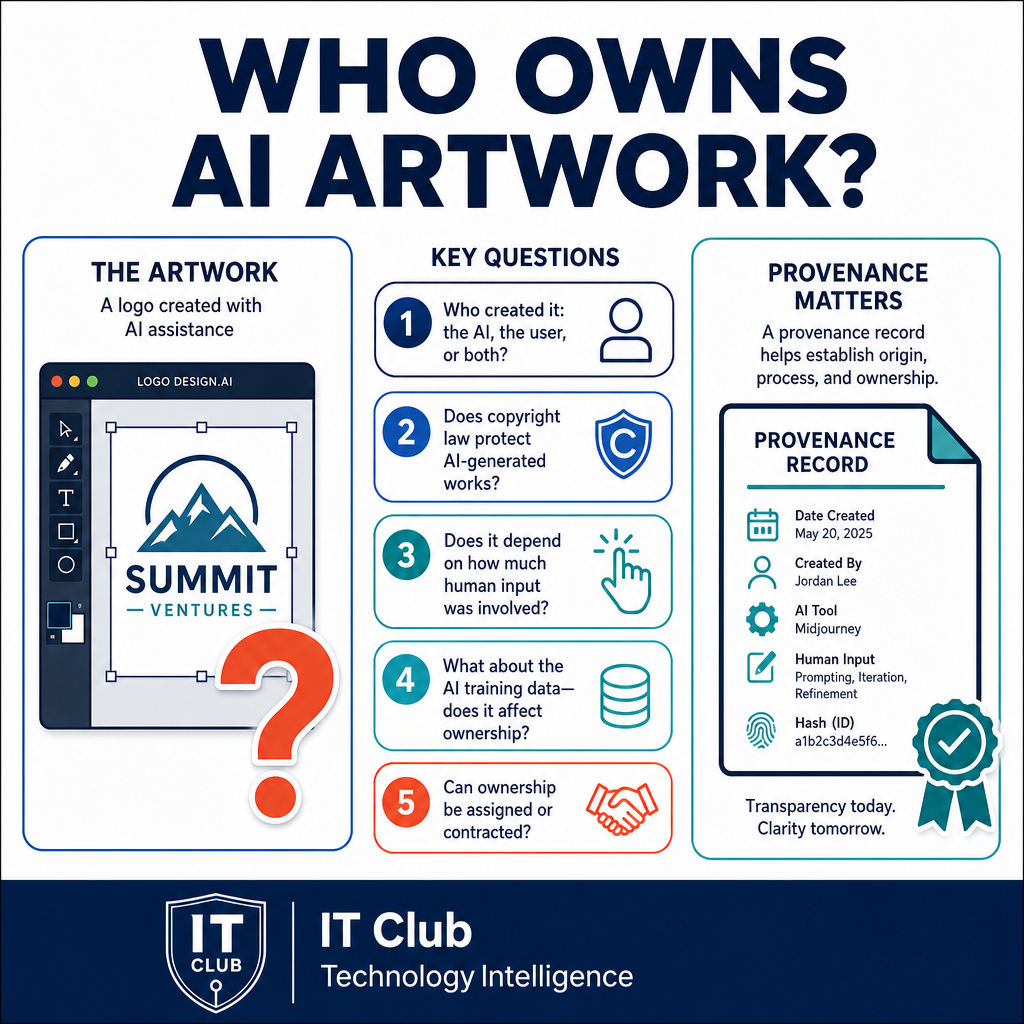
Who Owns the Logo Your AI Just Designed?
Read the articleSources and further reading
- GOV.UK / IPO — Copyright and Artificial Intelligence consultation
- Copyright, Designs and Patents Act 1988, section 9
- Courts and Tribunals Judiciary — Getty Images v Stability AI judgments
External guidance changes. Check the source itself for the current position before acting on it.